Korva is a scroll of the internet’s best ideas.
Madagascar speaks Borneo's language
A language clue
Linguists puzzled over Malagasy for years because it has little in common with the languages of the African mainland. The link appeared when its grammar and syntax were compared with Indonesian languages. The word for island is nosy in Malagasy and nusa in Javanese, and the nearest relative, Ma'anyan, comes from southern Borneo.
DNA and crops
DNA points the same way. The most modern analysis of mitochondrial DNA in Madagascar traces the islanders back to about 30 mothers who arrived from what is now Indonesia, which suggests a single boatload of settlers crossing one of the widest oceans in the world.
They brought crops with them. Botanists estimate that 7% of the plant life on Madagascar today originated in Indonesia, including bananas, plantains, taro, and yams, and all of them were well established by the medieval period.
A Portuguese account
A Portuguese writer in 1602 described the Javanese as men so experienced at navigation that they claimed to be the most ancient of all. He wrote that they had sailed to the Cape of Good Hope and kept contact with the east coast of Madagascar, where the people looked Javanese to him and traced their descent from them.
How did Indonesians cross the Indian Ocean?
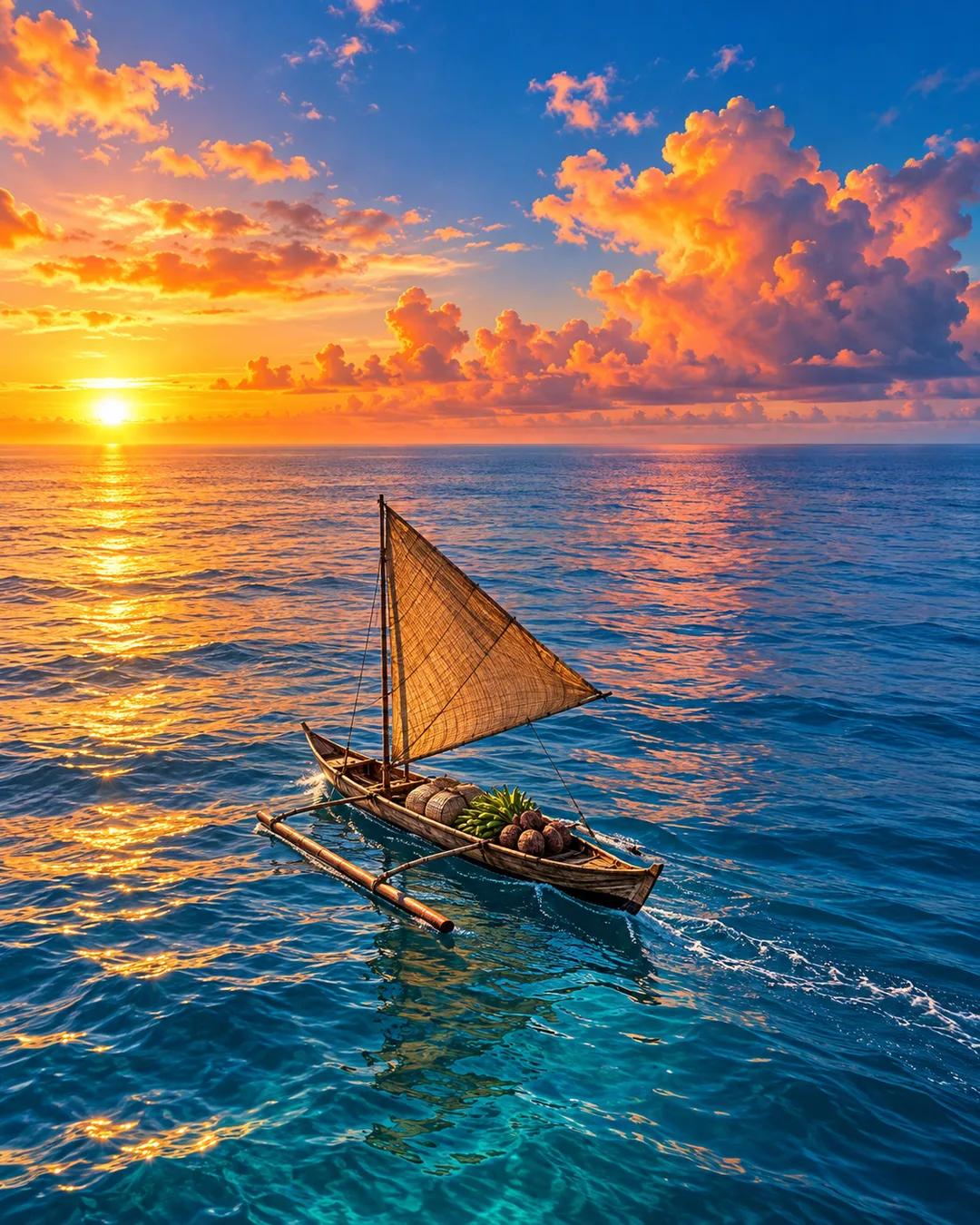
Austronesian sailors traveled in outrigger canoes and double-hulled vessels with sails, the same designs that carried their relatives across the Pacific. Seasonal monsoon winds in the Indian Ocean reverse direction through the year, which gave sailors a regular push in each direction. Most estimates place the settlement of Madagascar somewhere in the first millennium CE. Genetic studies, such as a 2017 survey published in the Proceedings of the National Academy of Sciences, find that Malagasy people carry both Southeast Asian and East African ancestry.
Why does Malagasy also contain African words?
Bantu-speaking settlers from East Africa arrived on Madagascar alongside or after the Austronesian newcomers. Their languages left loanwords in Malagasy, especially for cattle, household items, and some plants. The grammar and core vocabulary stayed Austronesian. Malagasy belongs to the Malayo-Polynesian branch, a language family stretching from Madagascar across Southeast Asia to Easter Island.
How do linguists find a language's closest relative?
Linguists compare basic vocabulary such as numbers, body parts, and words for water and fire, which change slowly. They look for regular sound correspondences, where a sound in one language always matches a particular sound in another. Words that match this way point to a shared ancestor rather than coincidence or borrowing. For Malagasy, the closest matches lie with the Barito languages of southern Borneo, which include Ma'anyan.
More from Fall of Civilizations