Korva is a scroll of the internet’s best ideas.

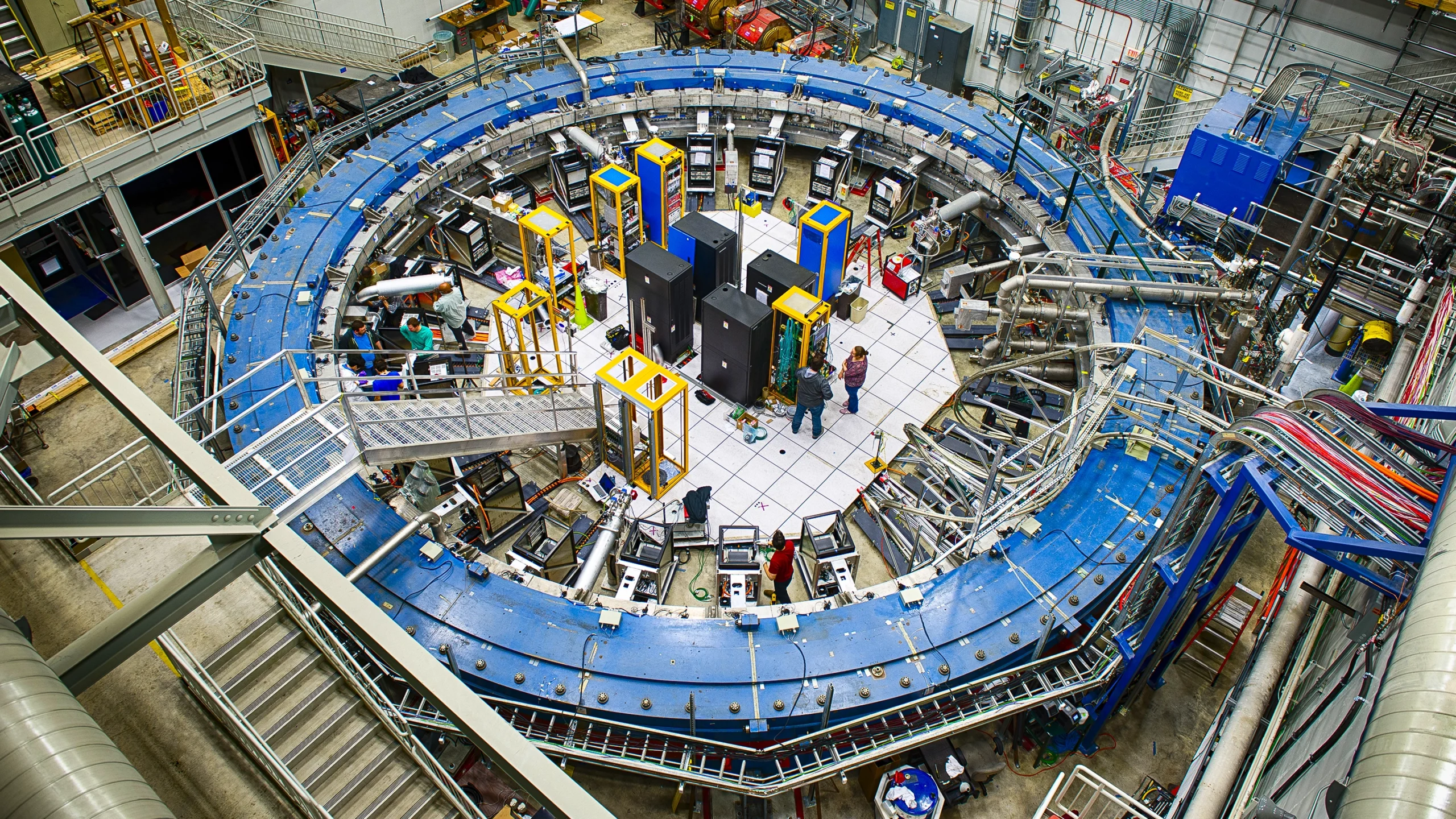
Magnet ring shipped by barge
The first surprise
In 2001, an experiment at Brookhaven National Laboratory on Long Island measured the g-factor of the muon, a heavier cousin of the electron, and it came out larger than expected. To some physicists that hinted at new particles, perhaps even ones that could account for dark matter.
The move to Illinois
Checking it demanded a more precise measurement. In 2013, the ring was moved through an elaborate series of barges and trucks to Fermi National Accelerator Laboratory in Illinois, where an upgraded version of the experiment took even more data.
The prediction
Theorists meanwhile worked to pin down the prediction. Gravity is so weak they can ignore it, and the electromagnetic and weak forces yield to a standard technique. The strong force, which binds quarks into protons and neutrons, resists standard methods, so they measured it instead by colliding electrons with positrons and counting the quarks that appear. The more quarks appear, the more strongly they affect the muon.
That data-driven prediction came out in June 2020. Fermilab's precise measurement followed in April 2021 and differed so sharply from it that it nearly crossed the stringent threshold for claiming a discovery of new particles.
Why measure a muon instead of an electron?
The muon is about 207 times heavier than the electron. The sensitivity of the g-factor to heavy unknown particles grows roughly with the square of the mass, which makes the muon around 40,000 times more sensitive than the electron. Electron measurements are extraordinarily precise, but that mass difference lets the muon reveal effects the electron would hide.
How does the ring actually measure the wobble?
Muons are injected into a ring of superconducting magnets, which hold them on a circular path inside a very uniform magnetic field. Their spins precess at a rate that depends on the g-factor, and the muons decay into electrons whose direction reveals the spin direction. Detectors around the ring count those electrons over time, producing a rhythmic signal at the precession frequency. The magnetic field has to be uniform to within a few parts per million for the result to be trusted.
How sure must physicists be to claim a discovery?
Particle physicists use a standard called five sigma, which corresponds to roughly a one in 3.5 million chance that random fluctuation produced the result. The Higgs boson was announced at that level in 2012. Results at three sigma are called evidence rather than discovery. A gap between measurement and prediction is expressed in these sigma units, scaled by the combined uncertainty.
More from Matt von Hippel