Korva is a scroll of the internet’s best ideas.
Magpies learned to ring doorbells

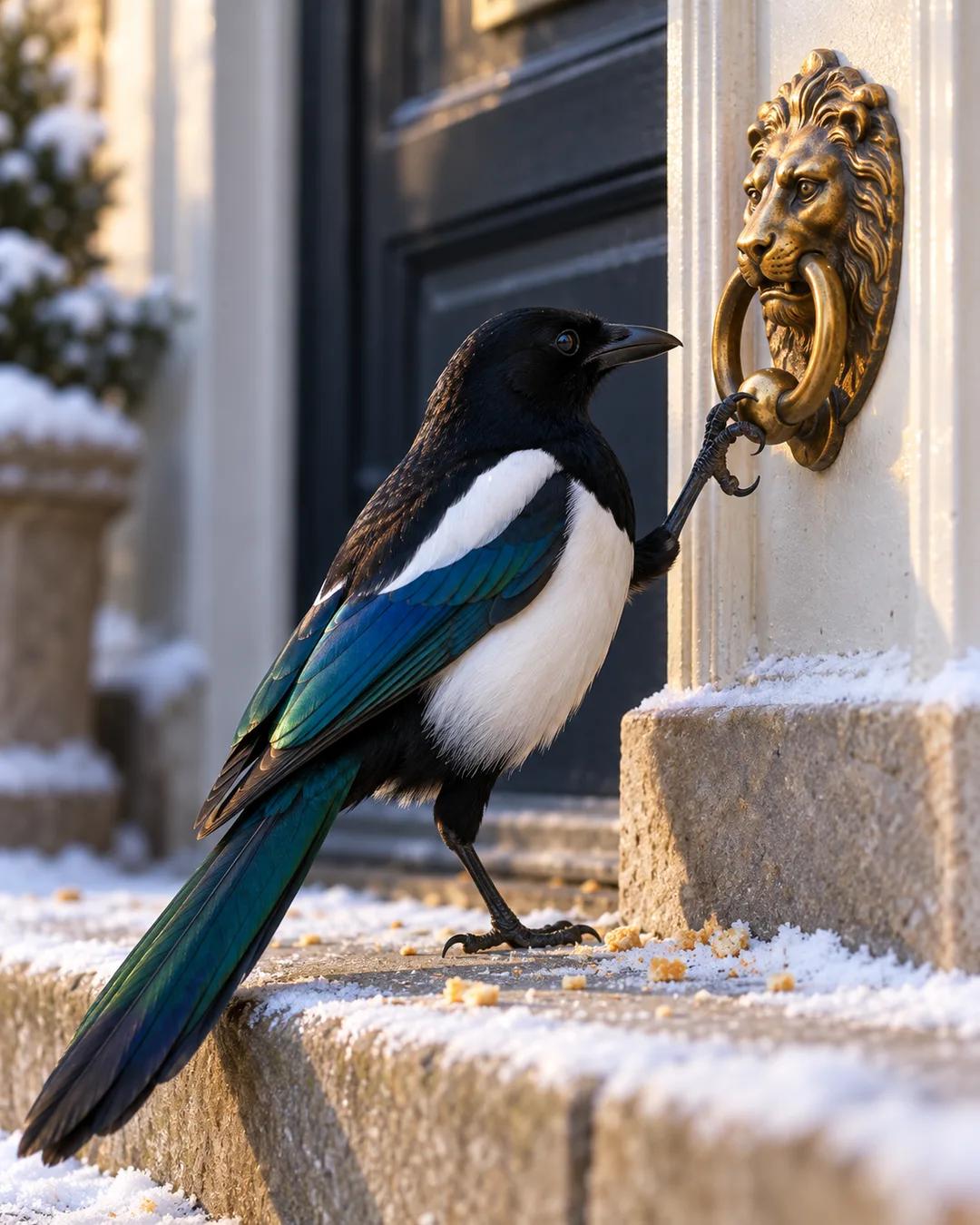
One winter, a woman tossed bits of food to magpies and enjoyed having them around. They began following her past the window, and she gave them a little more food. Then they started pecking at the window whenever she walked by, and she gave them a little more. Finally the doorbell rang. She went to answer it and found nobody there.
It took her a while to catch the magpies in the act: they were pressing the tongue of a lion-shaped doorbell ringer. She gave them more food, and the birds had conditioned her as much as she had conditioned them.
They clearly knew her from her husband, who did not like the magpies around and once acted as if he were throwing something at them. From that day on, the magpies left droppings on his car windshield every morning, only on the driver's side. When he and his wife swapped cars, the magpies still found his.
How does food reward shape a bird's habits?
Operant conditioning is the principle that a behavior followed by a reward becomes more likely. B. F. Skinner formalized it in the 1930s, largely through experiments with pigeons and rats. Any animal that can link an action to an outcome can be trained this way, and corvids are quick at it. The magpies in the story linked ringing a bell to food arriving, which is the same structure as Skinner's lever.
How do magpies tell people apart?
Magpies, like crows, are members of the corvid family and have large brains for their body size. Studies of corvids, including the 2012 face-recognition work on American crows by John Marzluff's group, show that these birds can learn individual human faces. Australian ecologists have also reported magpies recognizing the specific people who feed them or threaten their nests. Faces, clothing, and gait can all serve as cues.
Why are magpies so good at problem solving?
Magpies are corvids, a family whose members use tools, cache food, and solve puzzles in lab tests. In a 2008 study in the journal Proceedings of the National Academy of Sciences, Eurasian magpies passed the mirror test, in which an animal touches a mark on its own body that it can only see in a mirror. Very few species have passed it. The result is often cited as evidence of self-awareness in birds.
More from TEDx Talks