Korva is a scroll of the internet’s best ideas.
Matching needs magnitude and phase

A failed fix
In the lab, a transmission line at 50 ohms fed an antenna array at 12.5 ohms. Adding a 37.5 ohm resistor to bring the two up to a match did not help. A resistor dissipates power as heat, so it loses energy no matter what.
Capacitors and inductors
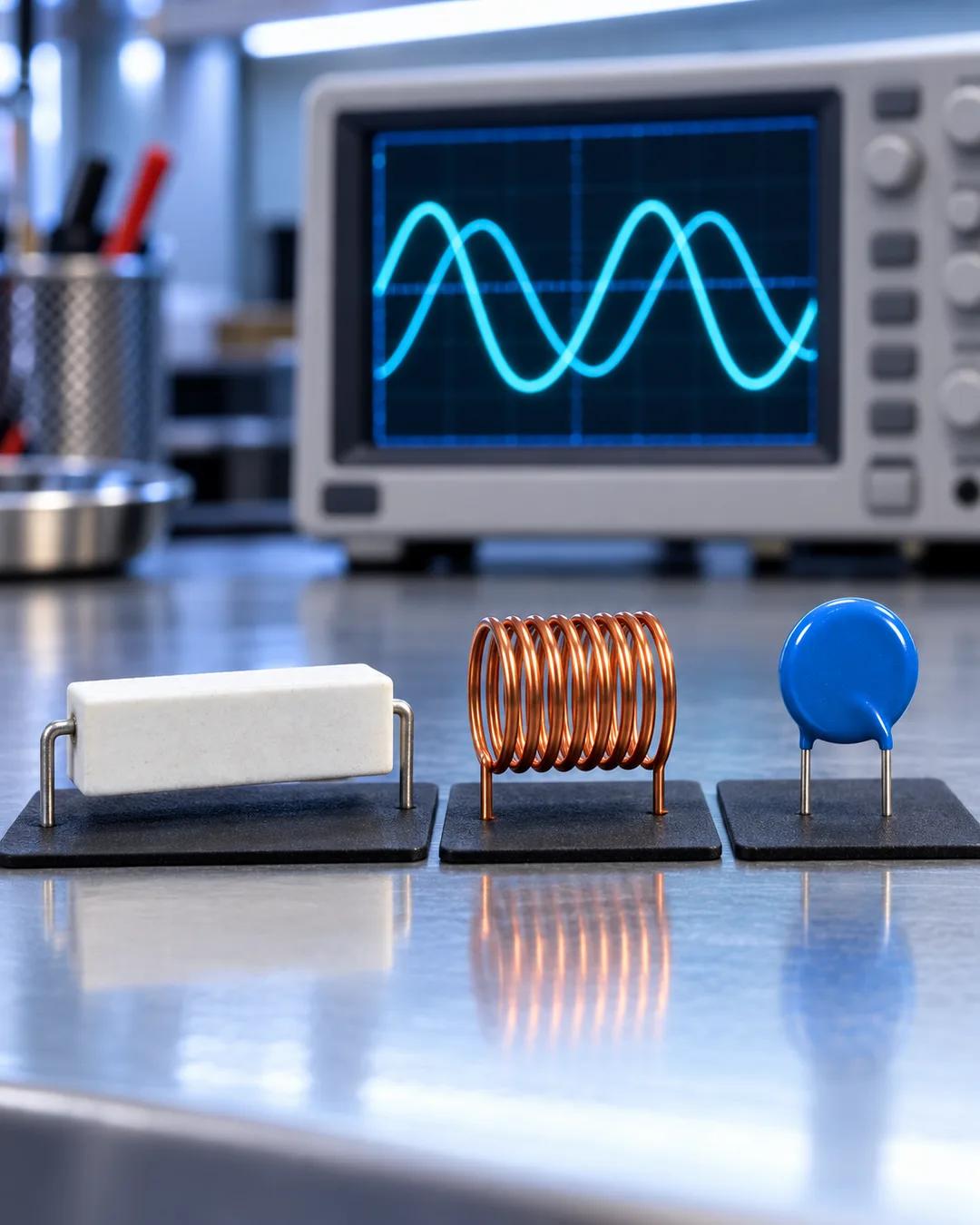
Real circuits have more than resistance. In a capacitor on an alternating current, the current peaks a quarter of a cycle before the voltage, so the voltage lags the current by 90 degrees. Any current in a wire also creates a magnetic field, which induces a voltage that opposes changes in the current, and that makes the voltage lead the current by 90 degrees.
Impedance defined
Resistance describes only the relative size of the voltage and current waves, and says nothing about their timing. Complex numbers carry both: resistance runs along the horizontal axis, and reactance runs along the vertical axis, with inductors rotated up by 90 degrees and capacitors down by 90. The combined quantity is impedance, Z, equal to voltage over current. Its magnitude gives the relative size of the waves, and its angle gives how far the phase has shifted.
Why does current lead voltage in a capacitor?
The current into a capacitor is proportional to how fast the voltage across it is changing. A sine wave changes fastest as it crosses zero and is momentarily flat at its peak. So the current is at its maximum when the voltage is at zero, and at zero when the voltage is at its maximum. That puts the current peak a quarter of a cycle ahead, and in an inductor the order is reversed.
Why do engineers use complex numbers for circuits?
A sine wave of any timing can be described by two numbers, its size and its phase, and a complex number holds exactly that pair. Multiplying and dividing complex numbers handles the sizes and phase shifts together, which replaces pages of trigonometry. Charles Proteus Steinmetz, an engineer at General Electric, brought the method into alternating-current circuit analysis in the 1890s. He presented it at the 1893 International Electrical Congress in Chicago.
Why does an inductor not waste power as heat?
An ideal inductor stores energy in its magnetic field while the current grows, then returns the same energy to the circuit as the current falls. Because its voltage and current are a quarter cycle apart, power flows in during one part of the cycle and back out in the next. Over a full cycle the average power it consumes is zero. Real inductors still lose a little energy as heat in the resistance of their wire.
More from Veritasium