Korva is a scroll of the internet’s best ideas.

Waves reflect where the line changes

Slinkys and boundaries
Tie two slinkys together, one with a high mass per unit length and one with a low mass per unit length, and a pulse sent down the first splits at the boundary. Part of the energy continues through and part reflects back. The reflection coefficient measures how severe that is, as the size of the reflected wave divided by the forward wave. If both slinkys have the same mass per unit length, the wave passes straight through and the coefficient is zero.
What decides the reflection
How a wave travels through a slinky depends on how tightly it is stretched and on its mass per unit length. Tied together, the two slinkys are under the same tension, so only the mass per unit length can differ. Match it and the join disappears, as if it were one slinky again.
The electrical version
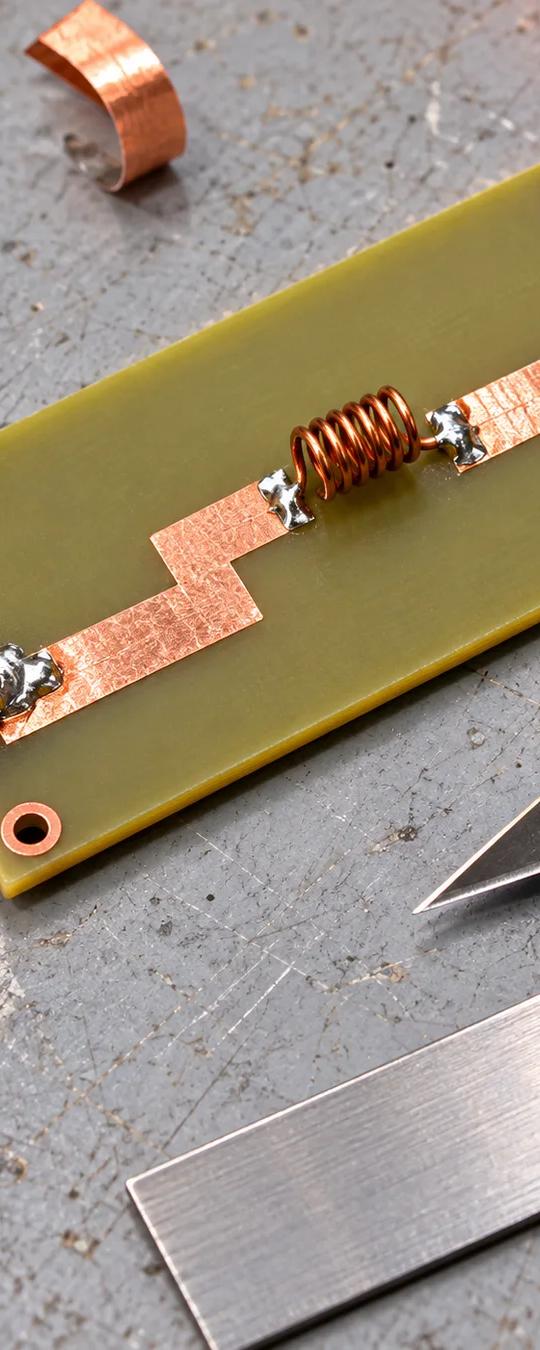
An electrical system works the same way. A transmission line and the antenna it feeds each have their own electrical properties, like two slinkys tied together. In a scaled model of Smith's setup inside an anechoic chamber, the received signal was expected at about negative 55 decibels and came in around negative 59. A four decibel drop on that logarithmic scale means more than half the power was lost.
Why does a wave partly reflect at a boundary?
At the join, both sides must agree on the position of the line and on the force across it. Each side carries waves with its own ratio of force to speed, which is set by its tension and mass per unit length. A single transmitted wave cannot satisfy both sides at once, so a reflected wave appears to make up the difference. A pulse passing from a heavy rope into a light one returns upright, and a pulse passing from light into heavy returns flipped.
Why do engineers measure signals in decibels?
Received radio power can span many orders of magnitude, and a logarithmic scale squeezes that range into small, readable numbers. Gains and losses multiply in a chain of components, and on a log scale they simply add. Every 3 decibels corresponds to roughly a doubling or halving of power. The unit was introduced by Bell System engineers in the 1920s and named for Alexander Graham Bell.
How does an anechoic chamber stop echoes?
The walls are covered in foam wedges or pyramids loaded with carbon, which absorbs radio waves. The tapered shape changes the material gradually from air to absorber, so there is no sudden boundary to reflect from. This is the same matching principle as the slinky join, spread over a long distance. The lower the frequency to be absorbed, the longer the wedges must be.
More from Veritasium