Korva is a scroll of the internet’s best ideas.
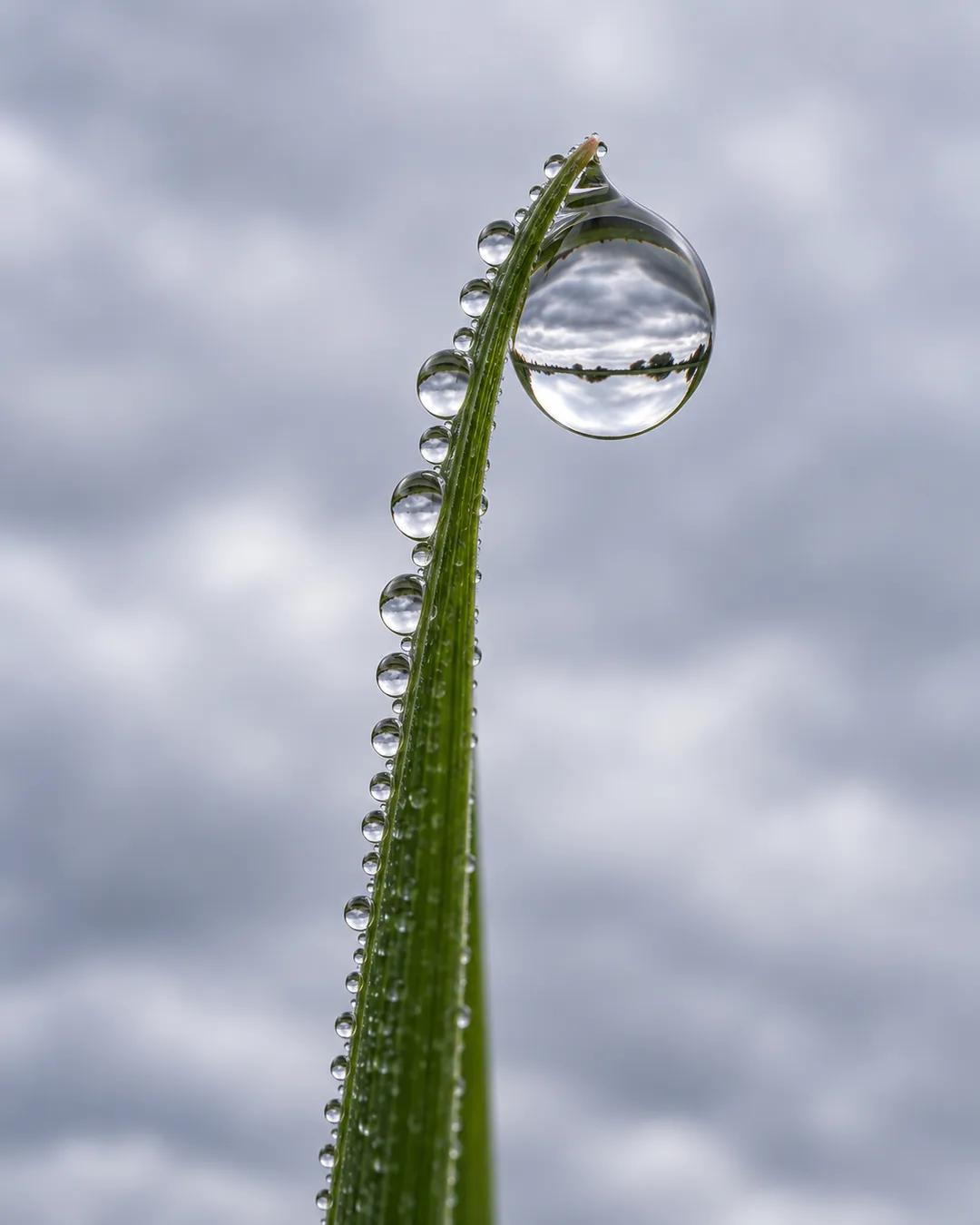
More cloud droplets than data bits

How Clouds Make Rain
Clouds are liquid water that has condensed from vapor into droplets only about 20 microns wide, small enough to stay aloft. A raindrop is about 2,000 microns, or two millimeters, roughly 100 times wider. When tiny droplets touch and merge, they grow too heavy to stay up and fall as rain.
Counting the Droplets
Averaging the estimates, clouds hold around 1,000 cubic kilometers of water, counting ice clouds too. That is two thousandths of a percent of the water in Earth's atmosphere, which is mostly vapor. Dividing that volume by the size of a cloud droplet gives about 238 septillion droplets.
Counting the Bits
The cloud's side of the comparison is an estimated 240 zettabytes of stored data, or about 24 sextillion bytes. Multiplying by eight gives roughly 190 sextillion bits, and a bit is the smallest piece of information there is, a one or a zero. The estimates could be off by an order of magnitude or even a couple in either direction, and the droplets still outnumber the bits.
A droplet can be divided further, too: a single raindrop contains septillions of molecules.
How do cloud droplets grow into raindrops?
In warm clouds, droplets of different sizes fall at different speeds, so larger ones collide with smaller ones and merge, a process called collision and coalescence. In colder clouds, ice crystals grow at the expense of supercooled water droplets, because water vapor settles more readily on ice. Meteorologist Tor Bergeron described this ice-crystal process in the 1930s. The crystals fall, melt on the way down, and arrive as rain. Because volume scales with the cube of width, a raindrop 100 times wider than a cloud droplet holds about a million droplets' worth of water.
Why don't tiny cloud droplets simply fall?
They do fall, but extremely slowly. A droplet 20 microns wide sinks at roughly one centimeter per second, slower than the gentle updrafts inside most clouds. Measurements by Gunn and Kinzer in 1949 found that a raindrop two millimeters wide falls at about 6.5 meters per second.
How do scientists measure the water in clouds?
Satellites estimate it by measuring how clouds absorb and scatter microwave and infrared radiation. Radar adds the vertical view: NASA's CloudSat satellite, launched in 2006, carried a radar that profiled the layers inside clouds. Aircraft flights through clouds provide direct samples that check the satellite numbers. Estimates still differ between methods, which is why global cloud water is given as a range.
More from The Rest Is Science