Korva is a scroll of the internet’s best ideas.
Mother trees feed their seedlings
The hub trees
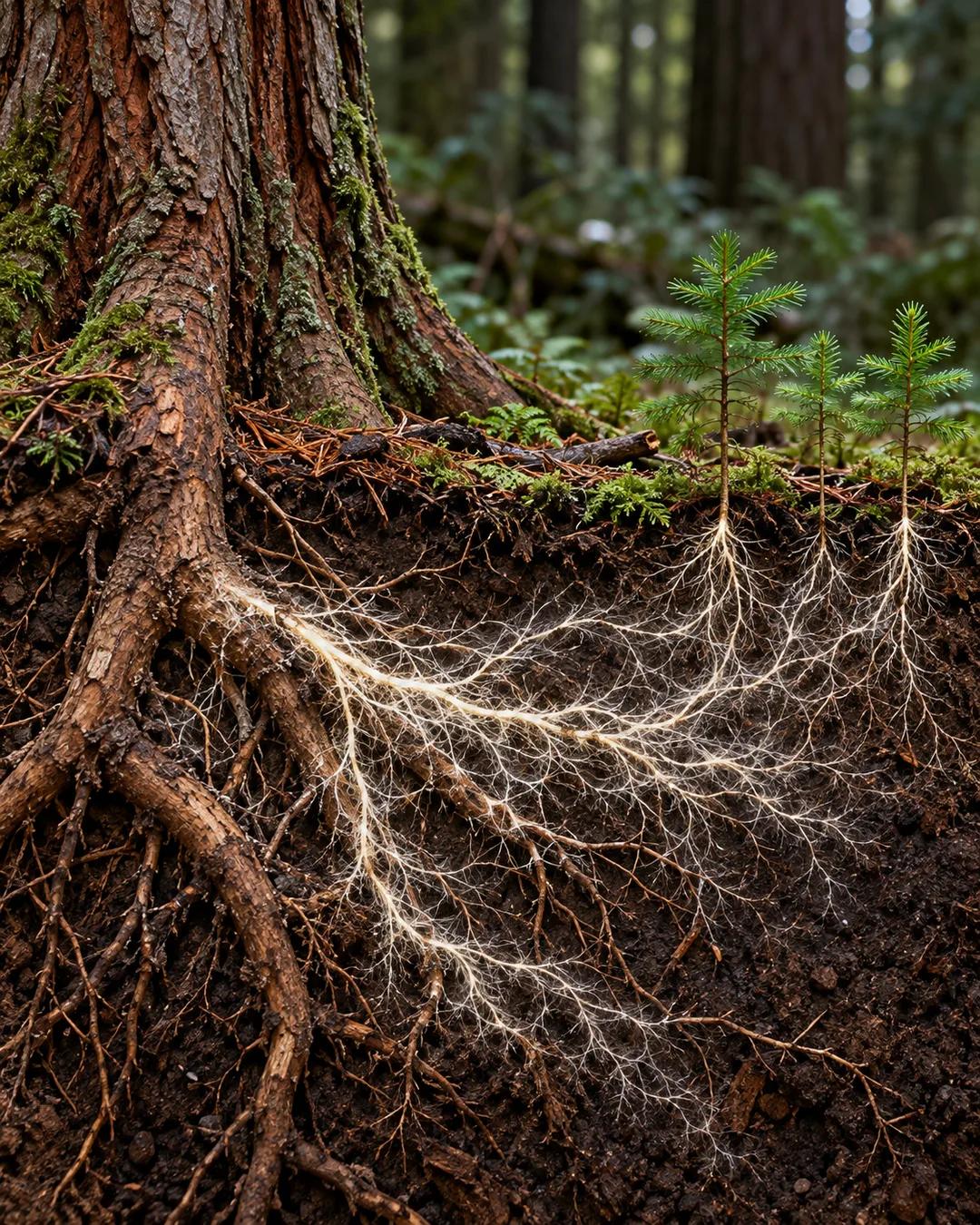
Mapping the forest with DNA microsatellites revealed the network. Each Douglas fir shows up as a circle, bigger and darker for bigger and older trees, and the small, light circles in the middle stand for seedlings in the understory. Lines of mycorrhizal fungus link the circles, and the oldest trees have the most of them. Researchers called these hub trees and later, more fondly, mother trees, because they nurture the young seedlings below. The map covers only two of what are thought to be 100 fungal species in that forest.
What the network carries
What moves through the network is what plants need to survive and grow: carbon, nutrients, and water. Plants labeled with carbon isotopes showed carbon passing back and forth, like messages transmitting through the internet. It flows from a robust source plant to a needful sink plant, and when a seedling is small, shaded, or short on nutrients, the other plant sends more. The source plants are not harmed.
Kin and strangers
A mother tree can also tell whether the seedlings around her are her kin or strangers. She sends more carbon to her kin, and even more when she is injured, as though she were passing her energy to the next generation.
How do fungi trade with tree roots?
Mycorrhizal fungi grow threads called hyphae through the soil, far finer than any root. Those threads reach water and minerals such as phosphorus that roots alone can't easily collect. The tree pays for this with sugars made in its needles by photosynthesis. Douglas fir partners with ectomycorrhizal fungi, which wrap each root tip in a sheath of fungal tissue.
How do researchers trace carbon between trees?
Researchers expose one plant to air containing carbon dioxide made with a rare, heavier form of carbon, such as carbon-13 or radioactive carbon-14. The plant builds that carbon into its sugars during photosynthesis. Days later, the researchers measure the same isotopes in the needles of neighboring plants. Suzanne Simard and her colleagues used both isotopes in a 1997 paper in Nature to track carbon between birch and Douglas fir.
How do microsatellites map a forest?
Microsatellites are short stretches of DNA that repeat and differ from one individual to the next, which gives each tree and each fungus its own genetic fingerprint. Researchers sample root tips and match the fungal fingerprint on each one to see which trees share the same fungus. In a 2010 study in New Phytologist, Kevin Beiler and colleagues used this method to map a Douglas fir stand in British Columbia. Two fungal species in the genus Rhizopogon linked the trees in that map.
Why would a tree favor its kin?
Relatives share many of the same genes, so helping a relative survive can pass those genes on even when the helper never reproduces. Biologist W. D. Hamilton set out this logic, called kin selection, in 1964. It was first used to explain animal behavior, such as warning calls and shared nursing. Hamilton's rule says helping evolves when the benefit to the relative, weighted by how closely related they are, exceeds the cost to the helper.
More from TEDx Talks