Korva is a scroll of the internet’s best ideas.
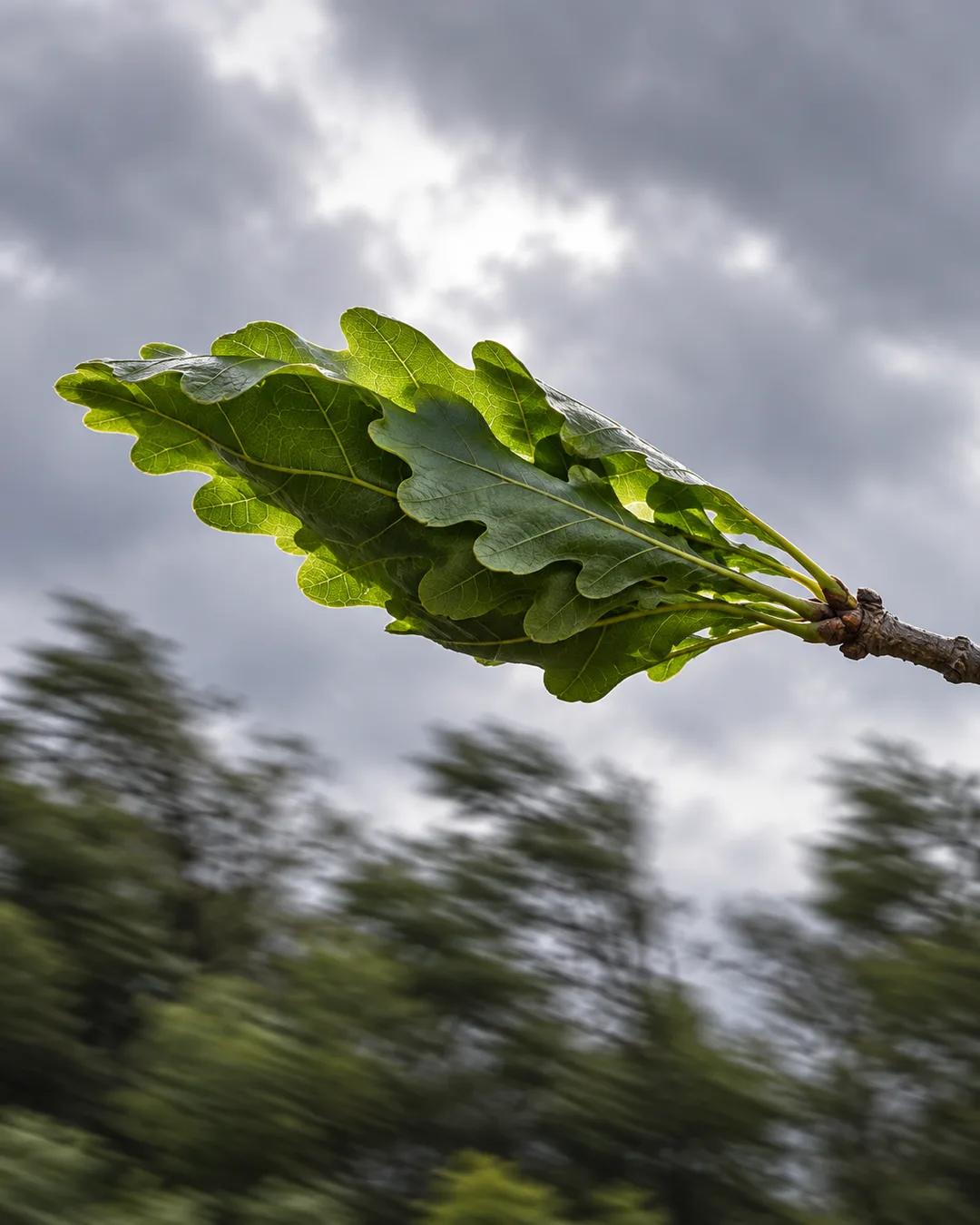

The biophysicist Stephen Vogel took bunches of leaves on twigs and put them in a wind tunnel. He found that the lobes at the base of an oak leaf help a bunch of leaves align themselves into a cone, with the sharp end of the cone facing the wind.
In strong winds the leaves collapse into that streamlined shape, which makes the wind slip over them rather than tear them off the twig. Leaves do get torn and fall in a storm, but it takes life-threatening winds to strip a tree completely, because leaves are adapted for wind.
Why an oak leaf is lobed while a beech leaf has an entire margin is still an open question, and biophysics is part of the explanation. Tom Givnish at Madison, Wisconsin, has done much to unravel why leaves have the shapes and angles they do, including the different shapes found on climbing vines, and ties them to the light and heat of the environment.
How does a leaf cone cut wind drag?
A flat, rigid plate takes ever more force as wind speeds up, roughly in proportion to the square of the speed. Flexible leaves bend and roll into narrower shapes as the wind rises, so the force on them climbs more slowly. Stephen Vogel, who wrote the book Life in Moving Fluids, measured this in tests with leaves in moving air and water. His measurements showed that a flexible leaf at high speed meets much less drag than a rigid copy of the same shape.
Why do hot, sunny places favor small or lobed leaves?
A leaf sheds heat through a thin layer of still air hugging its surface, and that layer is thinner on small or deeply cut leaves. Thinner layers let a leaf stay closer to the air temperature, which spares it from overheating in strong sun. In 1972, Geoffrey Parkhurst and Orie Loucks published a model showing that the best leaf size depends on the balance between water loss and carbon gain in each environment. Shaded forest floors favor large, broad leaves for the opposite reason.
How do leaf edges reveal ancient climates?
Botanists early in the twentieth century, including Irving Bailey and Edmund Sinnott, noticed that warm regions have a larger share of tree species with smooth-edged leaves. Cooler regions have more species with toothed or lobed edges. Paleobotanists apply the same pattern to fossil leaves to estimate past temperatures. The method is known as leaf margin analysis.
More from The joe gardener Show - Organic Gardening - Vegetable Gardening - Expert Garden Advice From Joe Lamp'l