Korva is a scroll of the internet’s best ideas.
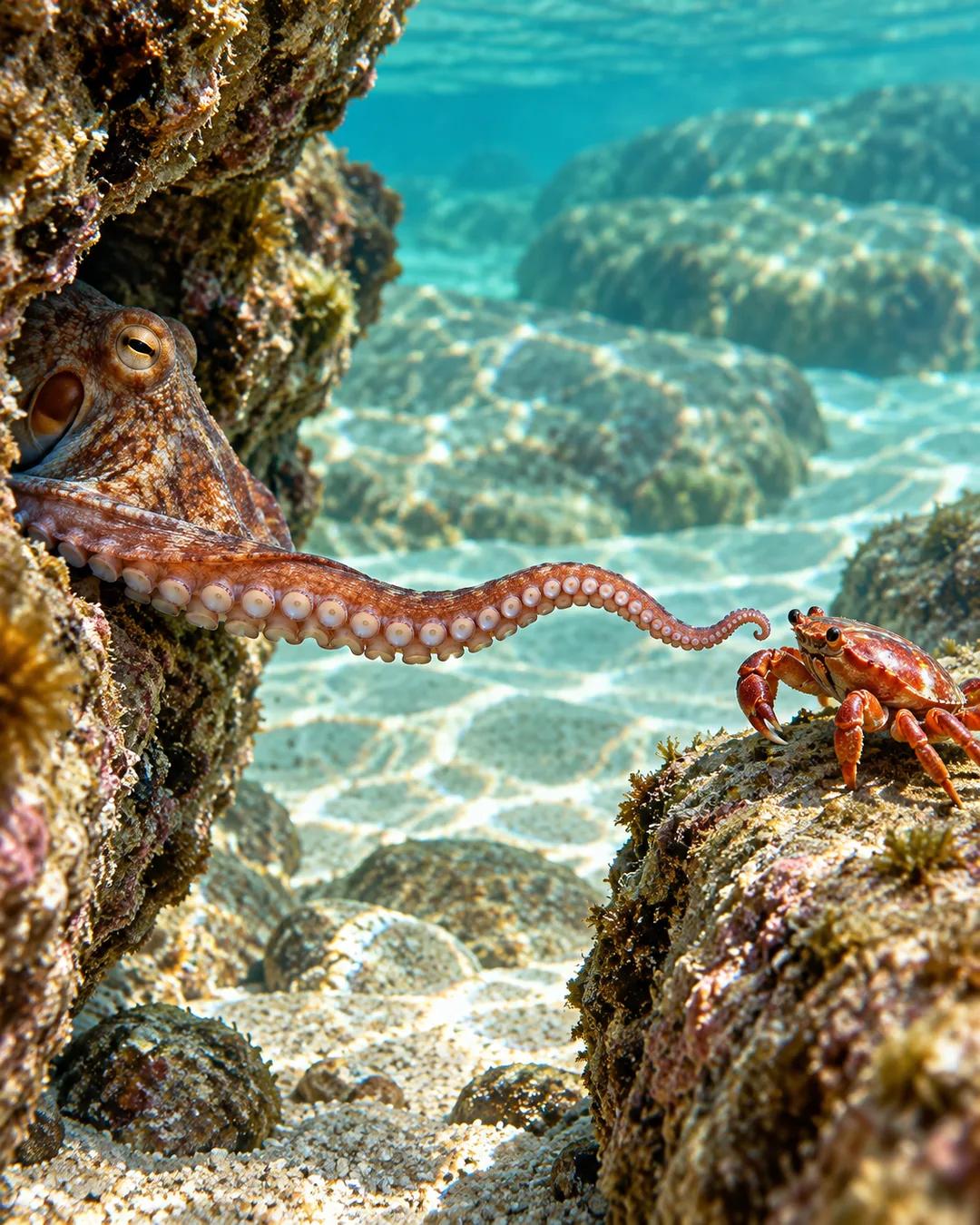
Octopuses have a behavior library

How humans reach
Picture an apple. A human brain holds a neurological map of the body, so when the eyes spot the apple, the motor center activates the right muscles: the arm reaches out, the hand grabs, the elbow bends, and the apple travels to the mouth.
How an octopus reaches
An octopus handles the same task another way. Seeing food activates a behavioral response to grab, and the brain does not address any specific body part. The signal travels through the network, and the arm neurons pick up the message and jump into action to command the movement.
Life without bones
Octopuses have no bones, so their limbs bend at any point and in any direction. Shaping a tentacle into any one of a virtually limitless number of arrangements is unlike anything humans are used to, with their knees that cannot bend backwards and forearms that cannot bend in the middle.
Why is a bendy arm so hard to control?
A human arm from shoulder to wrist has about seven degrees of freedom, each set by a joint. An octopus arm has no joints, so it can bend at any point along its length and take up an effectively unlimited number of shapes. Directing every possible shape from a central controller would demand enormous computation. Roboticists building soft robotic arms study octopuses for that reason.
How does an octopus bring food to its mouth?
In a 2006 study in Current Biology, Germán Sumbre and colleagues examined how octopuses pass food along an arm to the mouth. The arm folded into a temporary structure with segments separated by joint-like bends, an arrangement that resembles a vertebrate limb. The bends formed only for the movement and disappeared afterward.
How do octopus arms taste what they touch?
The suckers are packed with sensory cells, and each one can detect chemicals as well as touch. In a 2020 study in Cell, Lena van Giesen, Nicholas Bellono, and colleagues at Harvard identified a family of receptors in octopus suckers. These receptors respond to poorly soluble molecules found on the surfaces of objects and prey. They sit in the suckers themselves, so each sucker tastes what it grips.