Korva is a scroll of the internet’s best ideas.
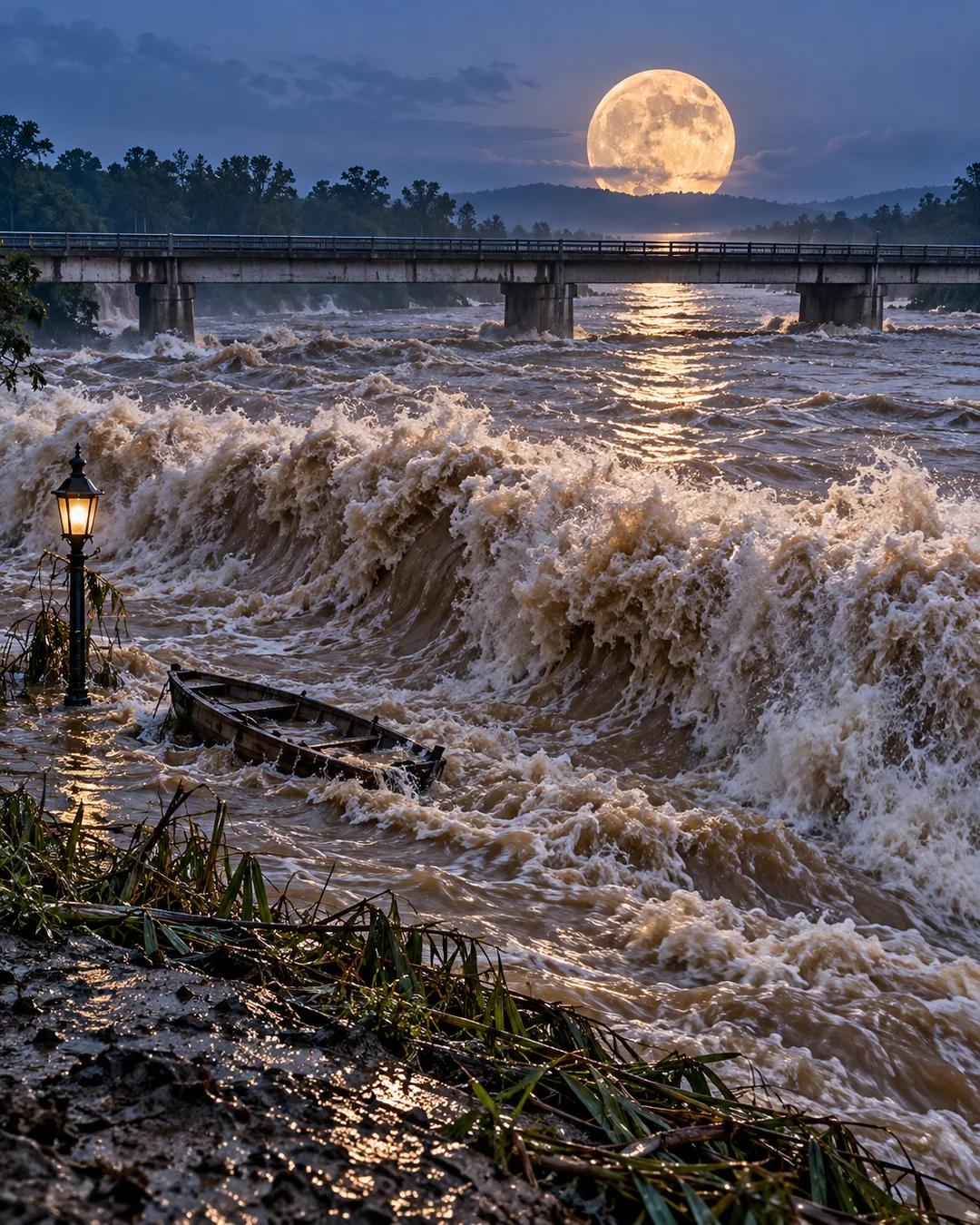
Rivers flow backwards

Rising tides
Tides exist because the Moon's gravity pulls harder on the near side of Earth than on the far side, so the oceans bulge beneath it as the planet turns. As the Moon draws closer, the bulge grows. After one month it has covered half the distance to Earth, and high tide reaches 4 meters, flooding coastal cities every day.
By the end of month two the Moon has covered two thirds of the distance, and tides above 10 meters displace up to a billion people who live near coastlines. Ports become inoperable and shipping grinds to a halt, which slows the delivery of food along with everything else. Ocean-crossing cables carry 95% of the internet. The cables largely tolerate water, but their terminals on land do not, so global communications fall into disarray.
Rivers and satellites
Inland offers little shelter. Tidal bores push rivers backward, carrying salt water into surface and groundwater supplies. Refineries near the coast are abandoned, gas runs short, and countries ration whatever is left on their shelves. In the cities, people scavenge during the hours of low tide and retreat to high-rises when the water returns.
By month three the Moon is close enough to warp the orbits of navigation and communication satellites, which normally sit too far away to feel its gravity in any serious way. When their fuel for orbital corrections runs out, the satellites careen out of control.
Why does Earth bulge on both sides?
The Moon pulls hardest on the water nearest it, less on the solid center of Earth, and least on the water on the far side. Measured against the center, the near water is pulled toward the Moon and the far water is left behind, so two bulges form on opposite sides of the planet. Earth rotates beneath them, which gives most coasts two high tides a day. The gap between successive high tides is about 12 hours and 25 minutes, because the Moon moves along its orbit while Earth turns.
Why are some tides far bigger than others?
Coastline shape matters as much as the Moon's pull. In the Bay of Fundy in eastern Canada, a long funnel-shaped bay squeezes the incoming water, and its length lets the water slosh back and forth at nearly the same rhythm as the tide itself. Together these effects stack the water up to a range of about 16 meters between low and high tide. Most open coastlines see a range of only a meter or two.
How do undersea cables survive the ocean?
Submarine cables are built for water: a thin glass fiber core is wrapped in copper, plastic insulation, and, in shallow water, steel wire armor. Amplifiers spaced along the route draw electrical power sent through the cable from stations on shore. Those landing stations hold the equipment that links the cable to land networks, so they are the vulnerable end of the system. A typical cable in deep water is about as thick as a garden hose.
How do satellites hold their position?
Satellites in high orbits are tugged by the Moon and the Sun, which slowly tilts the orbits of geostationary satellites by roughly 0.8 degrees a year. Operators fire small thrusters regularly to correct the drift, spending fuel that cannot be refilled. When the fuel nears its end, the satellite is lifted into a graveyard orbit so it stays out of the way of working ones. International guidelines place that graveyard orbit about 300 kilometers above the geostationary ring.
More from Kurzgesagt – In a Nutshell