Korva is a scroll of the internet’s best ideas.
Rivers rearrange themselves to save energy
The efficient layout
Imagine a square field where rain falls uniformly and all the water must leave through a single point. Digging a direct channel from every part of the field to the outlet would take extremely long channels, which is an inefficient process. A treelike system works better, with tiny streams merging into larger tributaries and eventually one main trunk. Individual raindrops may travel farther, but the network dissipates less energy through friction because much more of the infrastructure is shared. Computer simulations of river networks showed that the ones obeying Hack's law, with its exponent of 0.6, dissipate the least energy.
How streams compete
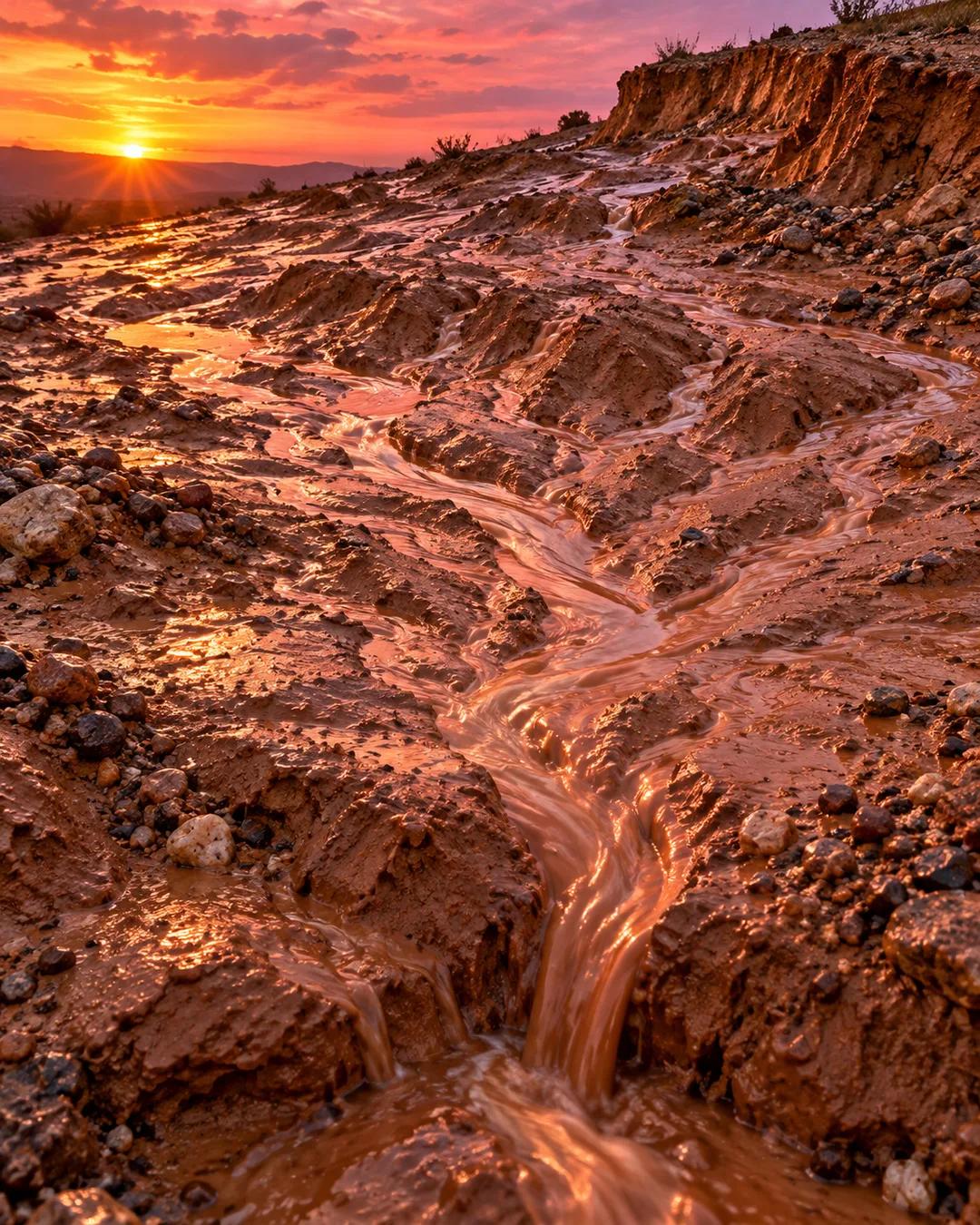
Landscape evolution models show how a real river gets there. Water flows downhill and erodes rock, and tiny random irregularities in the topography cause some channels to capture more runoff than others. Those channels erode faster and deepen, which causes them to attract still more water. One streambed may grow toward its neighbor and intercept some of its runoff. The victorious stream grows longer and carries more water, while the losing stream shrinks or disappears.
Gravity and friction
Gravity supplies potential energy to the flowing water, and friction, the cause of erosion, dissipates it. A layout that forces water along inefficient routes erodes rapidly and changes. A layout that routes water more effectively is stabler and therefore more persistent. The network keeps adjusting until it settles into a form that follows Hack's law.
How do landscape evolution models work?
These models start with a grid of elevation values and add rain to every cell. Each cell sends its water to its lowest neighbor, and the model removes rock from each cell at a rate that rises with the amount of water passing through and the steepness of the slope. A common version is called the stream power law. Small random bumps in the starting terrain are enough to make channels diverge over many simulated steps.
What happens when one river steals another's water?
Geologists call it river piracy or stream capture. In May 2016, the retreat of Canada's Kaskawulsh Glacier redirected meltwater that had flowed north into the Slims River toward the Alsek River to the south, in a matter of days. The Slims River, which had fed Kluane Lake, dropped to a trickle. Researchers led by Daniel Shugar reported the event in Nature Geoscience in 2017.
Do blood vessels branch like river networks?
In 1926, physiologist Cecil Murray derived that a branching vessel carries blood at the lowest combined cost of pumping and maintaining the blood when the cube of the parent's radius equals the sum of the cubes of the daughters' radii. Measurements of blood vessels in many animals come close to this relationship. Plant xylem and the airways of lungs have also been compared against it. Murray's calculation, like the river simulations, treats a branching network as the solution to an optimization problem.
More from Natalie Wolchover