Korva is a scroll of the internet’s best ideas.
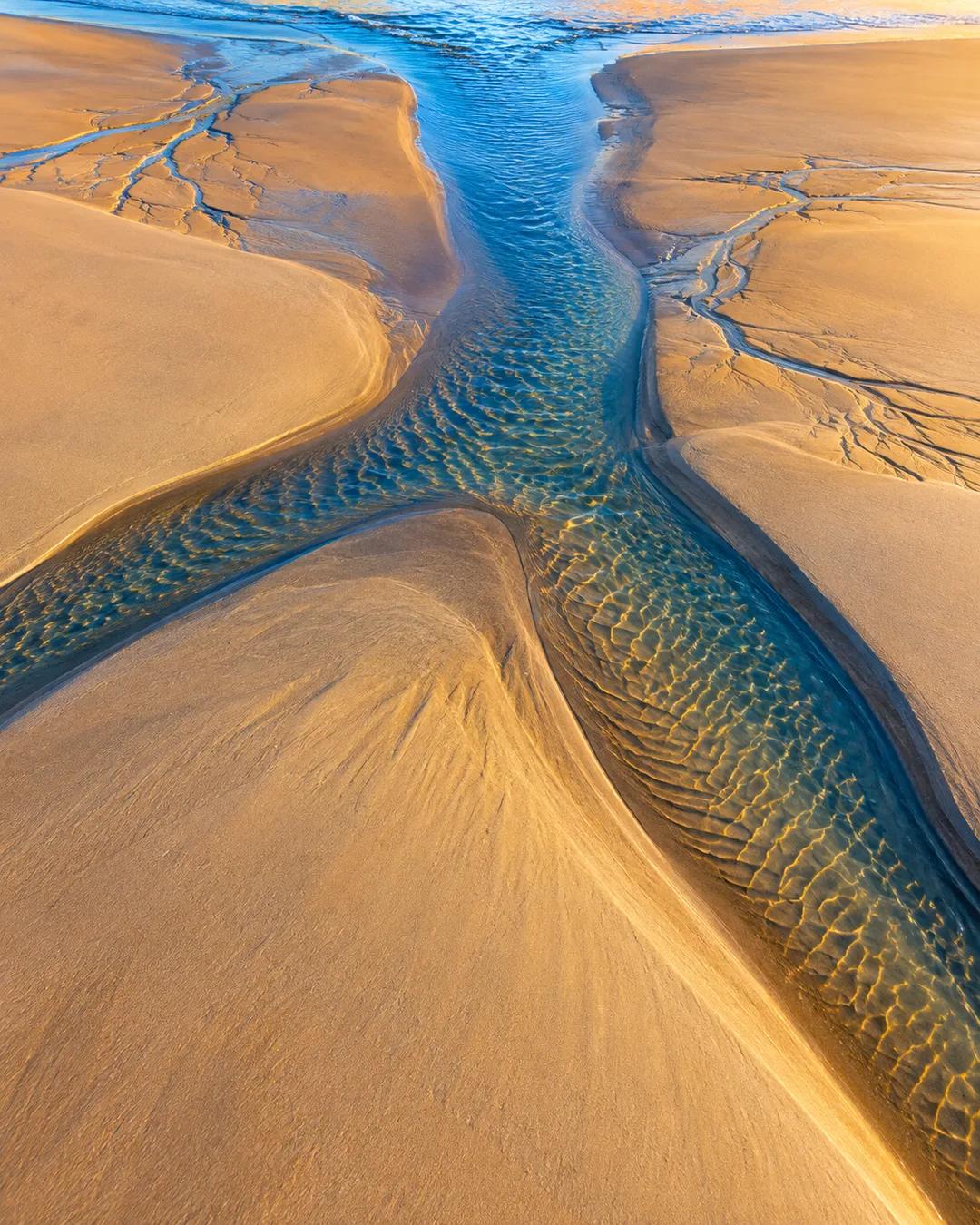
Rivers split at 72 degrees
Predicting the angle
Daniel Rothman of MIT and Hansjörg Seybold, now at the Austrian Academy of Sciences, began modeling stream evolution in the early 2010s as a process called Laplacian growth, which posits that growth begets growth. Their model predicted the 72-degree angle, and measurements of real streams later found it.
Why the angle holds
The angle holds because erosion pushes on both sides. If the split were wider, water flowing in from the land between the two branches would erode them toward one another. If it were narrower, excess water seeping in from the outer banks would draw them apart.
Fivefold symmetry
Seventy-two degrees gives river networks a kind of fivefold symmetry. Regular, repeating patterns cannot have fivefold symmetry, and regular pentagons will not tile a space. Pentagonal arrangements of atoms can fill space in almost-but-never-quite-repeating patterns, though, forming materials called quasicrystals. These exotic metal alloys are less regular than crystals and more ordered than glass, which gives them unusual properties. Researchers have speculated about whether the fivefold symmetry of a branching network relates to the geometric and physical strangeness of quasicrystals.
How does growth beget growth in streams?
In a Laplacian growth model, a channel's tip advances fastest where water converges on it most strongly. A tip that pokes out further draws in more flow, so it advances even faster than its neighbors. The same mathematics describes other branching patterns, including thin fingers of one fluid pushed into another between two close plates. It also appears in models of lightning, where a discharge tip grows toward the strongest electric field.
How were quasicrystals first discovered?
In 1982, Dan Shechtman observed an unusual diffraction pattern with tenfold symmetry in a rapidly cooled aluminum and manganese alloy at the US National Bureau of Standards. Crystallographers of the time held that such a pattern was impossible for a true crystal, and his claim met fierce resistance. Other labs later confirmed the structure, and the term quasicrystal was coined in 1984. Shechtman received the Nobel Prize in Chemistry in 2011.
How does groundwater carve a valley?
Seepage emerging at the base of a slope loosens the sand and rock there and carries grains away. With its base removed, the slope above collapses and the valley head retreats uphill. This process, called groundwater sapping, leaves valleys with blunt, amphitheater-shaped heads rather than pointed ones. It is well documented in the sandy terrain of Florida's panhandle.
More from Natalie Wolchover