Korva is a scroll of the internet’s best ideas.
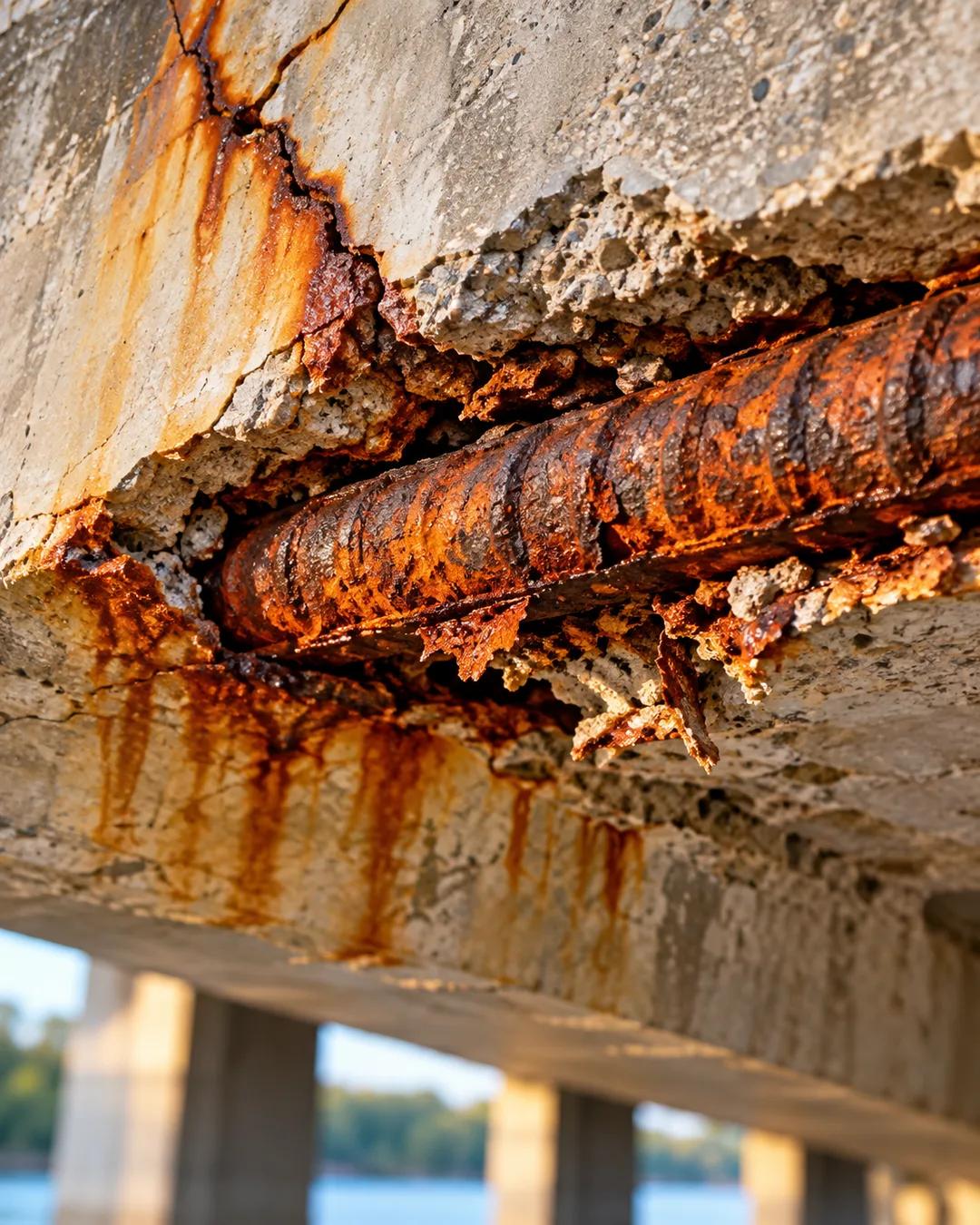
Rust swells 5 to 10 times

Why concrete needs steel
Concrete is very strong when it is pressed and weak when it is pulled or bent. Its tensile strength is only about 10% of its compressive strength. Reinforced concrete fixes that by embedding steel bars: the concrete handles the crushing forces and the steel handles the pulling forces.
How rust tears it apart
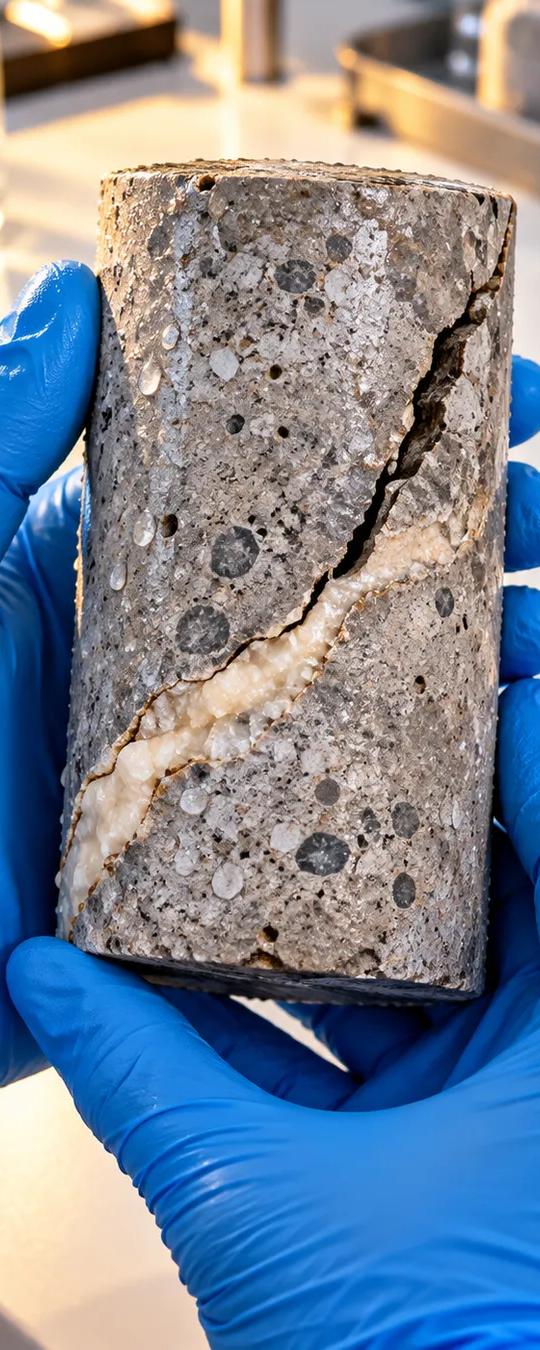
Concrete is also porous, like a hard sponge, and tiny cracks form over time. Water, oxygen, and road salt seep through them until they reach the steel and it starts to rust. The rust products occupy 5 to 10 times the volume of the original steel and press on the surrounding concrete with 3 to 4 megapascals, which lands on the material's weakest point.
Once the first chunk of concrete breaks loose, the exposed rebar corrodes faster, which makes more rust, more pressure, and more flaking. This flaking is called spalling. A small crack grows into a big one, and the structure pulls itself apart from within.
Carbon dioxide from the air adds to the problem. It slowly neutralizes the concrete and breaks down the protective alkaline shield around the steel.
Why is concrete so weak when pulled?
Concrete behaves like a brittle ceramic, and it is full of tiny flaws and pores. When it is squeezed, those flaws tend to close up. When it is pulled, stress concentrates at the tip of each flaw, so a small crack can run through the material almost without warning. That is the reason engineers treat its tensile capacity as close to nothing in design.
Why does rust take up more space than steel?
Rust is a family of iron oxides and hydroxides that include oxygen and often water in their structure. Their crystal structures are more open than the tightly packed iron atoms in steel, so each atom of iron ends up occupying more room. The exact swelling depends on which form of rust develops, which is why the volume increase is given as a range. The resulting internal pressure is enough to crack the concrete cover over the bar.
Why do steel and concrete work well together?
Steel and concrete expand and contract with temperature by almost the same amount, roughly 10 to 12 millionths per degree Celsius. Because of that match, a bridge can swing from winter cold to summer heat without the bars sliding or tearing away from the concrete. The alkaline environment inside fresh concrete also protects the steel from rusting at first. The pairing was developed commercially in the second half of the nineteenth century.
More from Medieval Wisdom