Korva is a scroll of the internet’s best ideas.
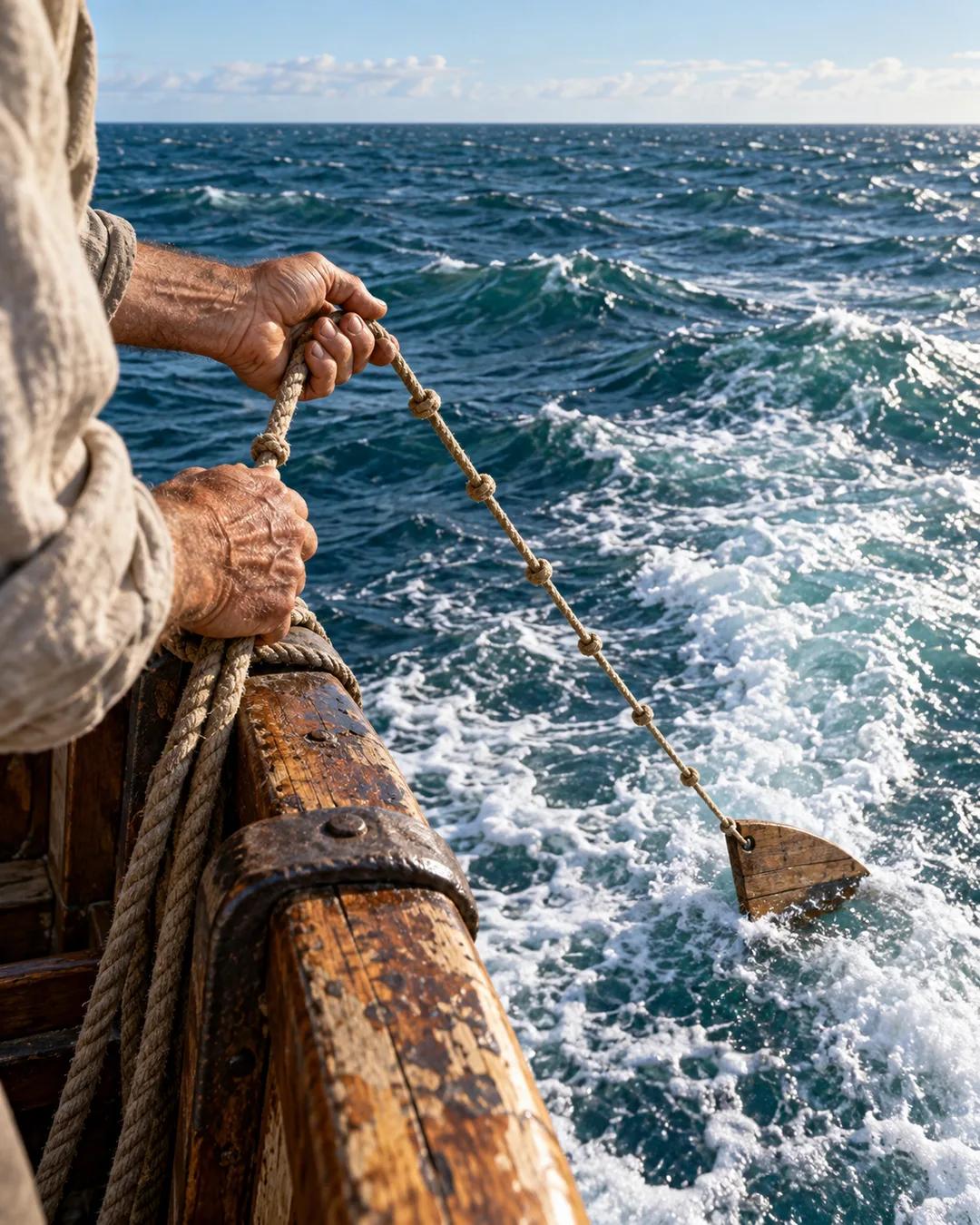
Sailors measured speed with a log

Two coordinates
Latitude was easy: a sailor lined up a sextant and read how many degrees north or south of the equator the ship was. Longitude meant measuring the rotation of the Earth against the ship's position on it, and for most of human history nobody could do that well.
Dead reckoning
The method was called dead reckoning. A crewman threw a log into the water on a rope with knots tied at regular intervals, held the rope, and counted how many knots slid through his hand in 60 seconds. That count gave the ship's speed in knots. Every six hours the crew repeated it, plotted the speed against the heading, worked out how far east or west the ship had moved, and wrote it in the logbook.
Each error stacked on the one before. A navigator could drift hundreds of miles off course and meet an island that was not supposed to be there.
Why is longitude harder to find than latitude?
Latitude can be read from the height of the sun at noon or of the pole star at night. Longitude requires comparing local time with the time at a reference point, because the Earth turns 15 degrees every hour. Every four minutes of time difference equals one degree of longitude. A clock error of just one minute translates to roughly 15 nautical miles at the equator.
Why did a 1707 shipwreck change navigation?
In October 1707 a Royal Navy fleet under Admiral Sir Cloudesley Shovell returning from the Mediterranean ran onto rocks off the Isles of Scilly. Four ships were lost, and more than 1,400 sailors died. The navigators had misjudged their position in fog after days without a clear sighting. The disaster helped prompt the Longitude Act of 1714, which offered a prize of up to 20,000 pounds for a practical method.
How did John Harrison solve the longitude problem?
Harrison, a self-taught clockmaker from Yorkshire, built marine chronometers that kept steady time at sea despite rolling and temperature changes. His fourth model, H4, was tested on a voyage to Jamaica in 1761 and 1762. After 81 days it had lost only about five seconds. A chronometer set to a reference time lets a navigator calculate longitude from the sun's position.
More from The Joe Rogan Experience