Korva is a scroll of the internet’s best ideas.
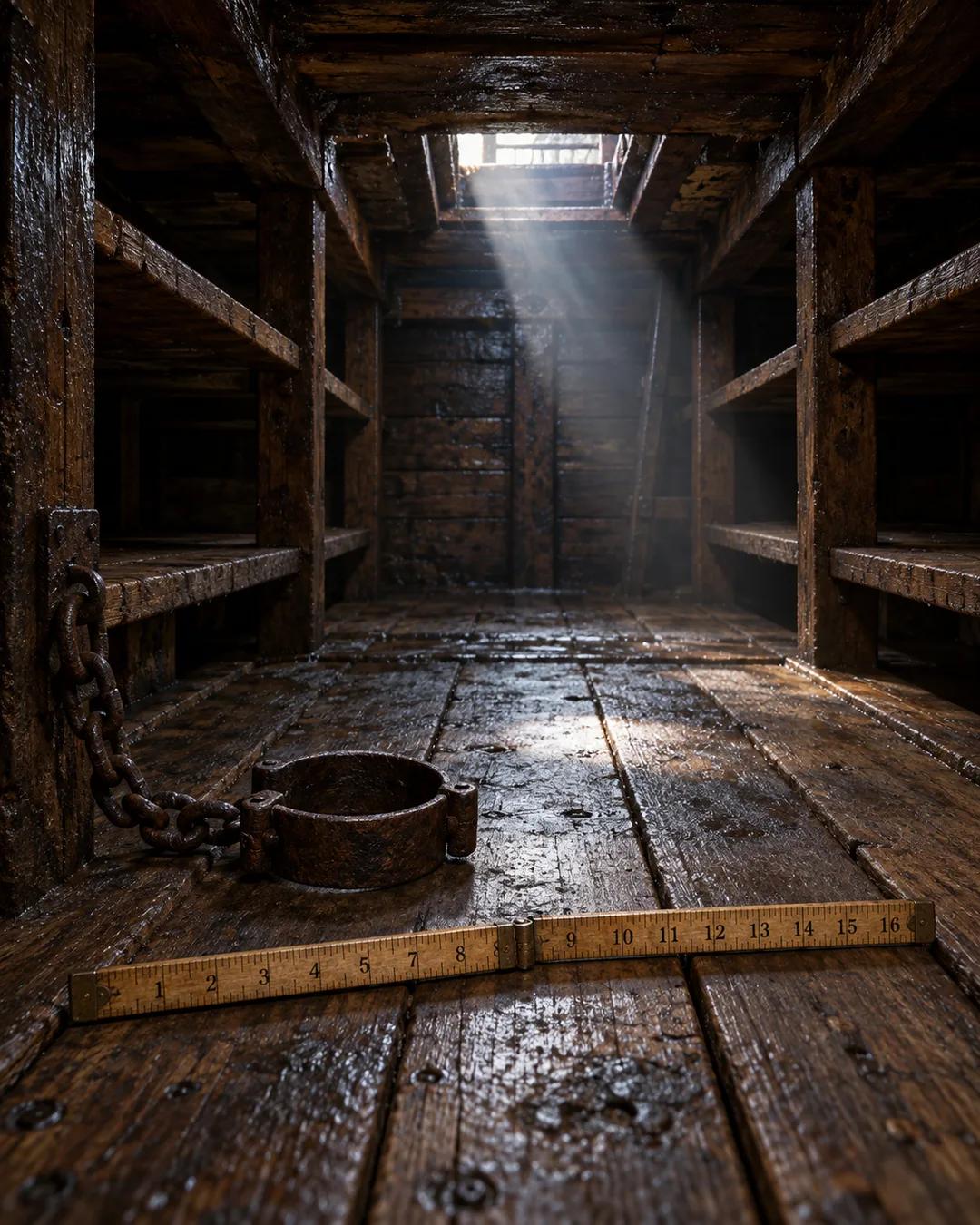
Sixteen inches of space each

Packed below deck
Schematics of the Brooks slave ship out of Liverpool show how the lower deck, called the tween deck, was packed. Captives lay shackled, unable to sit upright, and a partition added a second level above them, like overhead bin space, to raise the capacity. They were chained two by two.
Buckets stood along the deck for the bathroom, and a captive chained to a partner rarely reached one in time with the ship tossing. Within days the deck was covered in urine, feces, blood, and vomit, and it stayed that way for the whole crossing. Some women gave birth there.
Daily routine and control
Each morning captives were brought up, doused with seawater, and given a little food and half a pint of water. Men were kept at the front and women and children at the back, divided by a barricade down the middle with cannons mounted on it, so that if the men revolted the crew could retreat to the stern and still control the ship.
Forced feeding
Some captives refused to eat. Captains answered with a speculum oris, a device first made to pry open jaws in cases of lockjaw. They forced it into the mouth and pushed food down the throat, cracking teeth and lacerating tongues, and the hunger strikes ended.
How did the Brooks plan become law?
Sir William Dolben, a member of Parliament, boarded a slave ship in the Thames in 1788 to see conditions for himself. His Slave Trade Act of that year was the first British law to regulate the trade, limiting the number of captives a ship could carry relative to its tonnage. The abolitionists' diagram of the Brooks helped build support for it. The law capped a ship under 201 tons at five captives for every three tons.
Why were captives brought on deck each day?
Captains brought captives up for fresh air and exercise, because the hold's poor ventilation bred fever and the cramped conditions caused cramps and sores. Crews often made them dance to music, sometimes with a whip. A crew that lost too many captives lost the value of the voyage. The Slave Voyages database records average mortality of about 12 percent across the transatlantic trade as a whole.
How did captives resist aboard slave ships?
Historians have documented hundreds of shipboard revolts, along with refusals to eat and leaps into the sea. Refusing food was among the most common forms of resistance, and several contemporaries recorded that some captives believed death would carry them home. Captains answered with force-feeding, using the speculum oris and other instruments. Alexander Falconbridge, a former ship's surgeon, described these methods in his 1788 account of the trade.
More from The Joe Rogan Experience