Korva is a scroll of the internet’s best ideas.
Spiders spin silk by changing pH
Storing the proteins
Cells in the silk gland make proteins called spidroins, each with a long repeating middle between two ends, the N-terminal and the C-terminal. They are packed into a storage sac at high concentration, where proteins would normally clump into a solid. A tuned pH prevents that: the N-terminal ends carry a negative charge, and since like charges repel, the crowded proteins shove apart. Slowly they rearrange, with the water-loving ends facing outward and the water-repelling repeating regions tucked inside, forming micelles that cluster into globules.
Through the duct
The globules enter an S-shaped duct that gets skinnier and skinnier. Liquid near the walls moves slowly while the middle moves faster, and those sliding layers, called shear, stretch the globules. Water leaves and the pH drops. The extra hydronium ions bind to the negative parts of the proteins and cancel them, so the N-terminal ends pair up and link the proteins into long chains.
The final pull
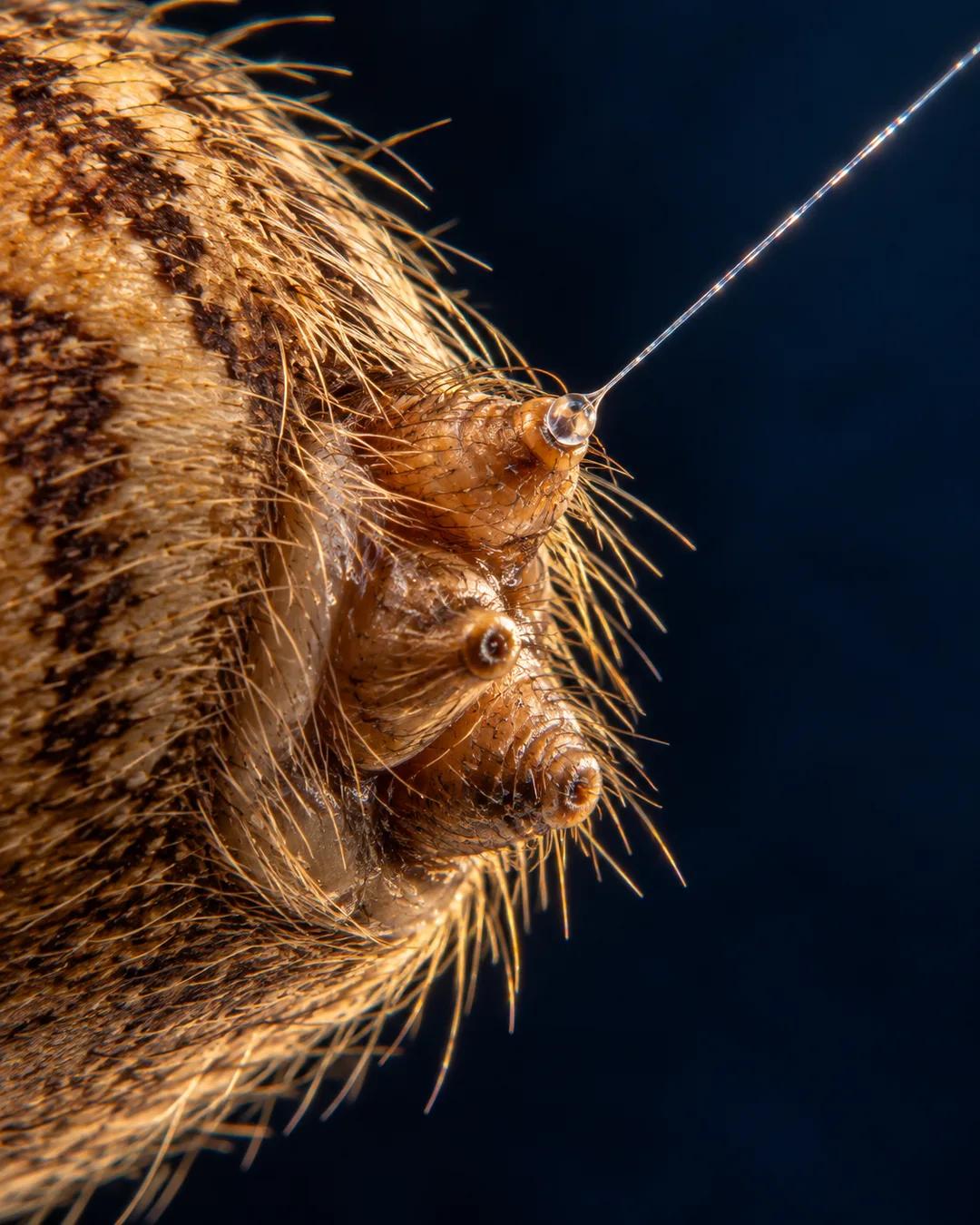
At the spigot, the liquid speeds up through a small opening, and that final stretch pulls neighboring spidroins tight alongside one another. Zigzag sections interlock, and rows of hydrogen bonds stitch them into rigid sheets that stack into nanocrystals. Looser sections stay amorphous. No one fully understands how the proteins assemble inside the duct.
How does a silkworm spin differently?
A silkworm spins its cocoon by swinging its head in a figure eight while two glands lay down a pair of fibroin filaments. The filaments are glued together by a gummy protein called sericin. Silk makers boil cocoons to dissolve the sericin, a step called degumming, and then unwind the thread. Silk fabric gets its softness and sheen from that step.
Why does the size of silk crystals matter?
The rigid sheets in silk are built from alanine-rich stretches that form beta-sheet nanocrystals only a few nanometers across. Simulations by Sinan Keten and Markus Buehler at MIT, published in Nature Materials in 2010, found that crystals of about that size get their strength because their hydrogen bonds share the load and fail together. Larger crystals broke at lower stress in the same simulations. Glycine-rich stretches stay disordered and form the soft matrix around them.
More from Veritasium