Korva is a scroll of the internet’s best ideas.
Stretch is what makes silk tough
Falling climbers
Picture a rock climber hanging from a rope: all that matters is whether it holds their weight. A climber who falls is different, because the rope has to absorb all of their kinetic energy. Stop the fall in a short distance and the energy has to be absorbed quickly, so the forces are enormous. Let the rope stretch and the same energy is absorbed gradually, so the forces are lower.
How webs stop bugs
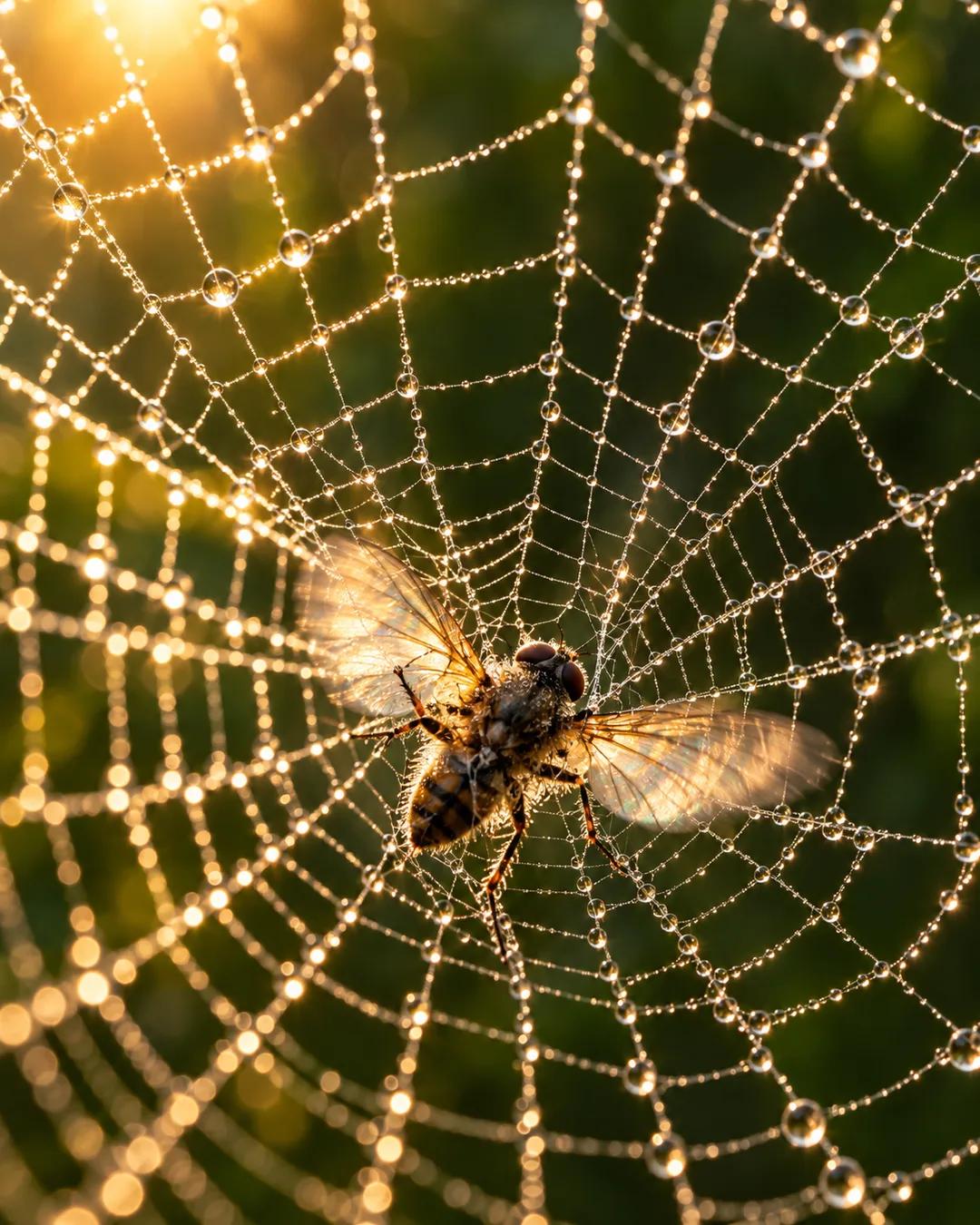
A web has the same job with a flying bug. A stiff structure like a brick wall stops a tennis ball instantly, and the ball bounces off. A web that slows the insect gradually gives its sticky threads time to hold on. The garden spider sample stretched to 70 percent of its length before it broke, which is exceptional for dragline silk.
Toughness compared
Toughness is the total energy a material absorbs before breaking, the area under its stress and strain curve. Kevlar reaches up to 50 megajoules per cubic meter, and experimental ultra-high-strength steel about 170. The garden spider sample came in around 205, and the silk of the Darwin's bark spider can peak at 520, roughly three times the strongest steel and 10 times Kevlar. Kevlar has very high tensile strength but is stiff, so its curve rises sharply and fails before it can stretch far.
Why does Kevlar break before it stretches?
Kevlar is made of rigid polymer chains that lie parallel and are held together by hydrogen bonds between neighboring chains. That arrangement makes the fiber very strong along its length but leaves it little room to extend, so it fails after stretching only a few percent. Its stress and strain curve therefore climbs steeply and ends early. Kevlar was invented by Stephanie Kwolek at DuPont in 1965.
How do climbing ropes absorb a fall?
Dynamic climbing ropes are made of nylon, which stretches under load. The stretch lengthens the distance over which the climber is stopped, which lowers the peak force on the body and on the anchors. Static ropes, used for rappelling and hauling gear, stretch very little and are not used when a fall is possible. The UIAA and CEN rope standards cap the peak force a single rope may transmit in the standard drop test at 12 kilonewtons.
Why doesn't a web fling insects back out?
Silk is viscoelastic, meaning part of the energy it absorbs turns into heat instead of springing back. A web that returned all of that energy would act like a trampoline and bounce the insect away. A web is also mostly empty space, so air passes through it and a gust does not load it like a solid sheet. Orb webs are often under 1 percent silk by volume of the space they span.
More from Veritasium