Korva is a scroll of the internet’s best ideas.
The Moon becomes a ring

The breakup
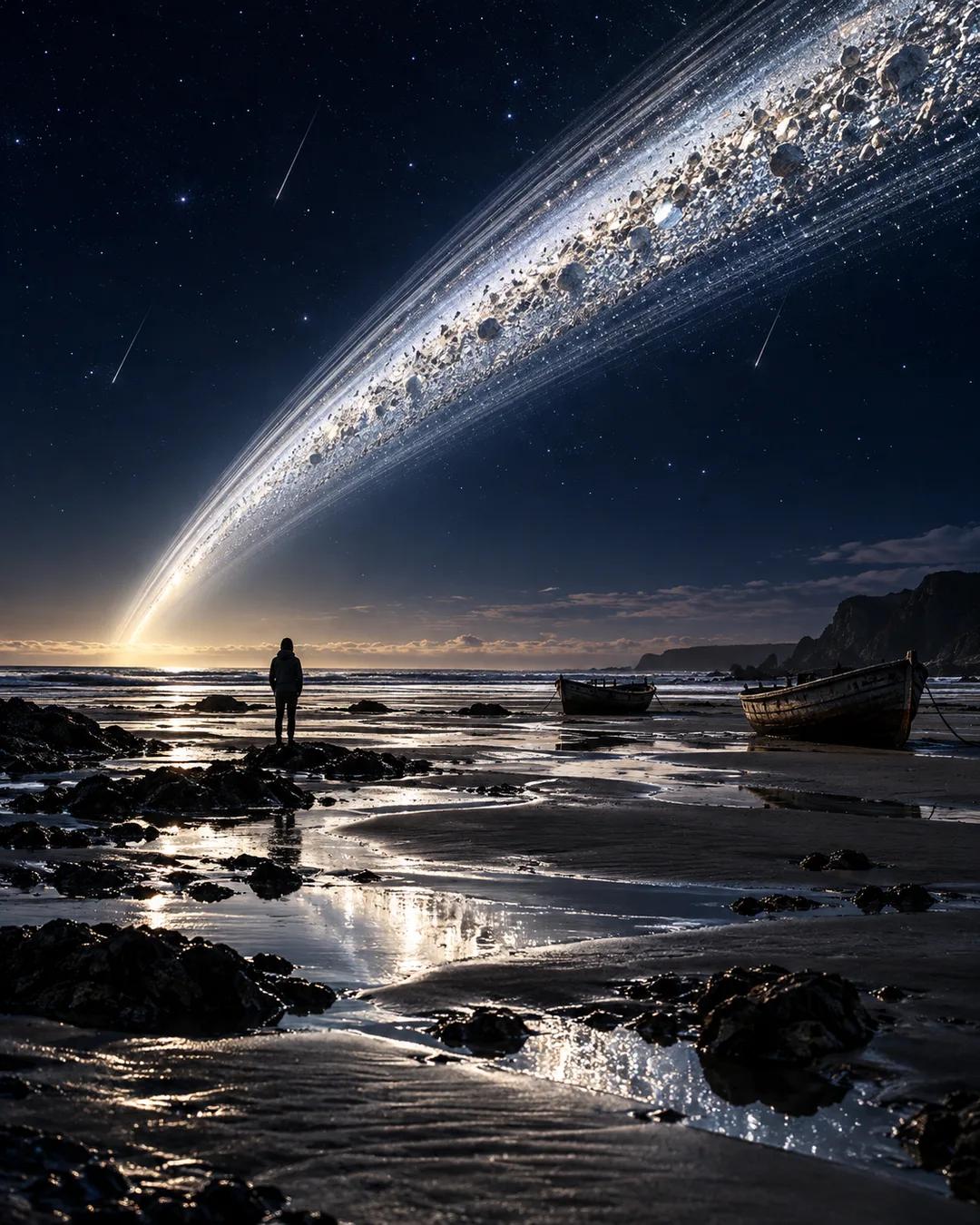
Material on the lunar surface starts falling toward Earth, and by the time the Moon crosses 10,000 kilometers from the planet, the whole thing has disintegrated into rubble, smeared into a massive ring system around Earth.
A sky of rings
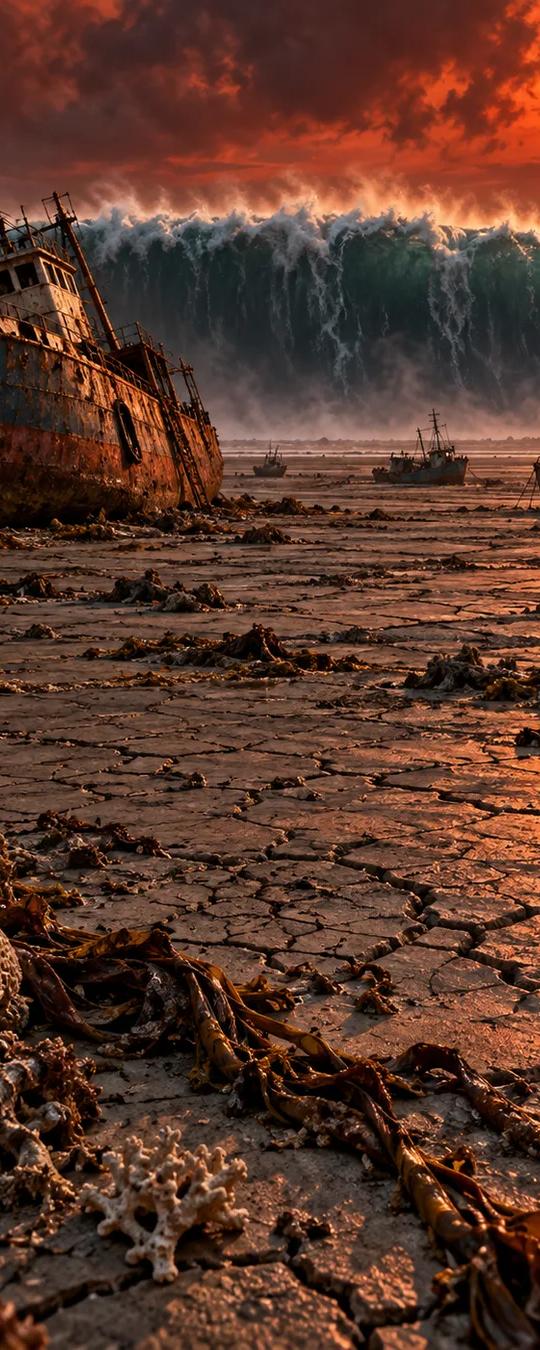
With the Moon gone, the tides end and the oceans flow off the land one last time. Survivors see tremendous arches spanning the sky, glimmering in the sunlight and lighting the night more brilliantly than any full moon ever could, while meteor showers of moon dust fill the sky.
What follows
What follows is hard to predict. If enough moon dust rains down, friction heats the atmosphere, possibly boiling the oceans. If not, the enormous shadows cast by the rings, together with all the volcanic and meteoric aerosols, block even more sunlight, and a runaway cooling could begin that freezes much of Earth's surface solid.
At some point people emerge again from submarines, bunkers, and mountaintops, and try to rebuild civilization under beautiful rings in the sky.
Why does a moon tear apart up close?
Gravity pulls harder on the side of a moon nearer the planet than on the far side, so the moon is stretched. Far away, the moon's own gravity holds it together against that stretch. Closer in, the stretch grows faster than the moon's self-gravity can resist, and loose material peels off. How close this happens depends on the moon's density and strength, since solid rock resists stretching better than a loose pile of rubble. The French astronomer Edouard Roche calculated the limit in the 1840s.
Has a moon ever turned into a ring?
Some planetary scientists propose that Saturn's rings formed from a moon or comet that strayed too close to the planet. Mars's moon Phobos may be a future example, because it is spiraling inward and tidal stress is already cracking its surface. Researchers at the University of California, Berkeley estimated in 2015 that it will break apart and form a ring within a few tens of millions of years.
Why would the rings be so flat?
Ring particles collide constantly, and each collision damps the motion that carries a particle above or below the ring's plane. Over time the debris settles into a thin disk. Saturn's rings span about 280,000 kilometers across, yet measurements from NASA's Cassini mission show they are often only about ten meters thick.
How was the real Moon made?
The leading explanation is the giant impact hypothesis. About 4.5 billion years ago, a Mars-sized body that scientists call Theia struck the young Earth. The collision threw molten rock and vapor into orbit around the planet, and that debris clumped together into the Moon. Moon rocks returned by the Apollo astronauts have oxygen isotope ratios nearly identical to Earth's, which fits this origin.
More from Kurzgesagt – In a Nutshell