Korva is a scroll of the internet’s best ideas.
Value follows what can't be pasted

Living analog
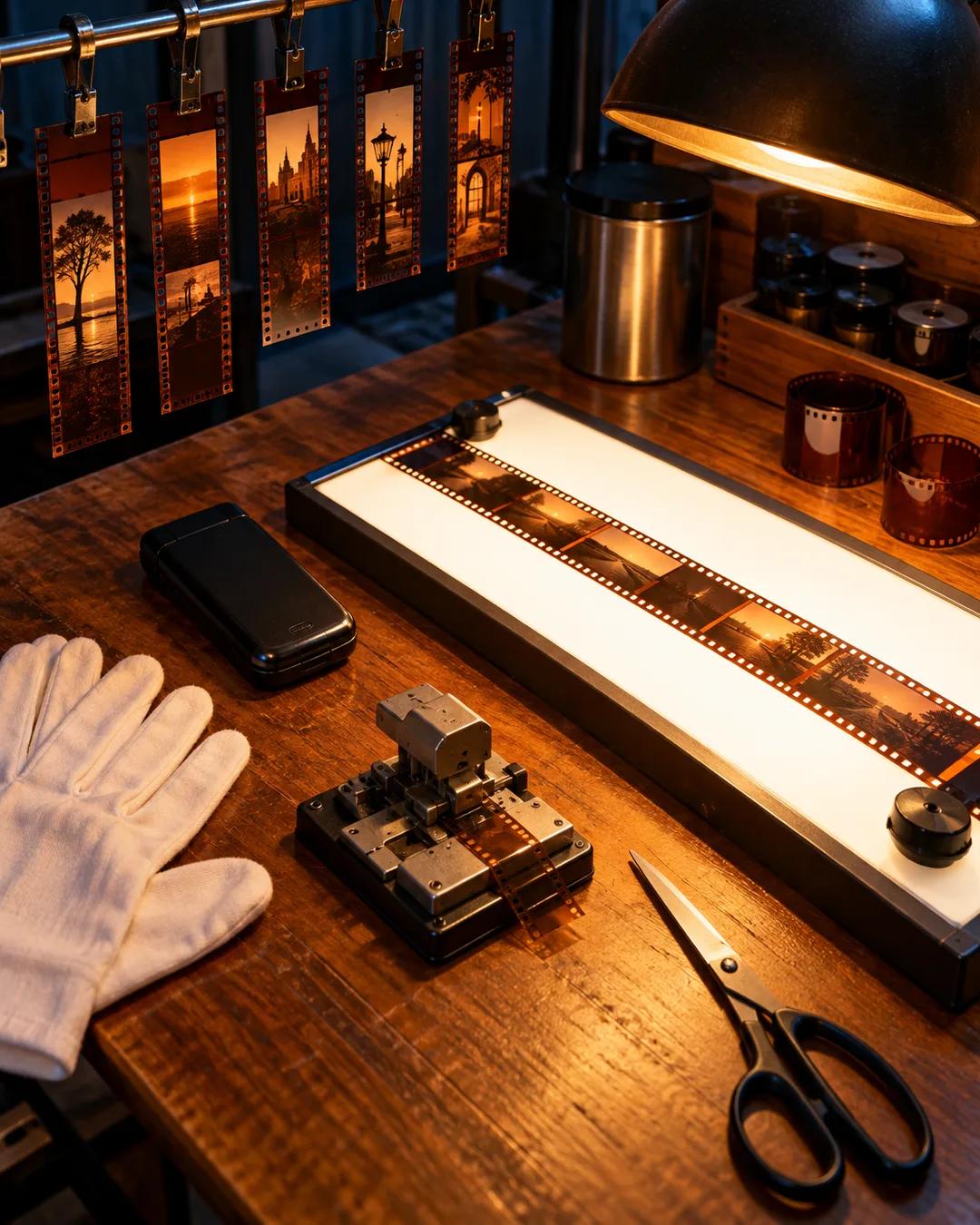
Christopher Nolan builds that principle into how he works. He has no email account or smartphone, only a flip phone, and anyone who wants to meet him goes through his assistant to set a time and a physical place. He prefers the grain and texture of celluloid to the flatness of digital, location shooting to sets, and physical sets to computer-generated backdrops.
The same reasoning accounts for the appeal of boutique hotels and Etsy.
Cutting film by hand
The Prestige in 2006 was the first film where the studio expected him to digitize the negative and edit electronically. His team shoots on film, edits electronically, then takes the frame numbers and cuts the film by hand. They have never converted to the workflow most of the industry uses, and The Prestige is where they separated from the rest of the industry.
How do editors cut film by hand after editing digitally?
Film negative has edge numbers printed along its border by the manufacturer. A digital edit produces a cut list that identifies, by those numbers, which frames belong in which order. A negative cutter then follows the list and splices the original film together by hand. The cut list is the link between the digital edit and the physical negative.
Why does film have grain?
Photographic film records an image in tiny light-sensitive silver halide crystals. In color film, dye clouds form around those crystals during development. The crystals are scattered randomly, so each frame carries a slightly different pattern. Faster, more light-sensitive film uses larger crystals, which produces more visible grain.
Why do original objects carry extra value?
Philosopher Walter Benjamin argued in his 1935 essay The Work of Art in the Age of Mechanical Reproduction that an original has an aura a copy lacks. Its aura comes from its presence in a particular time and place. Reproduction makes copies cheap, and the original stands apart because it cannot be duplicated. Benjamin wrote the essay while photography and film were reshaping how art was produced.
More from Founders