Korva is a scroll of the internet’s best ideas.
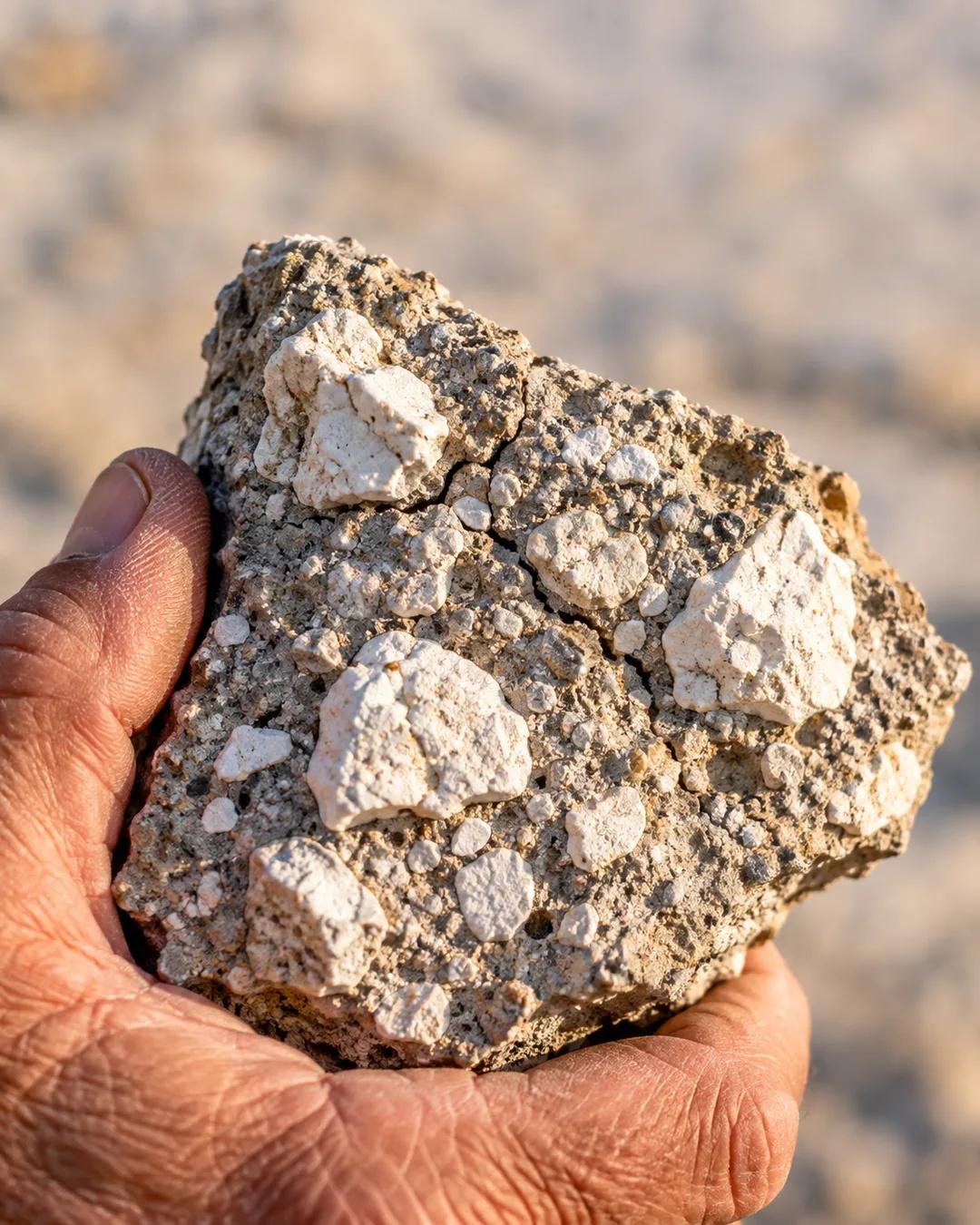
White chunks that heal cracks

The lumps nobody understood
For decades, the bright white lumps were treated as a defect. Admir Masic, a material scientist at MIT, asked why the Romans would be so consistently careless with a material they worked so hard to make, and decided to treat the lumps as a clue.
His team imaged 2,000-year-old concrete from an archaeological site in Italy down to the nanoscale. The structure of the lumps showed they had formed at extremely high temperatures. That pointed to hot mixing: quicklime, an unslaked form of calcium oxide, went straight into the mix with the volcanic ash and rock, and the water came last. The reaction happened inside the concrete itself, reaching 200 to 250 degrees Celsius, and it left behind small brittle pockets of unreacted, highly reactive lime.
How cracks repair themselves
When a crack opens, rain seeps in and finds those pockets. The water dissolves the lime into a calcium-rich solution that floods the crack and recrystallizes as calcium carbonate, stitching it shut. The same solution reacts with the surrounding volcanic ash and forms new stable minerals that reinforce the repair.
MIT tested it with two batches of concrete, one modern and one made with the Roman hot-mixing recipe. The researchers cracked both and ran water over them. The cracks in the modern concrete stayed open. The cracks in the Roman-style concrete had completely healed within 2 weeks, with no human help.
Why does quicklime get so hot in water?
Quicklime is calcium oxide, and when it meets water it turns into calcium hydroxide, known as slaked lime. That reaction is strongly exothermic, so it gives off heat as the new bonds form. Enough heat is released to boil the water that touches it, which is why builders handled quicklime with great care. Slaking lime for mortar and plaster was an old craft long before the Romans.
Why does volcanic ash make such good cement?
Volcanic ash contains reactive silica and alumina. When it meets calcium hydroxide and water, it forms calcium silicate and aluminate hydrates, the same kind of binding compounds that give modern cement its strength. Roman writers valued the ash from the area around Pozzuoli near Naples so highly that the word pozzolan still names this whole class of materials. Modern cement makers sometimes blend in fly ash from coal plants for the same chemical reaction.
How does dissolved lime turn back into stone?
Dissolved calcium hydroxide reacts with carbon dioxide from the air and from rainwater to form calcium carbonate. Calcium carbonate is the same compound as limestone, chalk, and marble. The reaction is also how ordinary lime mortar slowly hardens in old brick and stone buildings. In a crack, the new crystals grow outward from the walls until they meet.
More from Medieval Wisdom