Korva is a scroll of the internet’s best ideas.
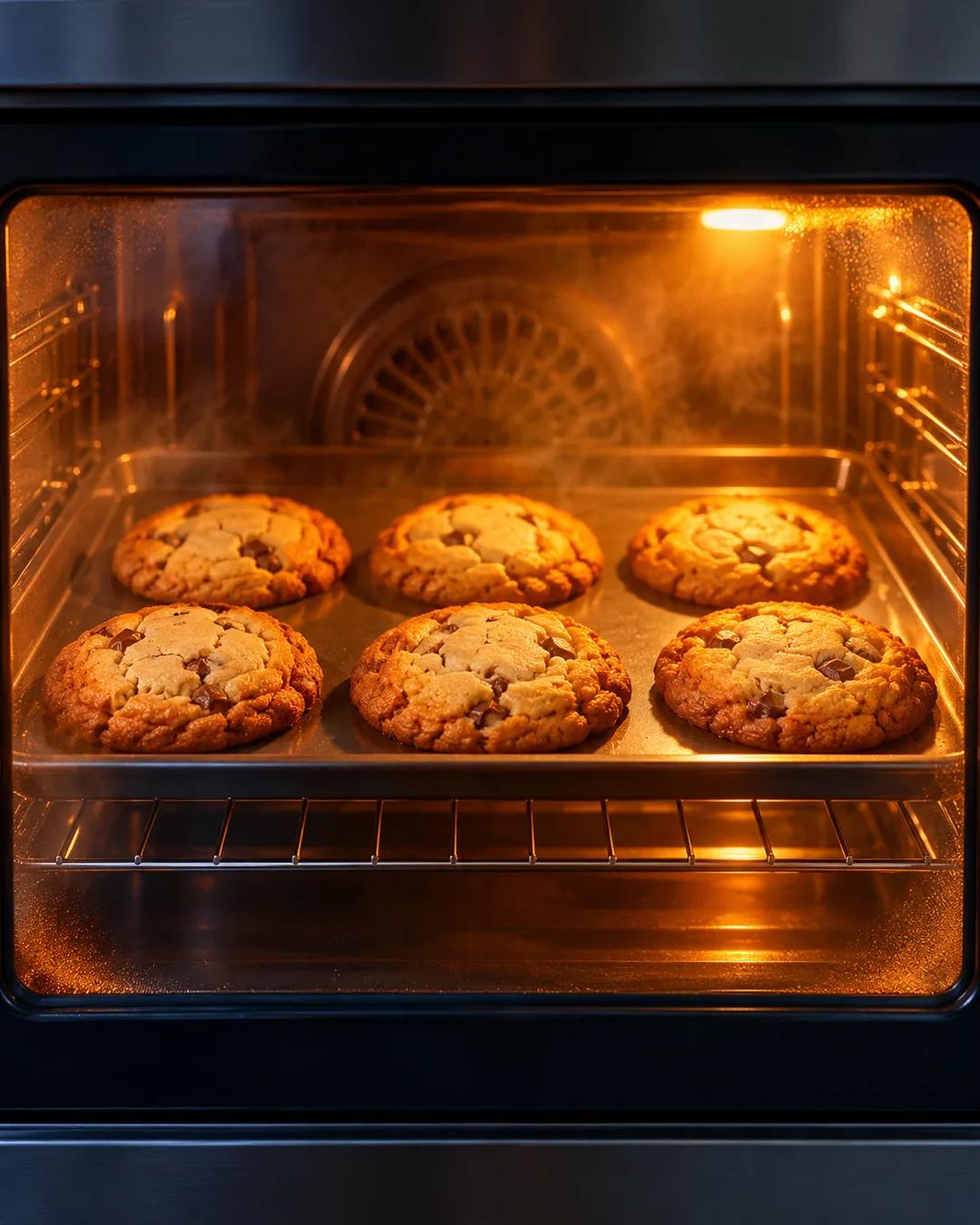
Your nose is the oven timer
The Maillard reaction
The Maillard reaction happens at 310 degrees Fahrenheit. Proteins and sugars break down and rearrange into ring-like structures that reflect light in a way that gives Thanksgiving turkey and hamburgers their rich brown color. The reaction also produces flavor and aroma compounds, which react with each other to form even more complex tastes and smells.
Where caramelization starts
Caramelization is the last reaction to take place inside a cookie. Sugar molecules break down under high heat and form the sweet, nutty, and slightly bitter flavor compounds that define caramel. It starts at 356 degrees, so a recipe that calls for a 350 degree oven never reaches it.
Oven temperature
An oven set to 310 degrees gives a barely browned cookie. Turning the heat up gives it a nice tan, and caramelization continues up to 390 degrees.
Why does browning make food taste so good?
The Maillard reaction does not produce a single flavor. It produces hundreds of different compounds, including ones that smell nutty, roasted, meaty, and toasty. Many of those compounds are volatile, which means they drift into the air and reach the nose as well as the tongue. That is why bread crust, roasted coffee, and seared steak all smell stronger than their unbrowned versions.
Why do boiled foods never brown?
Water at normal air pressure cannot rise above 212 degrees Fahrenheit while it is boiling, and browning reactions need far higher temperatures than that. Food surrounded by liquid stays at that ceiling until the water is gone. Roasting and baking work because dry oven air pulls moisture off the surface, which lets the surface climb past the boiling point. This is why a steamy oven delays crust color on bread.
How is caramelization different from the Maillard reaction?
Caramelization needs only sugar, while the Maillard reaction needs sugar together with amino acids from protein. Caramelization begins when heat breaks sugar molecules apart and the fragments recombine into new compounds. Those compounds range from sweet and buttery to bitter and dark. The temperatures involved are higher, which is why caramelization comes later in the baking process.
How does the nose pick up aromas?
Aroma molecules dissolve in the mucus lining the top of the nasal cavity, where they bind to receptor proteins on olfactory neurons. Humans have roughly 400 types of these receptors, and each aroma activates a particular combination of them. The brain reads that pattern as a specific smell. Linda Buck and Richard Axel shared the 2004 Nobel Prize in Physiology or Medicine for discovering this receptor family.