A Blind Test Is Mossbridge's Case That Spellers Write Their Own Messages
The helper leaves the room during a video or story, then asks the speller what it made them think about.
 The Why Files · The Basement: Julia Mossbridge | The Future Is Sending Us Information, and Science Can Prove It
Neuroscientist Julia Mossbridge says the way to test who is really spelling is to make sure the helper cannot possibly know the answer in advance.
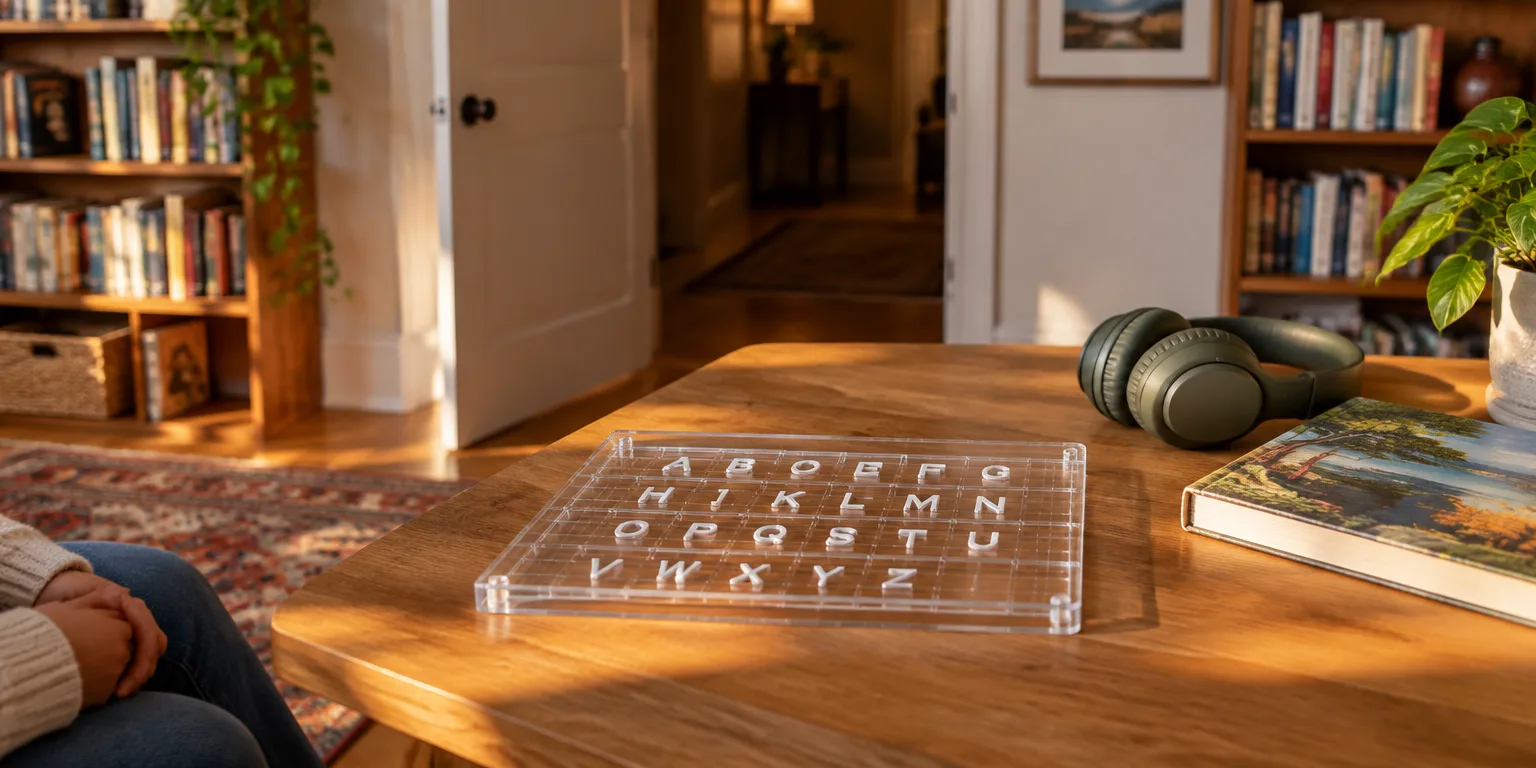
Letterboard spelling involves a nonspeaking autistic person pointing to letters on a board or keyboard held in the air by a helper, called a communication partner. Skeptics worry the helper may unconsciously move the board and steer the message, a concern Mossbridge calls the authorship question.
In the test she ran with co-investigator Jeff Tarant, software sends the partner to another room. While the partner is gone, the nonspeaking participant stays with a parent and watches a video or hears a story. The swap is recorded to check that no one shares what was seen or heard.
Then the partner returns, holds and moves the board as usual, and asks what Mossbridge describes as an open question: "What did that make you think about?" Because the partner never learned the video or story, Mossbridge argues, even unconscious nudges cannot push the speller toward a topic the partner does not know.
Researchers then use software to measure how closely the spelled response matches the hidden topic. Mossbridge says that, as a group, the participants described material their partners had not seen, which would mean they remembered and communicated it themselves.
She says that, as far as she and her team know, this is the first authorship evidence using methods more rigorous than current assessments, which she calls pretty lame. She also cautions that surprising remarks alone are only hints, not proof, and she says this blind test addresses authorship, not telepathy.
Questions people ask
Why does someone need to hold the board at all?
Nobody knows for sure. Mossbridge says possibilities include trouble focusing the eyes on a still object, needing the board to move slightly to see it, or needing another person present to feel settled enough to act. She says some spellers do graduate to a keyboard resting on a table and type independently, often after years of supported practice.
Does passing the test prove that everything spelled is true?
No. The test is designed to show that the nonspeaking person can supply information the partner does not have. It does not show that every spelled message is accurate, free of influence, or independent. Mossbridge cautions that surprising spelled remarks are only hints, not proof.
Does this prove telepathy?
No, and Mossbridge draws that line explicitly. The authorship test asks whether the speller, rather than the helper, produced the message. A separate set of experiments in the same project tested telepathy, or apparent awareness of things no one present knew. One result does not prove the other.