A Puff of Oxygen Saved the Mirrors That Print Computer Chips
The collector mirror needed cleaning every 10 hours, until engineers saw it looked cleaner whenever the chamber was opened and tested a small oxygen dose.
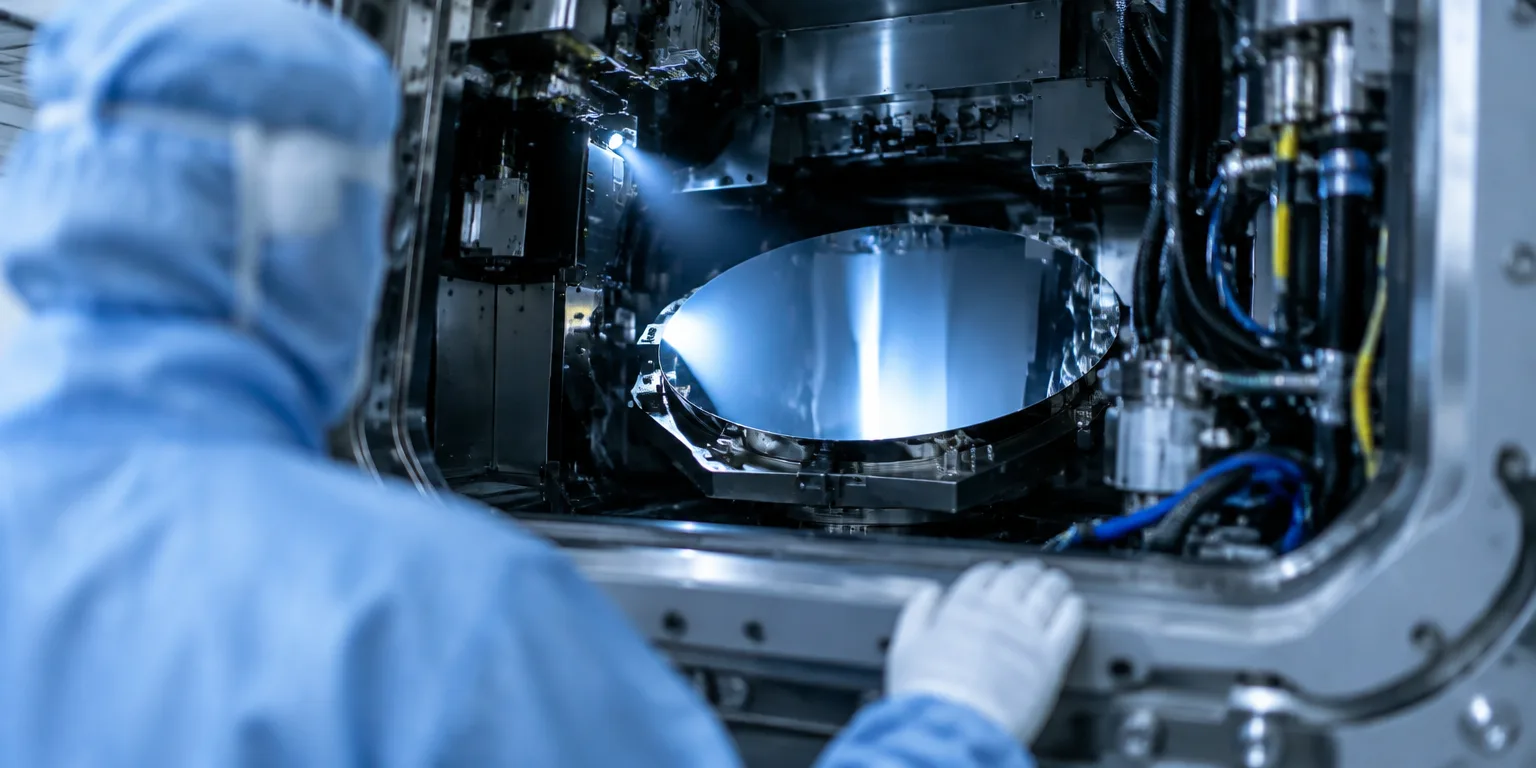
 Veritasium · The World's Most Important Machine
Every time the engineers opened the test machine, they saw something backward. The collector mirror inside looked cleaner than when they had closed it up.
That mirror had been their misery. Despite protection from hydrogen gas, intense light and hydrogen ions wore down its special top coating, so they had to stop and clean it every 10 hours. Martin van den Brink, EUV's greatest champion who would become ASML's chief technology officer, asked for progress updates every day. A colleague calls him the Steve Jobs of lithography.
The mirror problem threatened to keep the machine that prints the world's most advanced chips out of factories. The fix was a small, controlled dose of oxygen added to the vacuum, an idea an engineer proposed after noticing the mirror looked cleaner whenever the chamber was opened.
The Dutch company ASML makes the machine, which works by blasting tiny droplets of molten tin with a laser 50,000 times a second. Each hit creates superhot plasma that gives off extreme ultraviolet light, light with a much shorter wavelength than visible light that can draw the tiniest chip features. Lithography is the step that uses that light to print circuits.
Just 30 centimeters from those plasma blasts sits the collector, a large, atomically smooth and very expensive mirror made by the German optics company Zeiss. A layer of tin only a nanometer thick landing on it would force it out of service, yet the machine must stay nearly spotless for a full year while vaporizing liters of tin.
Engineers had filled the vessel with thin hydrogen gas to slow and cool flying tin and pull residue off the mirror as a gas called stannane. The machine cleaned itself while it ran, but the coating still deteriorated. Stopping every 10 hours for cleaning slowed production.
Then one engineer noticed the mirror looked cleaner each time the chamber was opened, and opening the chamber lets oxygen in. He said, "Whenever we opened up the machine, oxygen comes in and our problem is solved."
He proposed adding just a little oxygen to the vacuum to keep the collector clean longer. The team began testing how much oxygen was needed, and with the right dose the collector stayed clean far longer.
With that fix, the system stayed in operation far longer between stops and at last made economic sense for factories. By 2016, buyers began ordering in large numbers, and as of late 2025, every top-tier processor depends on ASML's equipment.
Questions people ask
Why would oxygen help keep a mirror clean in a vacuum?
Oxygen helps maintain the mirror's oxide top layer that is damaged by intense light and ions, and it reacts with tin and carbon residues so hydrogen can carry them away as gas. In chip tools, trace oxygen is also used to limit carbon buildup on optics. The dose must be tiny, since too much gas would absorb the useful light.
Why does the machine use tin at all?
When turned into hot plasma, tin gives off a lot of light at 13.5 nanometers, exactly the wavelength the multilayer mirrors are tuned to reflect. An earlier choice, xenon, wasted most of its energy at wavelengths the mirrors could not use. Tin converts laser energy to usable light five to ten times more efficiently.
What does the collector mirror actually do?
It is the first and largest optic after the plasma, shaped to gather extreme ultraviolet light spraying in all directions and funnel it into the rest of the machine. From there the light passes through other mirrors, hits the patterned mask, then projection mirrors shrink the pattern onto the wafer. If the collector degrades, the whole system loses power.