A Text Message Sends Blood by Drone in Rwanda
Hospitals order by WhatsApp, and self-flying planes deliver by parachute and return to a wire catch.
 TED · How we're using drones to deliver blood and save lives | Keller Rinaudo
In Rwanda, a doctor's text message can bring blood to a hospital or health center in the network in about 20 or 30 minutes on average. Blood spoils quickly, needs special storage, and demand for each blood type is hard to predict, so Rwanda keeps more blood centralized and sends it only when needed.
The drone network behind that promise now carries about 20 percent of the national blood supply outside Kigali. It is run by Zipline, a delivery company co-founded by Keller Rinaudo, from a distribution center about 20 kilometers outside Kigali built with the Rwandan government in a couple of weeks on a former cornfield. The network serves about 12 hospitals, with more being added, and most place multiple orders every day.
When an emergency arrives, a doctor or nurse requests what is needed by WhatsApp. Staff take blood supplied by the national blood center, scan it so the Ministry of Health can follow where it goes, and load it into a Zip, a small battery powered airplane that flies itself.
A launcher sends the Zip to flight speed in roughly half a second. After it clears the launcher, it travels on its own, while an air traffic controller coordinates with Kigali International Airport.
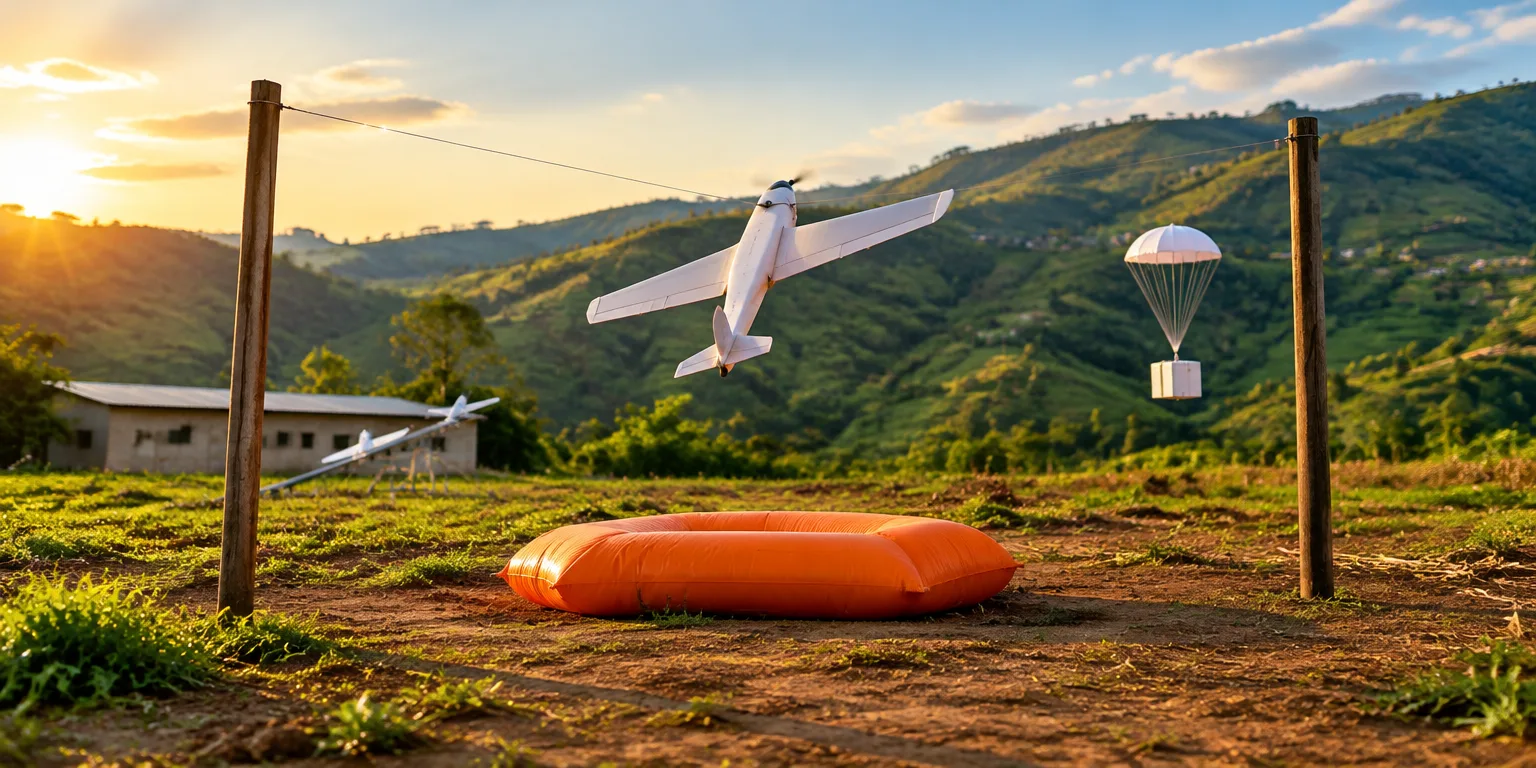
The Zip does not touch down at the hospital. It drops to around 30 feet and releases the package under a simple paper parachute, an approach Rinaudo summed up by saying simple things are best. Doctors receive a warning text a minute ahead telling them to step outside, and staff at the center can follow the flight even when the plane is 50 kilometers away.
The planes have no landing gear, and the operating sites have no runways. On return, a wire follows the incoming aircraft with centimeter level accuracy, catches it in the air, and brings it from a cruise near 100 kilometers an hour to a stop within half a second onto an actively inflated cushion.
Rinaudo joked, "This is basically a combination of an aircraft carrier and a bouncy castle."
Questions people ask
Does anyone steer the plane while it is flying?
No. Once it leaves the launcher, the Zip navigates on its own. People on the ground monitor its position and status, and air traffic staff coordinate with the regular airport so the drones share the sky safely.
Why use a parachute drop and a wire catch instead of landing?
Zipline's planes have no landing gear, and its operating sites have no runways. The parachute lets a hospital receive a package without a runway. The wire system brings the returning plane back to the distribution center.
How can a paper parachute be dependable enough for blood?
Rinaudo did not offer a technical explanation beyond saying that simple things are best. He said the paper parachute lets the package come down gently and reliably in the same place every time. Doctors are alerted a minute before arrival so they can meet the package outside.