Electric Thrusters Fly on Precisely Made High Voltage
A separate power box makes 300 to 800 volts for a Hall thruster and 1,800 volts for an ion thruster, plus separate feeds for magnets, keeper and igniter, and neutralizer.
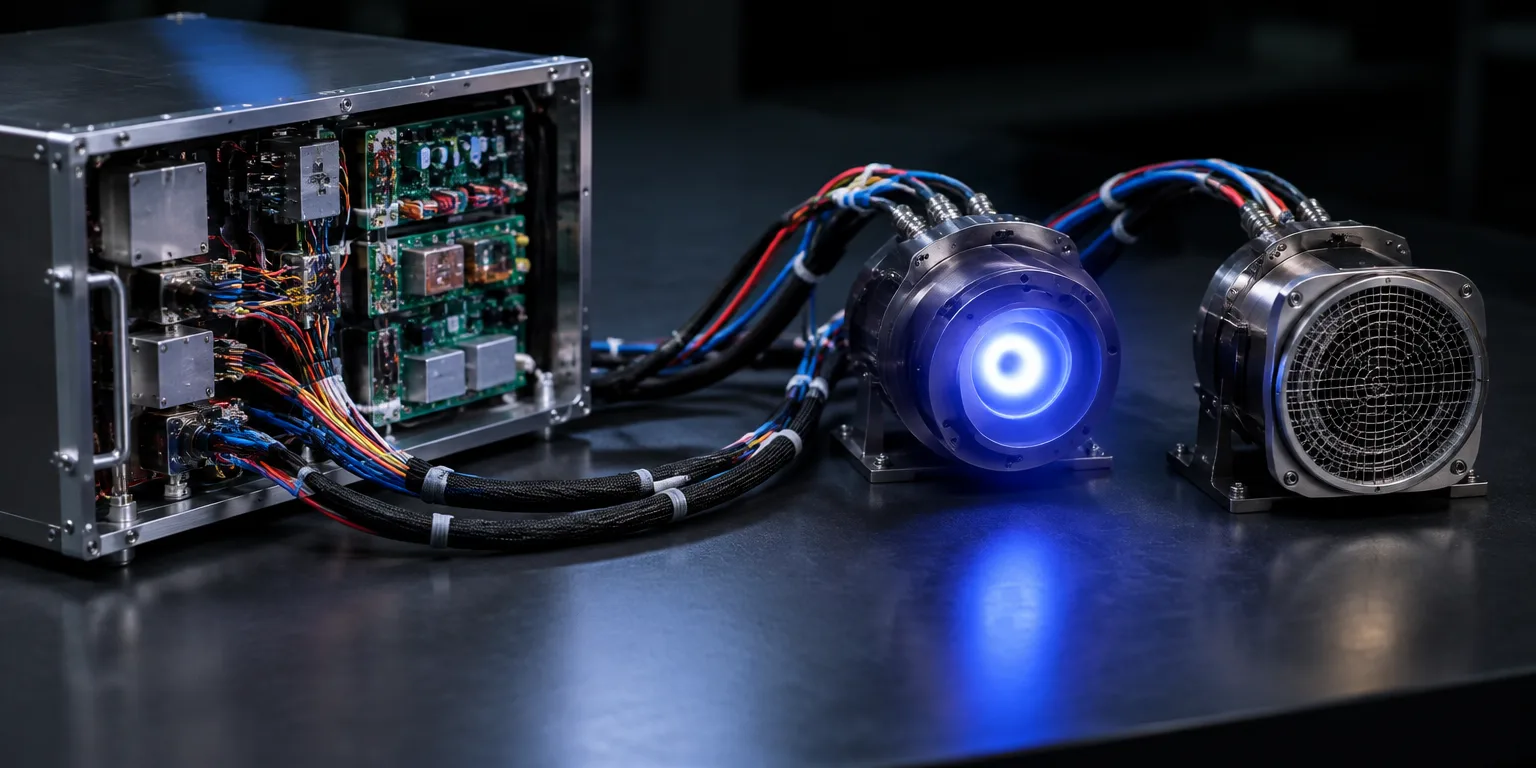
 hdl.handle.net · Future NASA Power Technologies for Space and Aero Propulsion Applications
A spacecraft using electric propulsion does not move by burning fuel. It moves by using electric fields to accelerate exhaust backward.
Those fields are made onboard by a separate box called the power-processing unit, which produces the voltages each thruster needs.
In a Hall-effect thruster, electrons held by magnets help create the field that does the pushing. For that discharge, the power unit supplies 300 to 800 volts.
In an ion thruster, a set of charged grids creates the field. For that main beam, the power unit supplies 1,800 volts.
The main supply is only part of the job. The unit also has separate supplies for the inner and outer magnets, the keeper and igniter, the accelerator, the beam, and the neutralizer.
Questions people ask
Why does the voltage matter so much?
Voltage sets how hard charged particles are pulled. Higher voltage generally means faster exhaust, so the spacecraft gets more motion from less propellant, which matters on long trips where carrying extra fuel is costly.
What is the difference between a Hall thruster and an ion thruster?
Both use electric fields to accelerate exhaust, but build the field differently. A Hall thruster uses magnets and trapped electrons to make its field, while an ion thruster uses charged grids. The different designs lead to different voltage needs.
Why not use one power supply for everything?
The source does not explain why one supply could not do the job. It only lists separate feeds for magnets, the keeper and igniter, and the neutralizer, among others.