NASA Designed Orion for 11 Kilowatts on Lightweight High-Voltage Power
Four sun-tracking solar wings are rated to supply the capsule, while higher voltage allows thinner wiring and direct battery connections.
 hdl.handle.net · Future NASA Power Technologies for Space and Aero Propulsion Applications
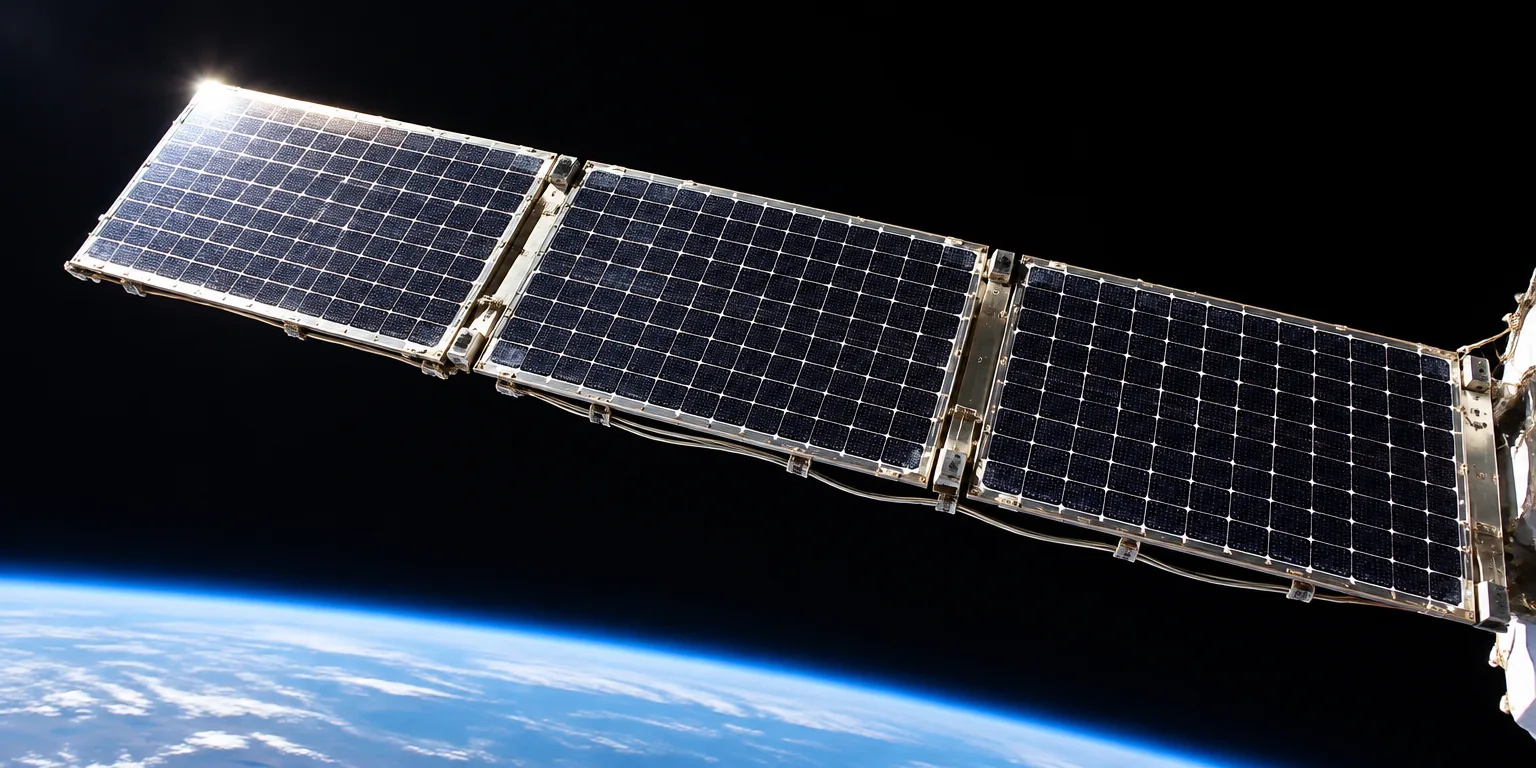
NASA's Orion crew capsule is designed so its four solar wings are rated at 11.1 kilowatts in total.
Each wing has three folding panels covered with triple-junction solar cells, layered cells chosen for high conversion efficiency. The wings tilt on two axes to follow the sun, supplying onboard loads and recharging batteries.
To save weight, electricity travels through four channels at 120 volts direct current, allowing thinner and lighter wiring than lower voltage lines would need.
For periods without sunlight, Orion carries four lithium-ion batteries, each rated at about 30 amp-hours, a measure of charge capacity. The lithium-ion chemistry was chosen for high energy density, and the high voltage lets the batteries connect directly to the power system.
For protection, current-limiting switches made with silicon carbide, a semiconductor material, guard against electrical faults.
Questions people ask
How big is Orion compared with earlier capsules?
NASA lists Orion at 16.5 feet in diameter with a crew of four. Its design volume is about 2.5 times that of the Apollo capsule.
What rocket was meant to launch Orion?
The Space Launch System was designed to launch Orion. Its initial configuration was rated to lift 70 metric tons, with a later configuration rated for 130 metric tons, to carry Orion, cargo, equipment and science experiments to Earth orbit and beyond.
What are triple-junction solar cells?
They stack three light-absorbing layers, with each layer tuned to a different part of sunlight. That captures more energy from the same area than a single-layer cell, which matters in space where panel area and weight are limited.