Ethiopia's Stolen Obelisk Came Home In Three Pieces
After years of petitions, engineers cut the looted tower apart, flew it from Rome, and strengthened every bridge to haul it home.
 The Why Files · The Basement: Cassie Coppersmith | Ancient Technology was More Advanced Than We Think
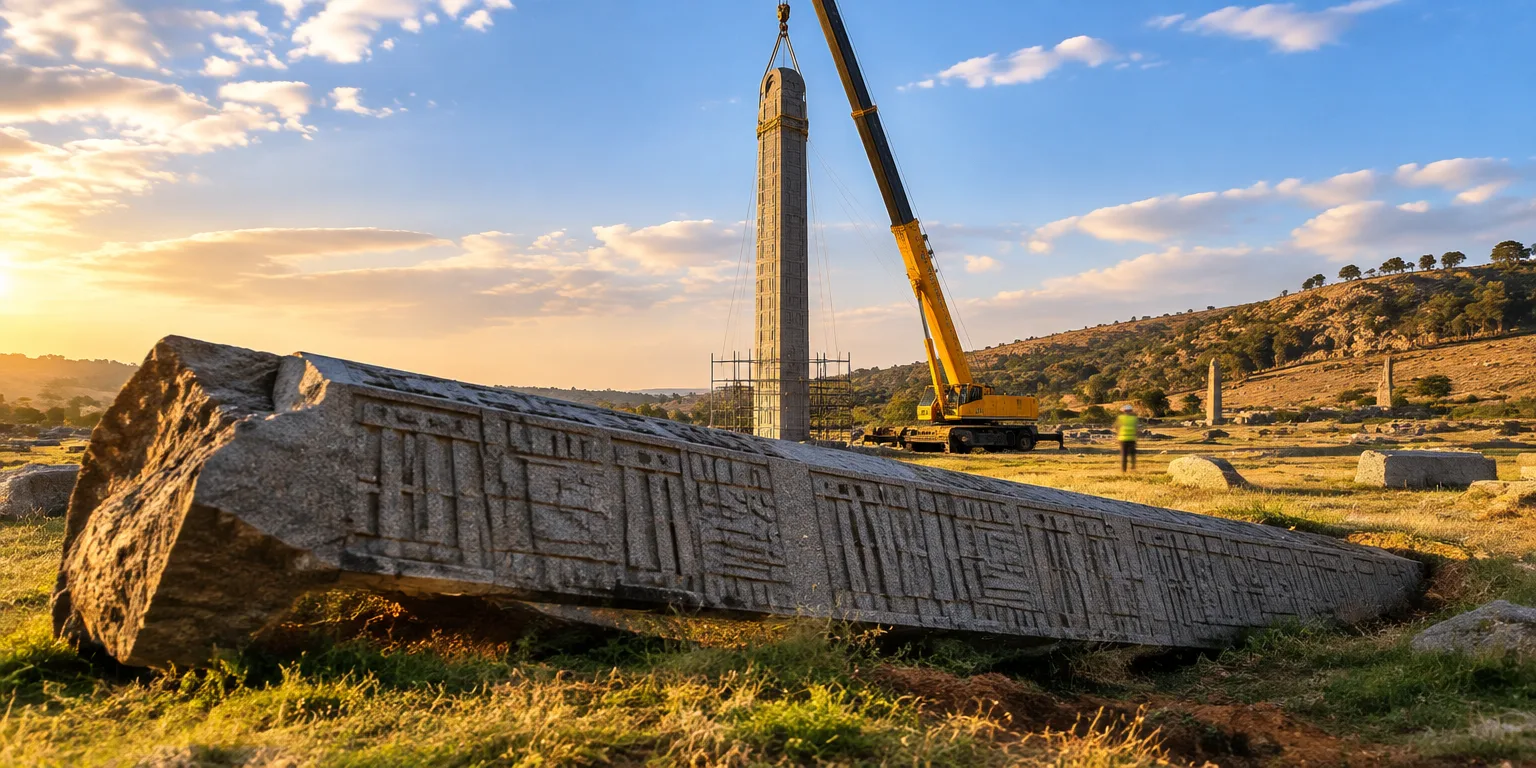
In Axum, Ethiopia, one massive carved tower lies fallen where it collapsed, and another stands upright behind it with a crane braced against its side.
Cassie Coppersmith, who visits ancient sites to film them, calls the remains at Axum extremely megalithic.
The fallen giant is estimated at about 500 tons. Accounts Coppersmith heard put its quarry six or eight miles away. It was stood upright, and then it fell.
Local legends say the fallen stone was transported using mammoths.
Its neighbor has an even stranger modern history. It was taken to Italy during the Italian occupation of Ethiopia in 1937, stood up in Rome, and stayed there while Ethiopia petitioned for years to get it back.
Permission finally came, but permission was only the start. To move a single carved shaft across continents, engineers had to cut the obelisk into three pieces.
Crews lengthened a runway so a large Eastern European cargo plane could lift the sections. The plane flew them from Italy to Ethiopia and set down on the extended strip.
Then came the slow part. All of the bridges on the road back to Axum were reinforced so trucks carrying the three pieces could cross.
Mile by mile, the convoy hauled the cut tower back to the ancient field. There, engineers joined the sections and stood the tower upright again, where, as Coppersmith puts it, “the ancients had no problem putting it up.”
What draws attention is the carving itself. There are no animals and no people, only stark geometry.
The carving looks functional and almost like science fiction.
Coppersmith calls Axum the very top of her travel list. She and her brother had been ready to buy plane tickets in June but backed off when the security situation worsened.
Questions people ask
Was the 500-ton fallen stone the same one that went to Rome?
The tower that went to Rome is the Obelisk of Axum, about 78 feet tall and about 160 tons. The much larger fallen stone nearby is the Great Stele, about 108 feet long and estimated at more than 500 tons, and it was never successfully kept upright.
When was the obelisk taken, and when did it come back?
Italian troops took the Obelisk of Axum in 1937 during the occupation of Ethiopia and erected it in Rome. After long negotiations, Italy agreed to return it, and the pieces were flown back in 2005 and re-erected in Axum in 2008.
How could ancient builders have moved a 500-ton stone?
No one knows for certain. Researchers generally propose large work crews using rollers, sledges, levers, ropes, and earthen ramps, plus a quarry road. Moving 500 tons over several miles and then raising it upright would still have required remarkable organization and labor.