Fort Worth Grows Outward Because Homes Cost Less Farther Out
Annexation adds housing and tax revenue, while land farther out stays even cheaper.
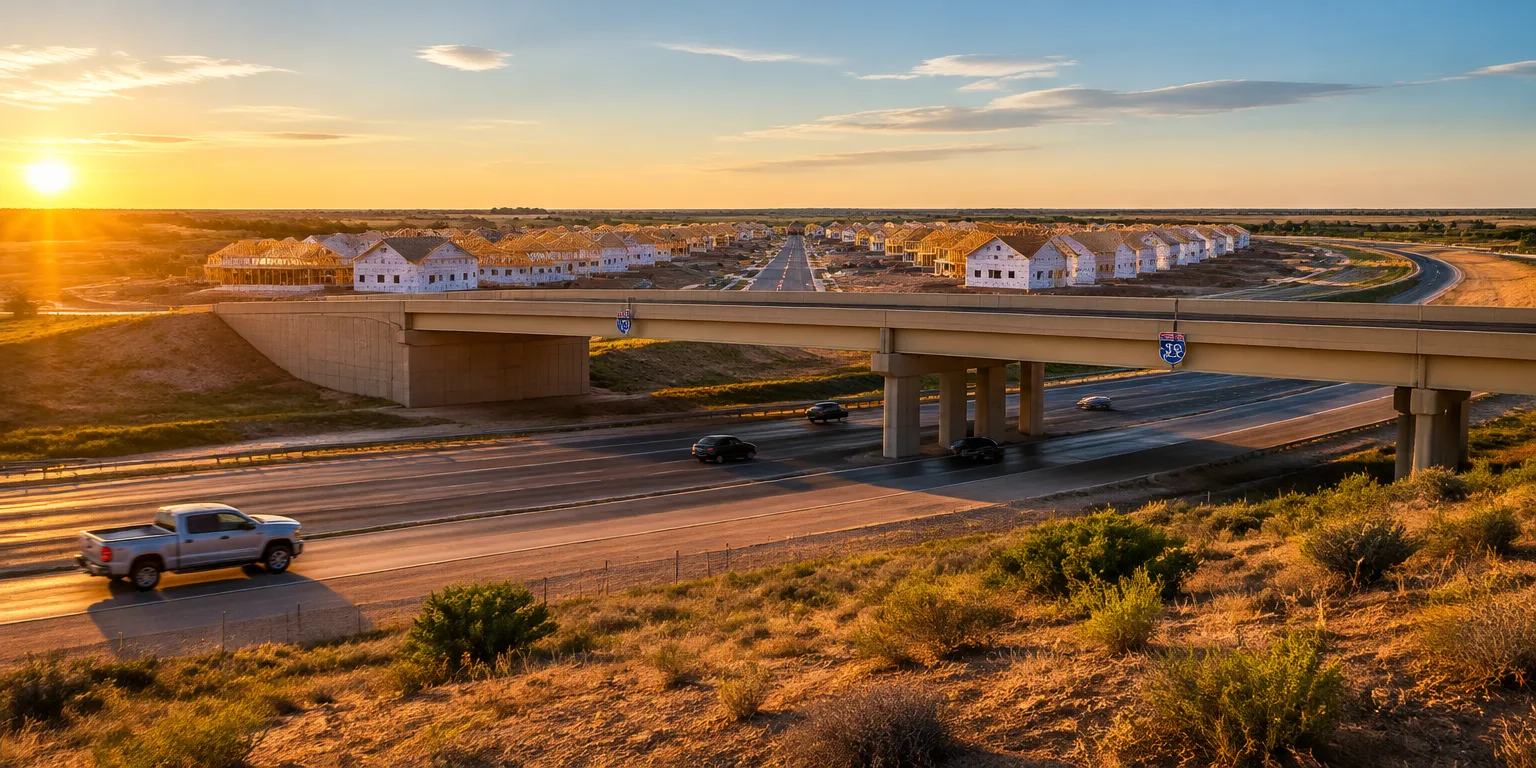
 Wendover Productions · Why Texas Wins
The highway that was supposed to circle Fort Worth now sits inside it. Interstate 820 was conceived in the midcentury and built out in the 1980s as a beltway, a loop road meant to surround the city and link its suburbs. Fort Worth has since spilled in almost every direction beyond that loop.
Long in the shadow of Dallas, Fort Worth is now drawing wider attention. Dallas presents as corporate and big-city with a Texas accent, while Fort Worth leans on its old cattle district and a more traditional Texas identity. It has recently moved ahead of Austin by population and ranks among the fastest growing cities in the country.
Land is what drives the growth, since Fort Worth can add residents so quickly because it adds territory so quickly, taking in edge areas and approving new subdivisions to meet demand for housing. The tool is annexation, the legal process by which a city expands its borders to absorb nearby land.
On that added land, builders put up single-family subdivisions such as Terrabella, now under construction about 20 miles from downtown. There buyers can get a five-bedroom home for less than $400,000, in what is planned to be a thoroughly generic suburban development, but with a Fort Worth address.
For the city, the trade is deliberate. Fort Worth must extend utilities and city services such as police and fire coverage to the new area, but in return it gains housing stock and added revenue through property tax.
For buyers, the payoff is comparative. Dallas-area homes remain modestly priced against other big metros, Fort Worth homes come in lower still, and places in the counties beyond come in lower again.
That ladder is pulling jobs outward. Companies and employers including AT&T, Fifth Third Bank, and Neiman Marcus, along with the Dallas Stars and Mavericks, have left downtown Dallas or plan to leave it for cheaper ground to the north. Counties surrounding the metro area have seen population gains above 30 percent across ten years, drawn by new houses, cheap square footage, and smaller suburban downtowns near a big city.
Questions people ask
What does it mean for a city to annex land?
Annexation is when a city legally expands its boundaries to take in neighboring land. Once annexed, residents and businesses get city services like water, police, and fire protection, and they pay city property taxes and vote in city elections.
Why is property tax so important to Texas cities?
Texas cities rely heavily on property taxes to pay for services. That gives fast-growing cities a strong incentive to add new homes and businesses, because each one widens the tax base even if home prices stay relatively low.
Why build a beltway if a city is just going to grow past it?
A beltway is a highway loop built to circle a city and move traffic around it. When growth passes the loop, as with I-820, the old bypass becomes an inner-city road, which is a visible sign that the city has expanded outward.