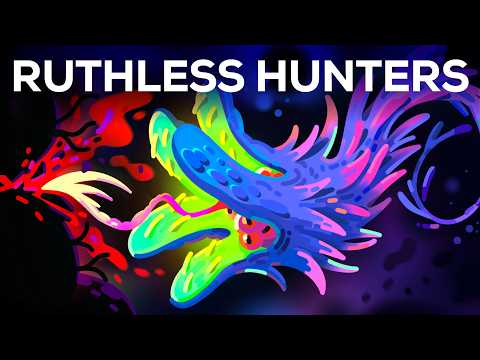
What’s It Like to Be Killed by Nature’s Most Brutal Predator
Watch on YouTube- By fusing several semi-independent units into one multicompartmental cell, Polykrikos achieves shark-like hunting because multiple flagella and integrated organelles let it circle, fire coordinated multi-stage harpoons, and reel prey in as a single, highly coordinated predator.@science· Biology
By fusing several semi-independent units into one multicompartmental cell, Polykrikos achieves shark-like hunting because multiple flagella and integrated organelles let it circle, fire coordinated multi-stage harpoons, and reel prey in as a single, highly coordinated predator.
- Polykrikos can check toxic algal blooms because its staged nematocyst-taeniocyst harpoon first breaches a prey's armour, then anchors and reels the cell in for digestion, and those attacks attract more Polykrikos so mass predation can reduce Alexandrium blooms.@science· Biology
Polykrikos can check toxic algal blooms because its staged nematocyst-taeniocyst harpoon first breaches a prey's armour, then anchors and reels the cell in for digestion, and those attacks attract more Polykrikos so mass predation can reduce Alexandrium blooms.
- Cyanobacteria can survive attacks by sacrificing parts of themselves because individual filaments sever and shed stiffened end sections when grabbed, leaving attackers with inert material while the main filament escapes and ramps up slime to seal holes.@science· Biology
Cyanobacteria can survive attacks by sacrificing parts of themselves because individual filaments sever and shed stiffened end sections when grabbed, leaving attackers with inert material while the main filament escapes and ramps up slime to seal holes.
- Micropredators breach slime-encased cyanobacterial fortresses by finding tiny weaknesses, forcing entry, then ejecting vesicles of ultra-aggressive digestive enzymes that liquefy filaments so they can be sucked in through mouth-rings.@science· Biology
Micropredators breach slime-encased cyanobacterial fortresses by finding tiny weaknesses, forcing entry, then ejecting vesicles of ultra-aggressive digestive enzymes that liquefy filaments so they can be sucked in through mouth-rings.
- Individual dying prey release chemical cues that attract other coleps, so a small initial bite quickly recruits dozens and turns a lone attack into a swarming onslaught that can overwhelm much larger victims.@science· Biology
Individual dying prey release chemical cues that attract other coleps, so a small initial bite quickly recruits dozens and turns a lone attack into a swarming onslaught that can overwhelm much larger victims.
- A tiny colep can kill much larger animals because its mineral armour lets it ram and its rotating, drill-like cilia bore into flesh while toxicysts inject a cocktail that dissolves cell membranes, which opens gaping wounds the predator then exploits.@science· Biology
A tiny colep can kill much larger animals because its mineral armour lets it ram and its rotating, drill-like cilia bore into flesh while toxicysts inject a cocktail that dissolves cell membranes, which opens gaping wounds the predator then exploits.
Want more like this?
Every card on Korva is an insight someone saved from a podcast or video they loved.