Korva is a scroll of the internet’s best ideas.

A good diagram helps everyone
Why styles seem real
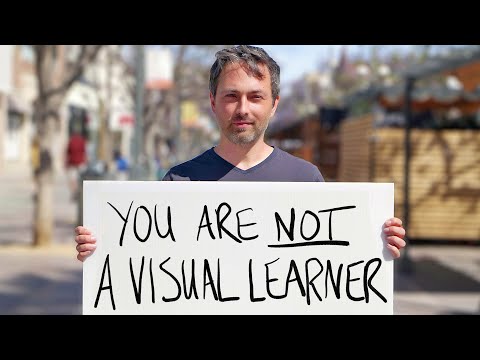
Learning styles make intuitive sense because everyone is different. Some people have better spatial reasoning, others better listening comprehension, some are stronger readers, and others are good with their hands. A survey of nearly 400 teachers from the UK and the Netherlands found that over 90% believed individuals learn better when they receive information in their preferred learning style.
How belief fills the gap
Belief does the rest. Someone who already thinks they're a visual learner watches a teacher draw a diagram of a bike pump, the concept clicks, and they count it as evidence for their style. People who hold the belief check whether an experience is consistent with learning styles, and if it is, they don't think further.
People who already believe the world works a certain way interpret new experiences to fit that belief, whether the experiences do or not.
Why do people hold on to beliefs that fit?
Psychologist Peter Wason coined the term confirmation bias after a 1960 experiment. He gave people the number sequence 2, 4, 6 and asked them to discover the rule behind it by proposing their own sequences. Most people tested only sequences that fit their first guess, such as numbers rising by two, and few tested sequences that could prove the guess wrong. The actual rule was any ascending sequence, so many people confidently held a rule that was too narrow.
Why do diagrams help so many people?
In a 1987 paper, Jill Larkin and Herbert Simon argued that a diagram is sometimes worth ten thousand words. A well-made diagram places related pieces of information next to each other in space, so a viewer doesn't have to search for them. It also makes relationships such as connections and sequences visible at a glance. These advantages come from how the diagram is organized, which is why they apply to nearly everyone.
More from Veritasium