Korva is a scroll of the internet’s best ideas.
A thief who became king
Raised by a thief
His father was the god Brahma, who appeared to his poor mother, Ken Endok, in the fields and forbade her to go to her husband again. She gave birth to a boy and left him in a burial ground for children. A thief named Lembong wandered in, saw something glowing, and followed the sound of crying to find that the light came from the child. He carried him home and raised him as his own.
The magic kris
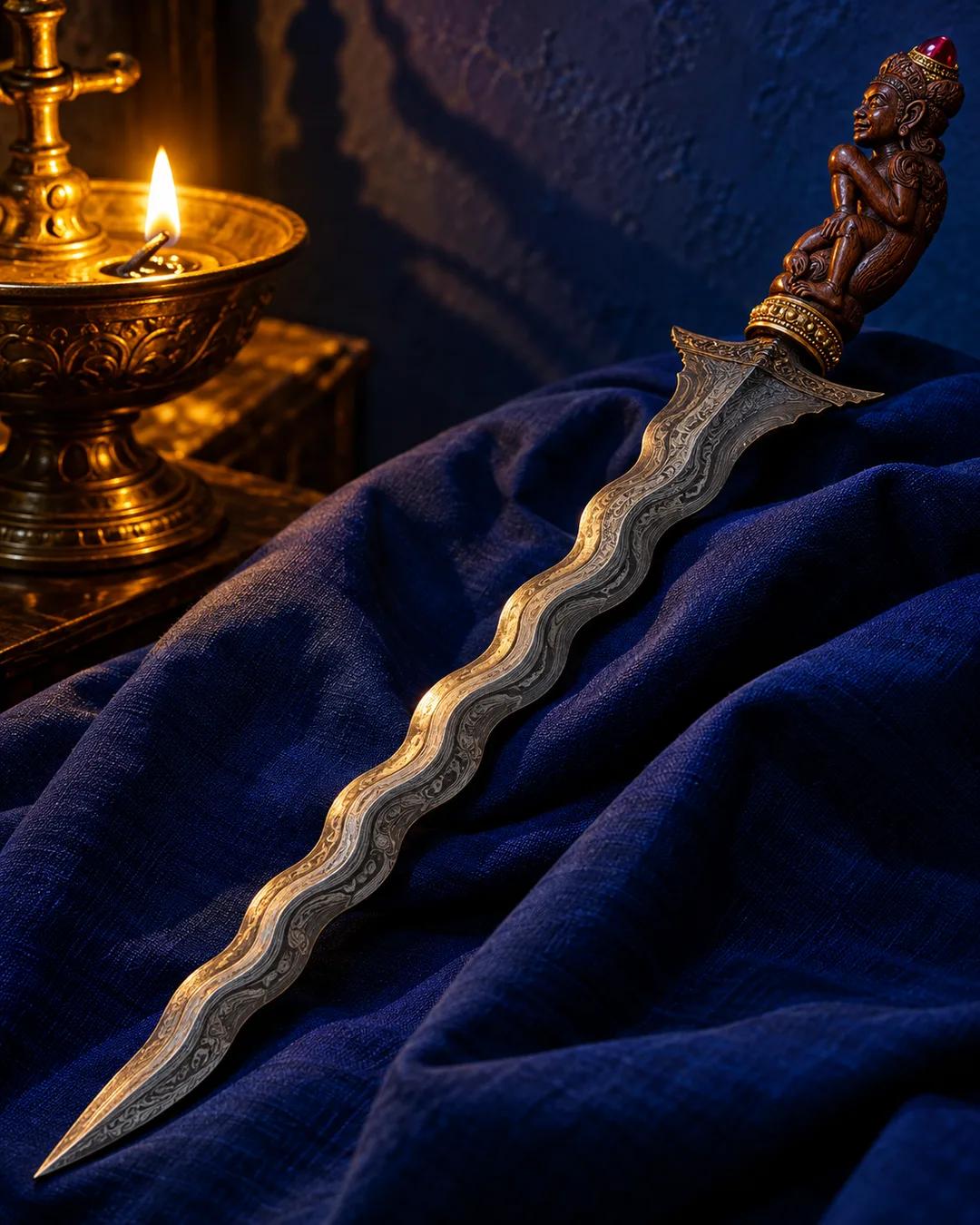
Ken Angrok learned every trick of the trade until he was the most accomplished thief in Java. An Indian holy man then named him the son of Brahma and an embodiment of Vishnu, and talked him out of his life of crime. He received a magic kris, the rippled dagger that Javanese men wore as a sign of status, a talisman against evil, and a sidearm for self-defense.
Becoming king
The commoner became king of Tumapel, with learned men of both the Shaivite and Buddhist traditions witnessing his enthronement, and he called his realm Singasari. King Dandang Gendis of rival Kediri refused to accept him and marched to battle, but the army of Singasari came down like a flood pouring from the mountains. Dandang Gendis fled into the realm of the gods, rising into the air with his horse, his grooms, his parasol-bearers, and the men who carried his drinking vessels and his mats.
Why do Javanese chronicles mix myth and history?
Court chronicles were written to show that a dynasty's rule was ordained, so founders were often given divine fathers and miraculous births. Ken Angrok's story appears in the Pararaton, written long after the events. Other sources, including the Nagarakretagama, trace Majapahit's kings back to him. Historians date his defeat of Kediri to 1222, at the battle of Ganter.
Why is the kris so important in Java?
A kris is more than a weapon. Owners treat it as a guardian object with spiritual power, passed down within families. Smiths fold iron with nickel-bearing metal to create the rippled pamor patterns on the blade, and some used iron from meteorites. UNESCO recognized the kris as a masterpiece of the oral and intangible heritage of humanity in 2005.
Why did Singasari's rulers keep killing each other?
The Pararaton describes a chain of assassinations in the dynasty that Ken Angrok founded. In its account, Ken Angrok was murdered by his stepson Anusapati, who was then killed by Ken Angrok's son Tohjaya. Each succession was disputed because Ken Angrok had children by more than one wife. The line ended with Kertanagara, who was killed in 1292.
More from Fall of Civilizations