Korva is a scroll of the internet’s best ideas.
An empire without governors or garrisons
The mandala model
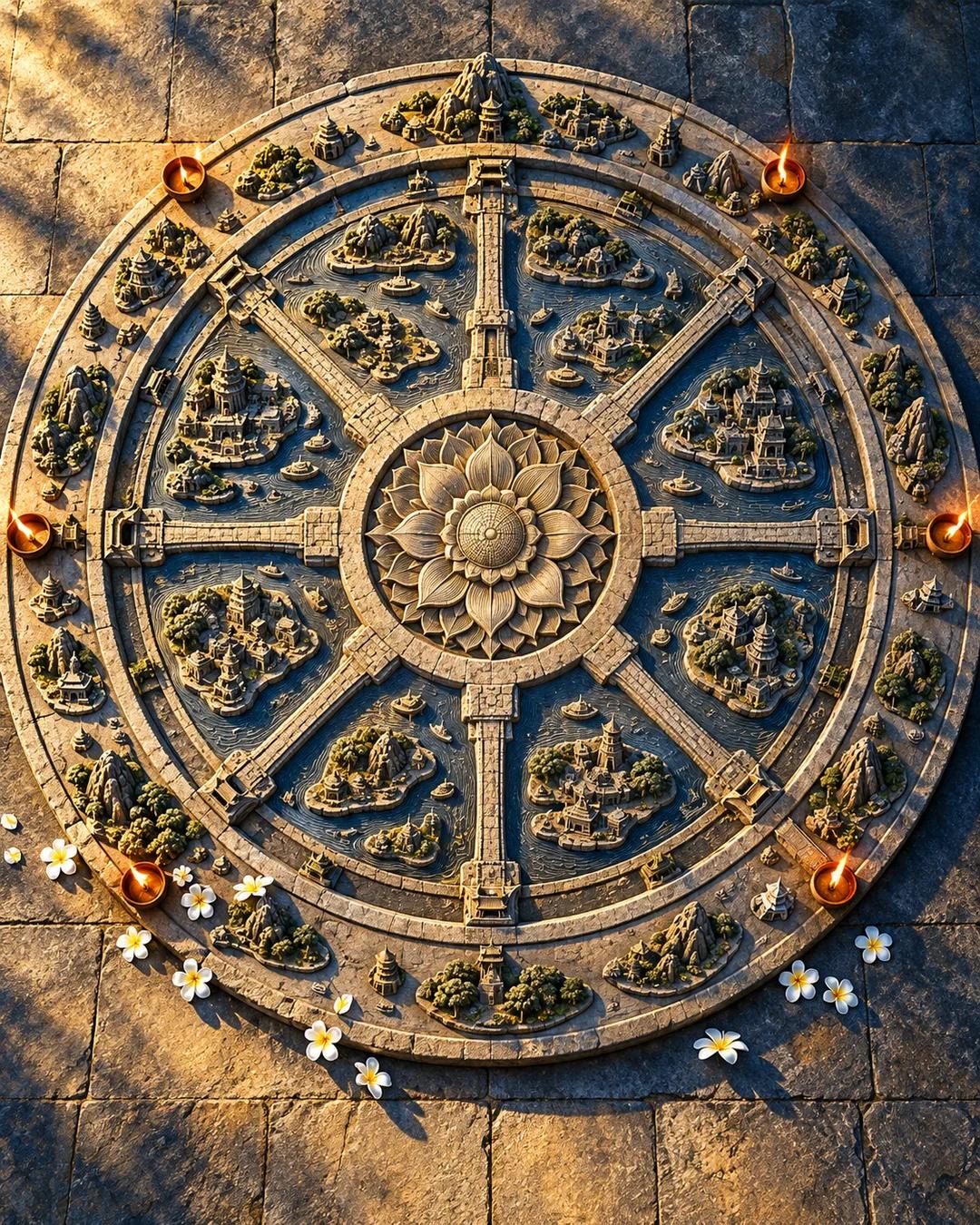
The model was the mandala, the circular diagram of the universe built into the temples at Sewu and Borobudur, with a sacred mountain at the center and rings of order spreading outward. A Javanese poem pictures Majapahit's capital as the sun and moon, with the other cities and islands as the stars and planets around it.
Rulers on the outer islands paid symbolic homage to the king, delivered an agreed tribute each year, and sent a set number of soldiers and ships for any campaign. Beyond that, they kept more or less total control of their own affairs. Rome erased the governments of the lands it conquered, and Majapahit left them standing.
Why it worked
The arrangement suited both sides. Each island had its own language and customs, and few people wanted a Javanese governor or Javanese troops in their hometowns. Appointing governors and stationing troops to put down uprisings would have been an unwelcome expense for Majapahit. While times were good, the arrangement gave the lightest possible touch with maximum cooperation, and everyone profited from the trade.
How it frayed
A hold that light weakened once the empire's attention turned elsewhere. During the Regreg civil war between Majapahit's western and eastern courts, formerly loyal subjects quietly stopped paying fees and sending troops. Malayu drifted under the Thai kingdom of Ayutthaya, Brunei ignored its overlord, and by 1405 western Borneo had drifted away too.
Why did Southeast Asian states use the mandala model?
Historian O. W. Wolters used the Sanskrit term mandala in 1982 to describe how early Southeast Asian states worked. A king's power rested on personal loyalty from lesser rulers, so it was strongest near his court and faded with distance. Borders shifted as rulers changed allegiance to whichever center looked strongest. Many states had overlapping circles of influence at once.
How did Rome govern its conquered lands?
Rome divided its conquests into provinces under governors appointed from the capital. Governors collected taxes, held courts, and commanded garrisons of legions stationed along the frontiers. Roman law and Latin spread through the provinces, and cities were built on Roman plans. By the second century CE, the empire stretched from Britain to Syria.
Why did Ayutthaya pull Malayu away?
Ayutthaya was founded in 1351 and expanded south along the Malay Peninsula. Its kings claimed overlordship of Malay towns, which had formerly looked to Majapahit. Its location on a river near the Gulf of Siam gave it access to both trade and rice lands. The kingdom lasted until 1767, when Burmese forces sacked its capital.
More from Fall of Civilizations