Korva is a scroll of the internet’s best ideas.
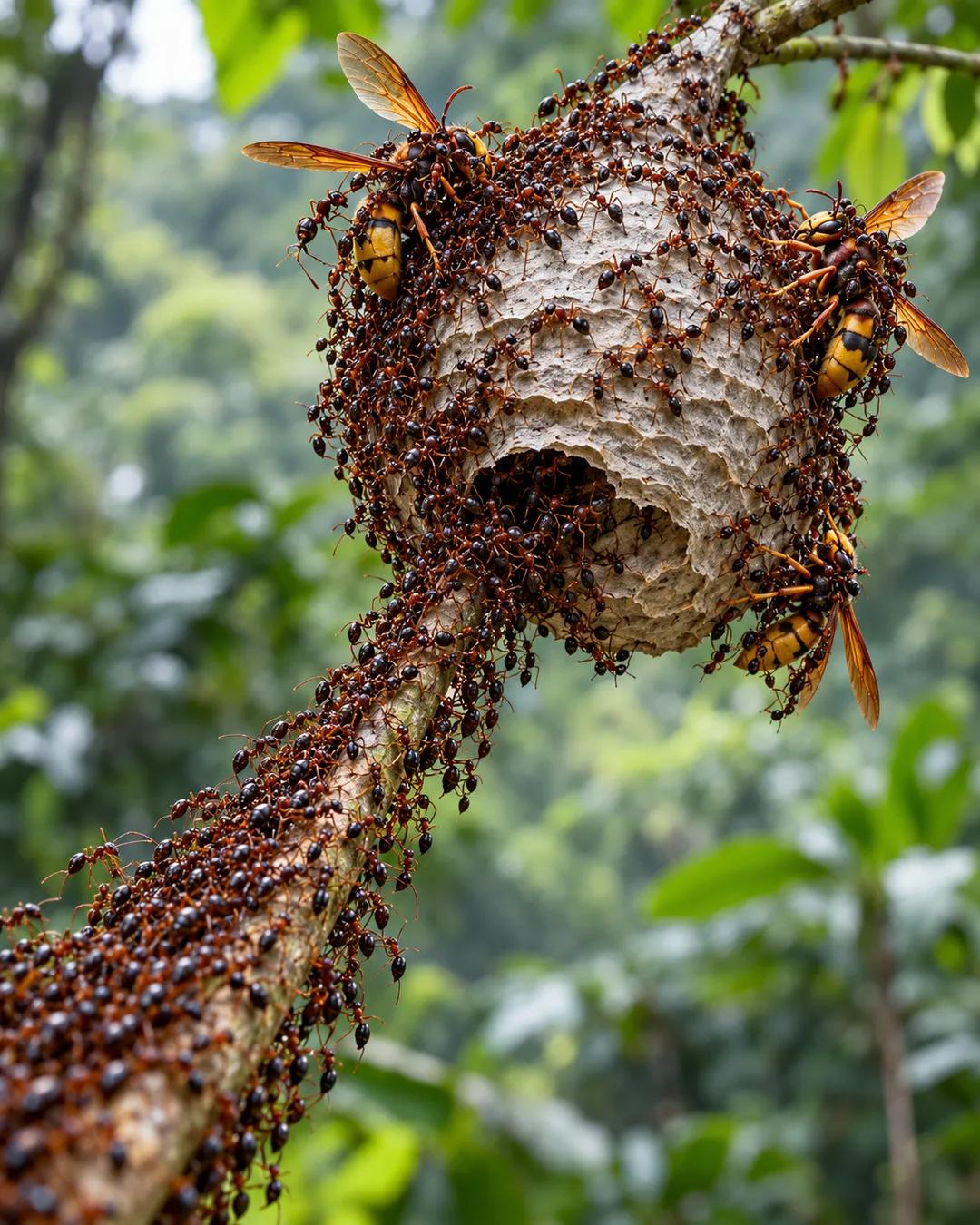
Army ants overwhelm fierce wasps

Army ants do not build nests. About 200 species live a nomadic life in groups of millions, and some form hunting columns up to 100 meters long that kill and immediately dismember every insect or small vertebrate they meet. The biggest hunting parties can kill up to 500,000 animals per day.
Against a wasp colony, the defenders might kill a few of the attackers before they are quickly overwhelmed. Even if the wasp queen survives, the army ants steal the colony's larvae and devour them. There is no recovery from that.
How do army ants hunt without a leader?
Army ant raids are coordinated without any central command. Each ant lays and follows chemical trails, and ants that find food reinforce the trail while the front of the swarm pushes outward. The queen does not direct the raid. Researchers such as Theodore Schneirla, who studied army ants in the twentieth century, showed that this pheromone feedback alone can steer a swarm of hundreds of thousands.
Why don't army ants build nests?
Some army ant species, such as Eciton burchellii, alternate between two phases. In the nomadic phase, the colony hunts and moves to a new site almost every day while its larvae grow. In the statary phase, it stays put while the queen lays a new batch of eggs. In both phases the colony shelters in a temporary bivouac, a living cluster built from the bodies of the workers themselves.
What happens to forests when army ants pass through?
Many other animals follow army ant swarms. Antbirds, for example, trail the swarm to catch the insects and spiders that flee from the advancing ants. Researchers have documented dozens of species that depend on army ants this way in Neotropical forests. Some butterflies also feed on the droppings left by those birds.
More from Kurzgesagt – In a Nutshell