Korva is a scroll of the internet’s best ideas.
Buried under four meters of ash

Water and rot
Without upkeep, the drainage system that channeled the slopes and filled the great reservoirs began to silt up within a decade. The water pooled and spread, turning streets into marshland and marshland into swamp. The red bricks had been fired from the volcanic clay of the Brantas River plain, and they did not last long in the wet heat. Mosses took hold first, then lichens and ferns, and the mortar softened and dissolved.
The forest returns
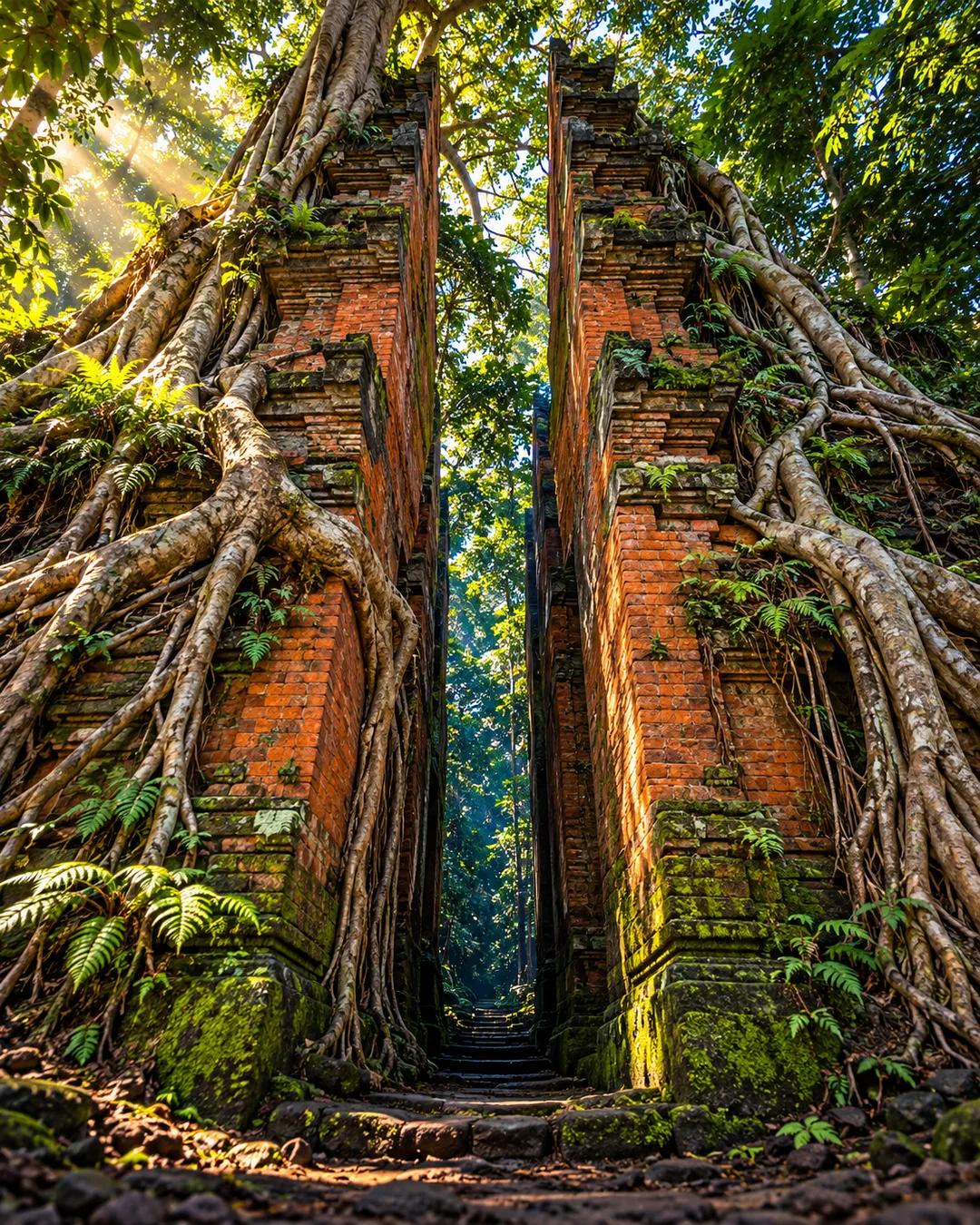
Strangler figs and banyans moved in next, clambering over the red-brick courtyards and ceremonial gateways, their roots pulverizing the brick. Teak and mahogany trees came after and shaded the crumbling walls. More than 10 major eruptions of the nearby Arjuno-Welirang and Anjasmoro volcanoes followed over the centuries, until some structures lay as much as 4 meters beneath the surface.
A Dutch visitor
In 1849, a Dutch traveler named Van Hoevell passed through the site and found the ruins shrouded in a dark forest, with banyan roots pushing walls apart. For that reason, he wrote, the Javanese also called the place Waringin Lawang, or Banyan Gate.
Why do strangler figs destroy masonry?
A strangler fig starts when a bird drops a seed into a crevice high on a host tree or wall. The plant sends roots down toward the soil, and those roots thicken and fuse around whatever they touch. As they grow, they force joints apart and crack stones and bricks. At Ta Prohm in Cambodia, silk-cotton trees and strangler figs grip the temple walls.
How did Majapahit's reservoirs and canals work?
Trowulan sat on the plain of the Brantas River, where builders cut brick-lined canals to carry water through the city. Large reservoirs held water for the dry season and for ceremonies. The Kolam Segaran, a large rectangular brick-lined pond, is still visible at Trowulan. Silt from the volcanic slopes clogged such systems quickly when no one cleared them.
How do volcanoes bury cities under ash?
Ash falls from an eruption column and piles up in layers, thick near the volcano and thinner farther away. Heavy rains then wash loose ash down slopes as mudflows called lahars, which can fill valleys. Repeated eruptions add new layers on top of the old ones. Vesuvius's eruption in 79 CE buried Pompeii under roughly four to six meters of ash and pumice.
More from Fall of Civilizations