Korva is a scroll of the internet’s best ideas.
Butter melts at 92 degrees
Butter and steam
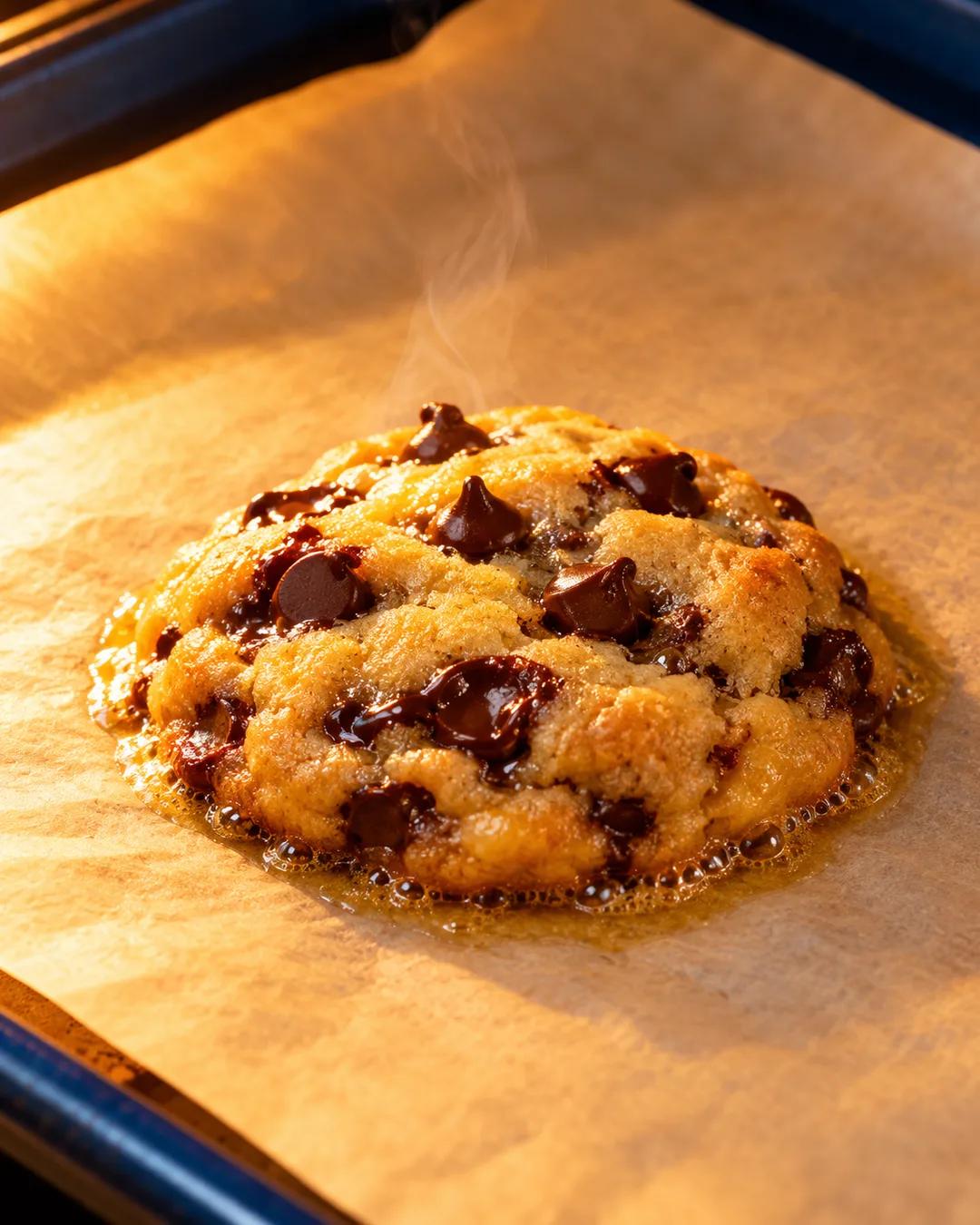
At 92 degrees Fahrenheit, the butter in the dough melts and the dough starts to spread. Butter is an emulsion, a mixture of water and fat that don't want to stay together, held in place by dairy solids. As the butter melts, its trapped water is released, and as the cookie gets hotter, that water expands into steam and pushes against the dough from the inside.
Eggs set
Eggs may have been home to salmonella bacteria, and 136 degrees is too hot for them, so they die off when the dough reaches that temperature. At 144 degrees, the egg proteins begin to change. In a fresh egg, they look like coiled-up balls of string. Heat unfolds the strings and tangles them with their neighbors, and that linked structure turns runny egg nearly solid, giving substance to squishy dough.
Water and gas
Water boils away at 212 degrees, so the cookie dries out and stiffens like mud baking in the sun, and cracks spread across its surface. The steam evaporates and leaves airy pockets behind that make the cookie light and flaky. Baking soda adds to them: sodium bicarbonate reacts with acids in the dough to create carbon dioxide gas, which makes more airy pockets.
Why does melting butter make cookies spread?
Solid butter is a rigid network of fat crystals, and that network is a big part of what holds a ball of dough in shape. When the fat melts, the dough loses that support and flows outward. It keeps spreading until the egg proteins and the starch in the flour set and lock the shape in place. Dough that reaches that setting point sooner ends up thicker, and dough that reaches it later ends up thinner.
Why does steam make cookies puff up?
When liquid water turns to steam at normal air pressure, it expands to roughly 1,600 times its original volume. Inside a cookie, that expansion pushes against the soft dough from within and stretches it into small pockets. Once the egg proteins and flour set around those pockets, they stay open after the steam escapes. This is the same mechanism that lifts puff pastry and popovers.
How does baking soda create bubbles in dough?
Baking soda is sodium bicarbonate, a base, and it reacts with acidic ingredients such as brown sugar, molasses, buttermilk, and cocoa. The reaction releases carbon dioxide gas, which collects in the dough as tiny bubbles. Heat makes the gas expand, which enlarges the pockets further. Baking soda also raises the dough's pH, and that makes sugars and proteins brown faster in the oven.
Why do egg proteins turn solid when heated?
Egg proteins are long chains folded into compact shapes, held that way by weak chemical bonds. Heat shakes those bonds loose, a process called denaturation, and the unfolded chains then bond to one another in a mesh. That mesh traps water between its strands, which turns the liquid into a soft solid. Egg whites and yolks set at different temperatures because their proteins differ, with whites starting to firm up first.
More from TED-Ed