Korva is a scroll of the internet’s best ideas.

Keep asking until the details run out
Digging into details
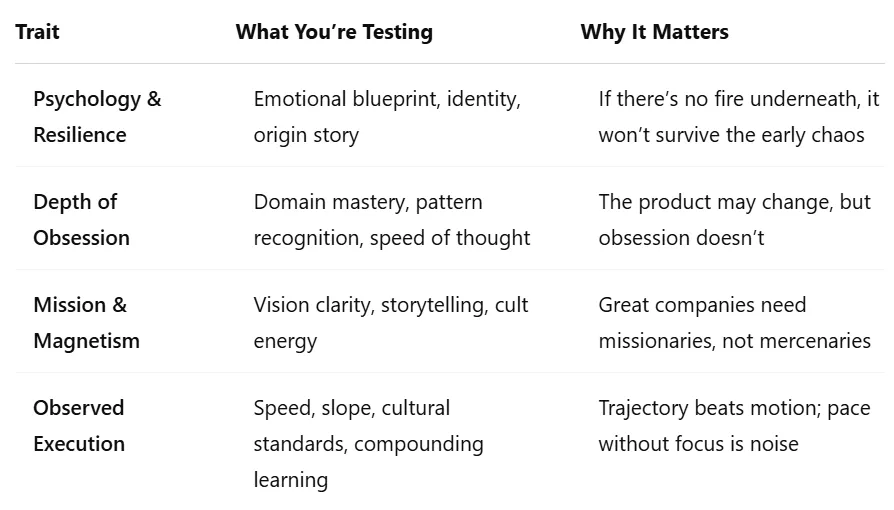
This is the interrogation method Marc Andreessen is known for: increasingly deeper and more specific questions. Asymmetric thinking is born out of depth of understanding, and depth is hard to fake.
Strong founders
Strong founders give layered insights and take joy in specifics. They offer crisp frameworks and counterintuitive depth, and they stay fluent in the hard parts. They surprise the interviewer and teach something new.
The weak founder
The weak founder falls back on jargon, can't go into great detail, and talks in broad strokes or hypothetical principles.
Why do detailed questions expose shallow knowledge?
In 2002, psychologists Leonid Rozenblit and Frank Keil at Yale described the illusion of explanatory depth. People rated how well they understood everyday devices such as zippers and toilets, then wrote out step-by-step explanations. After trying to explain, they lowered their ratings, because the gaps had become visible. Questions that demand specifics force the same discovery on whoever is answering.
Why is jargon a warning sign?
Physicist Richard Feynman told a story about his father teaching him that knowing a bird's name in many languages says nothing about the bird itself. Jargon works like that name: it labels a thing without describing how it works. Someone who can explain a mechanism in plain words has to understand its parts. Feynman later built his teaching style around explaining ideas without technical vocabulary.
What is Marc Andreessen's background?
Marc Andreessen co-wrote Mosaic, one of the first widely used web browsers, as a student at the University of Illinois in the early 1990s. He then co-founded Netscape and later started the venture firm Andreessen Horowitz with Ben Horowitz in 2009. Years of building products as an engineer gave him a technical basis for pressing founders on specifics. Mosaic was released in 1993.