Korva is a scroll of the internet’s best ideas.
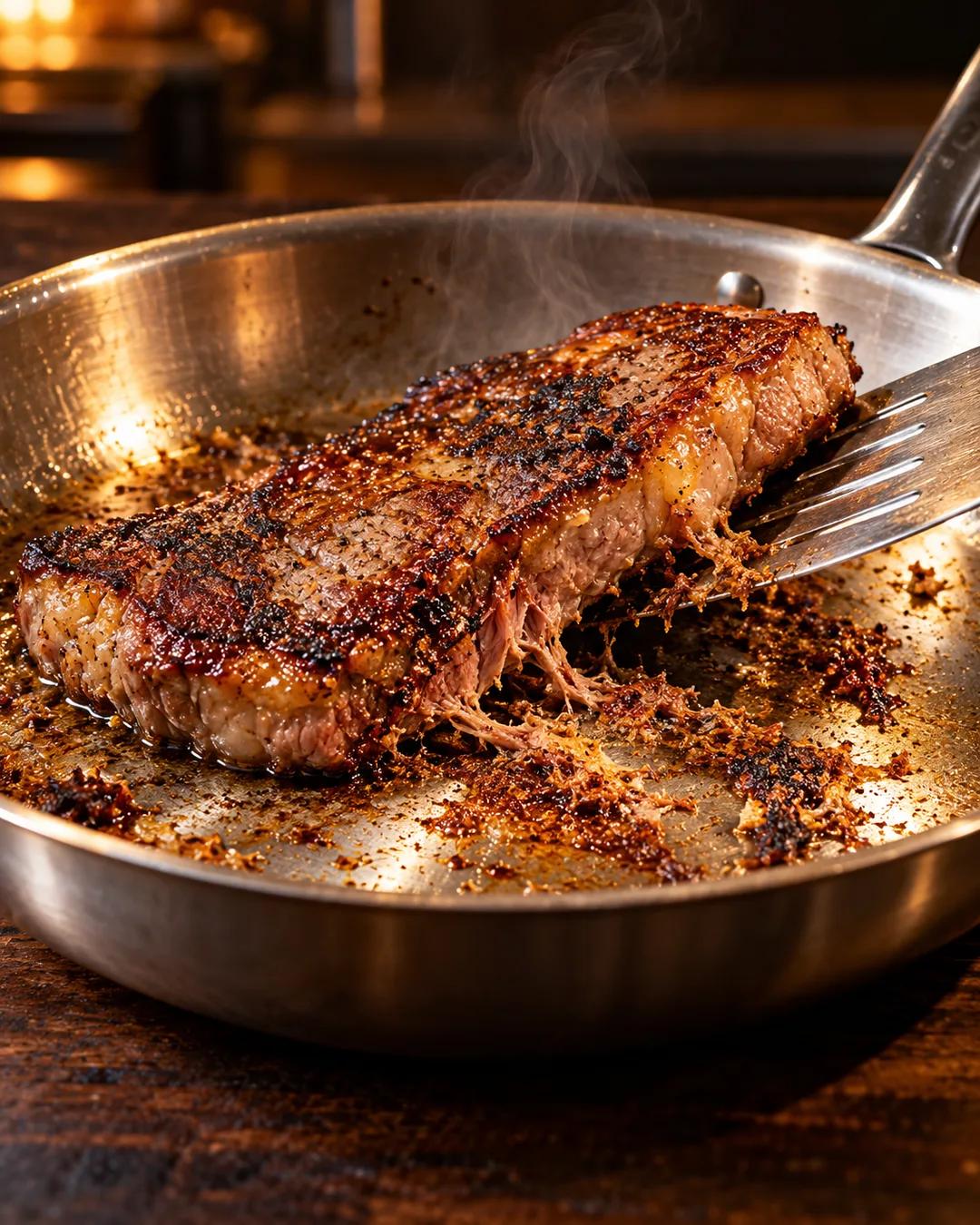
Meat sticks to pans like glue

Why meat sticks
Meat is mostly water and protein, and proteins form complexes with metal atoms when hot, so they literally bond to the pan. Once the surface is brown and rigid, the steak can be scraped free without tearing much of the meat. A lean sirloin with no added fat came out with a golden crust where it touched the metal, but also with nearly blackened bits and gray patches that hardly got any heat. There is probably not enough fat in a lean cut to act as a heat carrier, or it does not render into the pan fast enough to coat the surface.
How fat helps
How fat prevents sticking is less settled, because several reputable scientific sources do not fully agree. Liquid fat spreads across the pan and forms some kind of barrier between protein and metal. And because fat carries heat so well, it cooks the surface faster and more thoroughly, and a well-browned crust releases from the pan much more easily.
Non-stick and fatty cuts
A non-stick pan removes the sticking and still leaves the slow cooking. With no oil, the steak cooked slowly and its crust was worse, because nothing held it against the pan and big bubbles of steam pushed it up and away from the heat, which produced gray patches. Fatty meats are the exception. Wagyu beef needs no extra fat, and duck breast started in a cold, dry pan melts out its thick layer of fat and then fries in it. A skin-on chicken thigh handled the same way came out uneven, probably because it has less fat.
Why do proteins bond to hot metal?
Proteins are long chains with reactive groups along their length, and some of those groups can attach to metal atoms on the surface of a pan. Heat makes the chains unfold and expose more of those groups, which strengthens the contact. Stainless steel has a thin, microscopically rough surface that gives the protein plenty to hold onto. Cooks have long noticed that meat releases once the crust is fully formed and has stiffened.
Why does duck breast start in a cold pan?
Duck breast has a thick layer of fat under the skin, and warming it slowly lets that fat melt out gradually. A hot pan would sear the skin before much of the fat had time to leave. As the fat renders into the pan, it forms the liquid in which the skin crisps. This is why a cold start can yield a thin, crisp skin and a well-cooked breast.
Why does steam push meat off the pan?
Meat is mostly water, so heat turns some of that water into steam right at the surface. When the steam has nowhere to go, it forms bubbles between the meat and the metal. Those bubbles lift the meat away from the hot surface and leave gray, steamed patches. A layer of liquid fat helps by pressing the meat into contact and letting moisture escape around it.
More from Adam Ragusea