Korva is a scroll of the internet’s best ideas.
Neutrophils kill themselves on purpose
When a wound fills with more bacteria than the first defenders can handle, hundreds of thousands of neutrophils pick up the chemical signals in your blood and move to the battlefield. They arrive vomiting deadly chemicals at the bacteria or devouring them whole. They attack so carelessly that they damage your own cells along the way, and the collateral damage is not their concern.
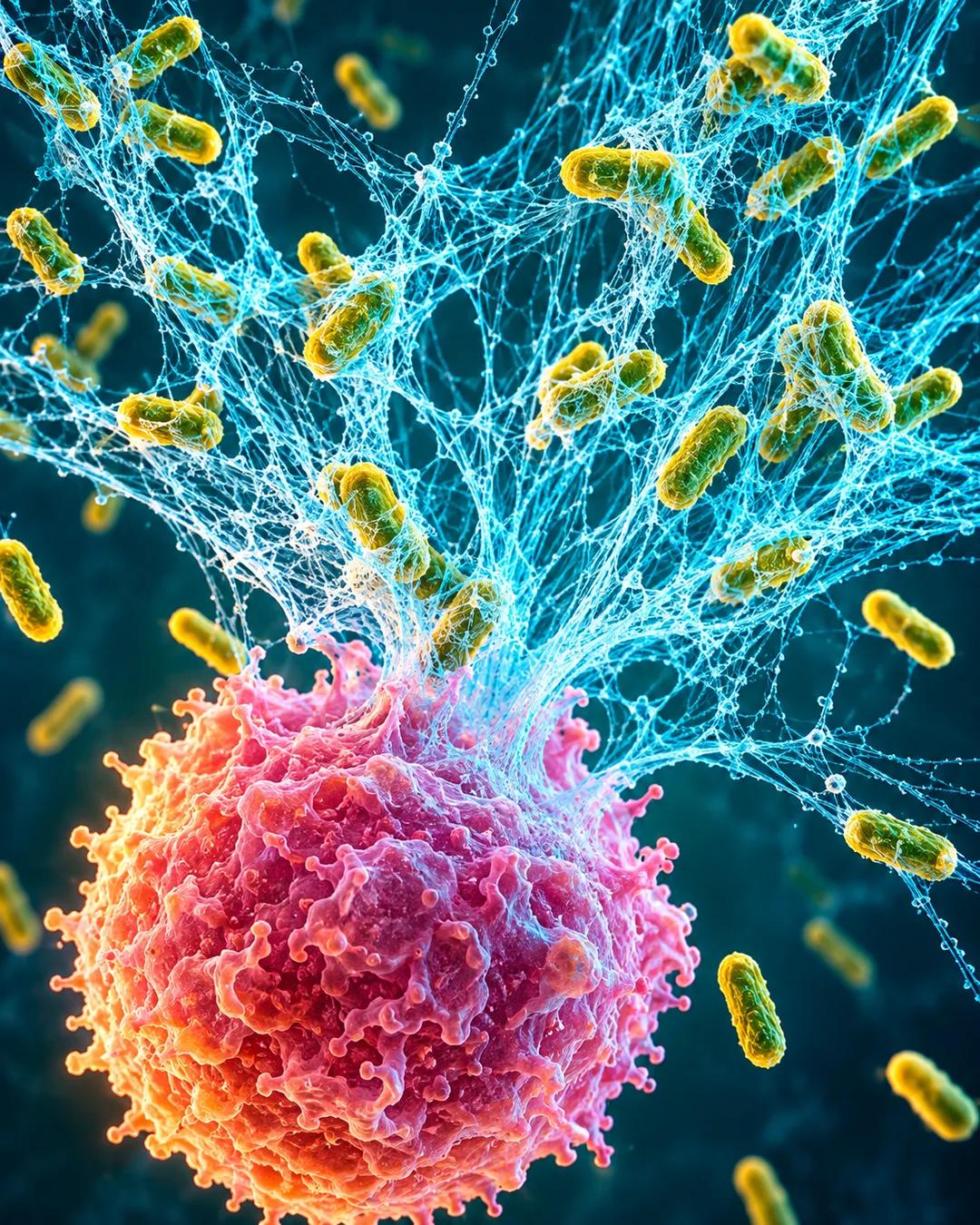
The short life is what keeps them from doing worse. Dying a few days after birth leaves them no time to accidentally destroy your body from the inside. Some neutrophils go further in the middle of a fight: they push their own suicide button and explode, casting wide, toxic nets made from their own DNA and filled with deadly chemicals. The nets trap and kill bacteria. Sometimes a neutrophil keeps fighting even after that, though it is already sort of dead.
How do neutrophils make nets from DNA?
The process is called NETosis. The neutrophil's nucleus swells, its DNA unwinds, and the cell membrane ruptures, releasing long strands of DNA coated with histone proteins and antimicrobial enzymes. Arturo Zychlinsky's group in Berlin described these neutrophil extracellular traps in a 2004 paper in Science. The strands catch bacteria like a web and hold them next to the enzymes that kill them.
Where do dead neutrophils go?
Dead neutrophils are the main ingredient of pus, which is why it looks creamy white or yellow. Macrophages arrive after the fight and swallow the dead neutrophils in a cleanup process called efferocytosis. Swallowing them also shifts the macrophage toward signals that calm inflammation and begin repair. Standard immunology textbooks put the replacement rate at roughly a hundred billion new neutrophils a day in an adult.
Why does a neutrophil damage healthy tissue?
Neutrophils carry granules loaded with enzymes such as elastase and with reactive oxygen compounds. These chemicals cannot tell bacteria from the body's own cells, so once they are released outside the cell they chew through nearby tissue as well. Neutrophil elastase can digest elastin, the stretchy protein found in lung tissue.
More from Kurzgesagt – In a Nutshell