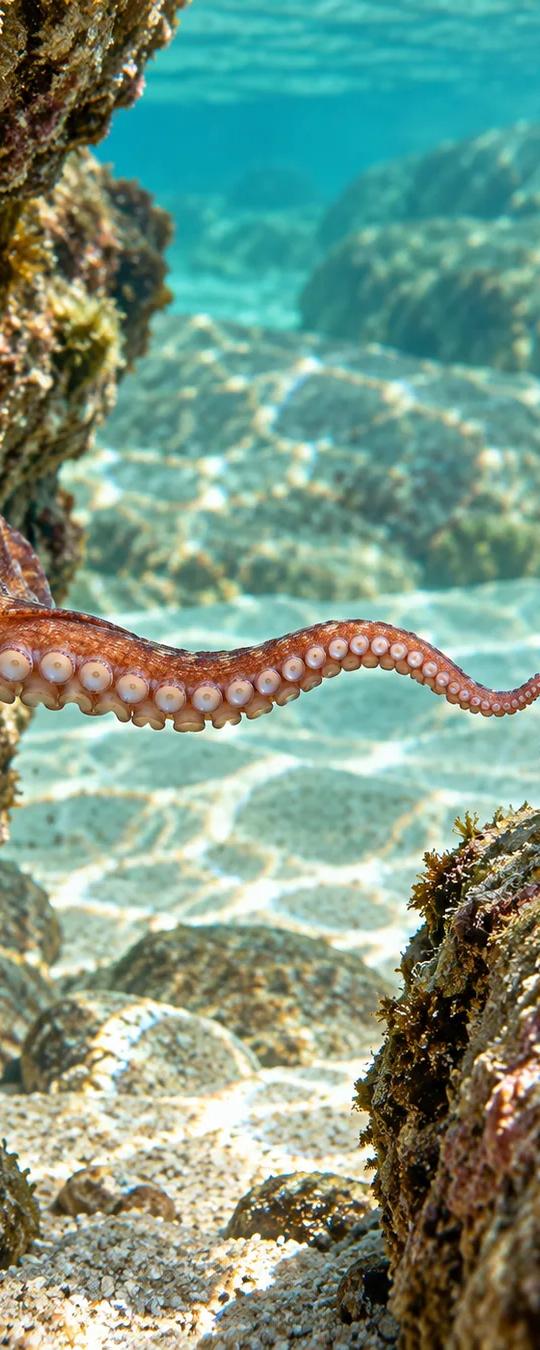
Korva is a scroll of the internet’s best ideas.
Octopus arms think for themselves

Where the neurons sit
Octopuses are cephalopods, a name that is Greek for head-feet, and their heads hold brains with a brain-to-body ratio similar to that of other intelligent animals. The nervous system has about 500 million neurons, roughly as many as a dog has, spread through a network of interconnected ganglia organized into three basic structures.
The central brain holds only about 10% of the neurons, and the two huge optic lobes hold about 30%. The other 60% are in the tentacles, which for humans would be like having arms with minds of their own.
How an arm bends
Octopuses have no bones at all, so an arm can bend at any point and in any direction. When an arm touches food, a muscle activation wave runs through it to its base, while the arm sends another wave back from the base to the tip. The two signals meet halfway between the food and the base of the arm, and that tells the arm to bend at that spot.
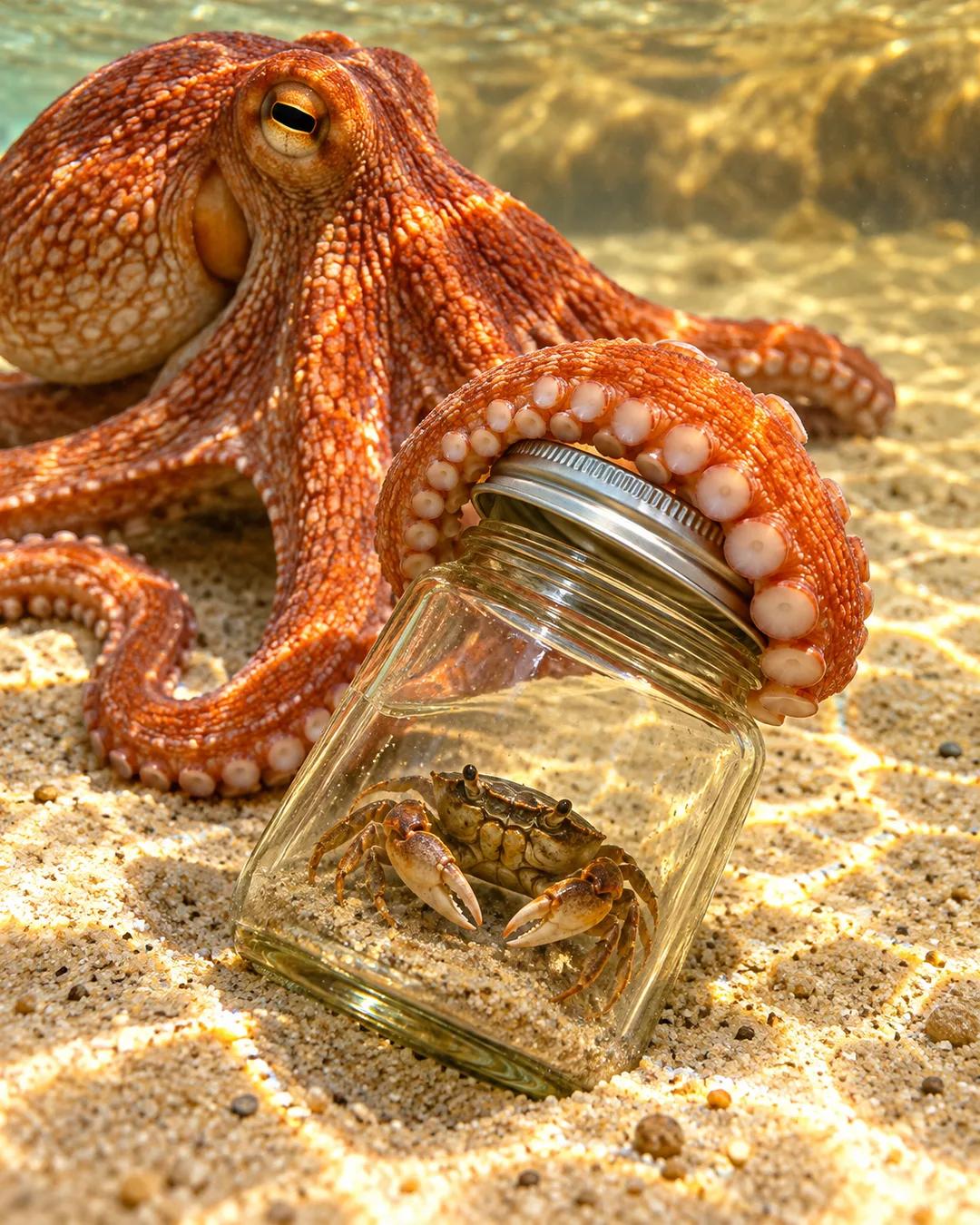
This gives an octopus flexibility and creativity when it faces a new situation or problem: opening a bottle to reach food, escaping through a maze, moving around a new environment, or mimicking other creatures to scare away enemies.
How do octopus arms bend without bones?
An octopus arm is a muscular hydrostat: it has no skeleton, and its tissue is mostly muscle packed around a central nerve cord. Muscle fibers run lengthwise, across the arm, and in spirals. Because the tissue cannot be compressed, squeezing the arm in one direction makes it longer in another, so a single contraction can bend, stretch, or twist it. Elephant trunks and human tongues work on the same principle.
Can an octopus arm move without the brain?
In a 2001 study in Nature, Germán Sumbre and colleagues stimulated the nerve cord of octopus arms whose link to the brain had been cut. The arms still produced the same stereotyped extension seen in an intact animal, with a wave of movement running from the base toward the tip. The pattern of the reach is built into the arm's own circuitry.
Why don't octopus arms tangle each other?
Octopus suckers grip almost anything, including the octopus's own skin, so arms should tangle constantly, yet they rarely do. In a 2014 study in Current Biology, Nir Nesher, Binyamin Hochner, and colleagues found that arms cut from the animal stuck to a dish but not to the skin of an octopus. Suckers did grip a piece of octopus arm once its skin had been stripped away. The skin carries a signal that tells the suckers not to hold on.
How did octopus intelligence evolve separately from ours?
Octopuses and vertebrates last shared an ancestor roughly 500 to 600 million years ago, a small worm-like animal with a simple nervous system. Large, complex nervous systems arose independently in each line afterward. The 2015 genome of the California two-spot octopus, published in Nature by Caroline Albertin and colleagues, found about 33,000 protein-coding genes. It also showed large expansions of gene families linked to neuron development, including the protocadherins.
More from TED-Ed