Korva is a scroll of the internet’s best ideas.
Over 20 kilograms before the backpack

What he carries
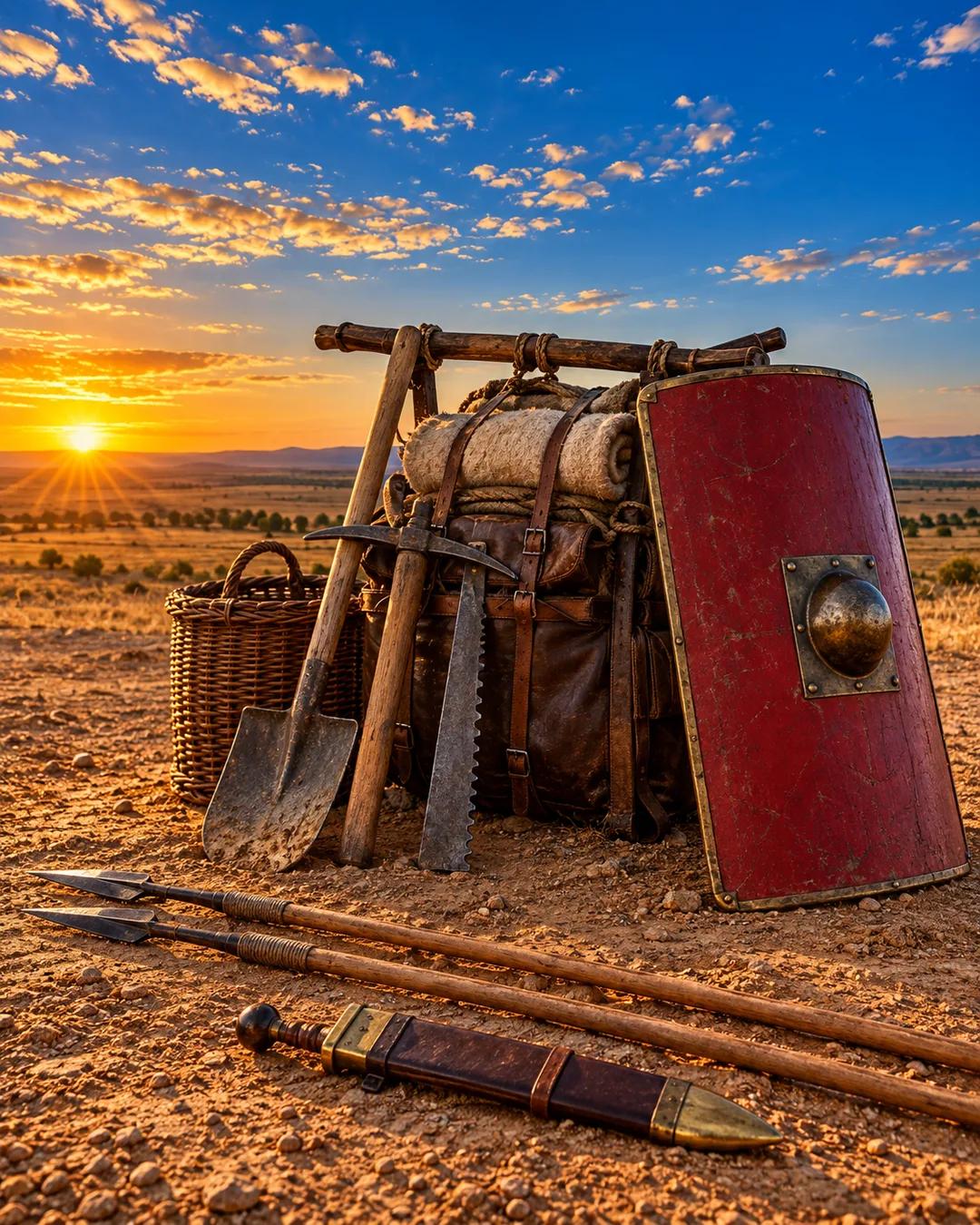
A great march covers 30,000 Roman paces, nearly 36 kilometers. Servius Felix, eight years into his service as a legionary, makes it with armor and weapons that include a gladius, a scutum, and two pila, and together they weigh over 20 kilograms.
On top of that comes his backpack, called a sarcina. It holds his food and all the tools he needs to help build the camp: a spade, a saw, a pickaxe, and a basket.
Watch and dawn
Exhausted as he is, Servius won't sleep much that night. He has the first watch, which means looking after the baggage animals and keeping alert against a possible ambush.
At dawn he eats breakfast with his seven tent companions. They are like a family, all bearing scars from the battles they have fought together. Servius is from Italia, while the others hail from all over the empire, which stretches from Syria to Spain, so every one of them is far from home in the northern land of Germania.
Why build a fortified camp every night?
A Roman army on the march dug a ditch, raised a rampart, and pitched its tents in a standard layout at the end of every day. The Jewish historian Josephus, who watched Roman armies campaign, wrote that the camp went up so quickly and so orderly that it resembled a city with streets and a marketplace. Every soldier knew where to pitch his tent, and every camp looked the same wherever it stood. Josephus noted that the work was done by the soldiers themselves with the tools they carried.
How did the pilum work against shields?
The pilum was a heavy javelin with a long, thin iron shank behind its point. When it struck a shield, the shank could bend, which made it hard to pull out and impossible to throw back. A bent pilum stuck in a shield also dragged on the arm of the man holding it, and many soldiers dropped the shield instead. Ancient writers such as Plutarch describe the Roman general Gaius Marius altering the pilum's design so that it would bend or break on impact.
Why were marching soldiers called Marius's mules?
Gaius Marius, a Roman general of the late second century BCE, reorganized how armies were supplied. Under his changes, soldiers carried much of their own food and gear, which shrank the baggage train that followed an army. The soldiers' joke was that they had become Marius's mules, a nickname that Roman writers such as Frontinus recorded. A smaller baggage train let armies move faster and made them harder to ambush.
More from TED-Ed
