Korva is a scroll of the internet’s best ideas.
Two million stones, no mortar
A mountain without mortar
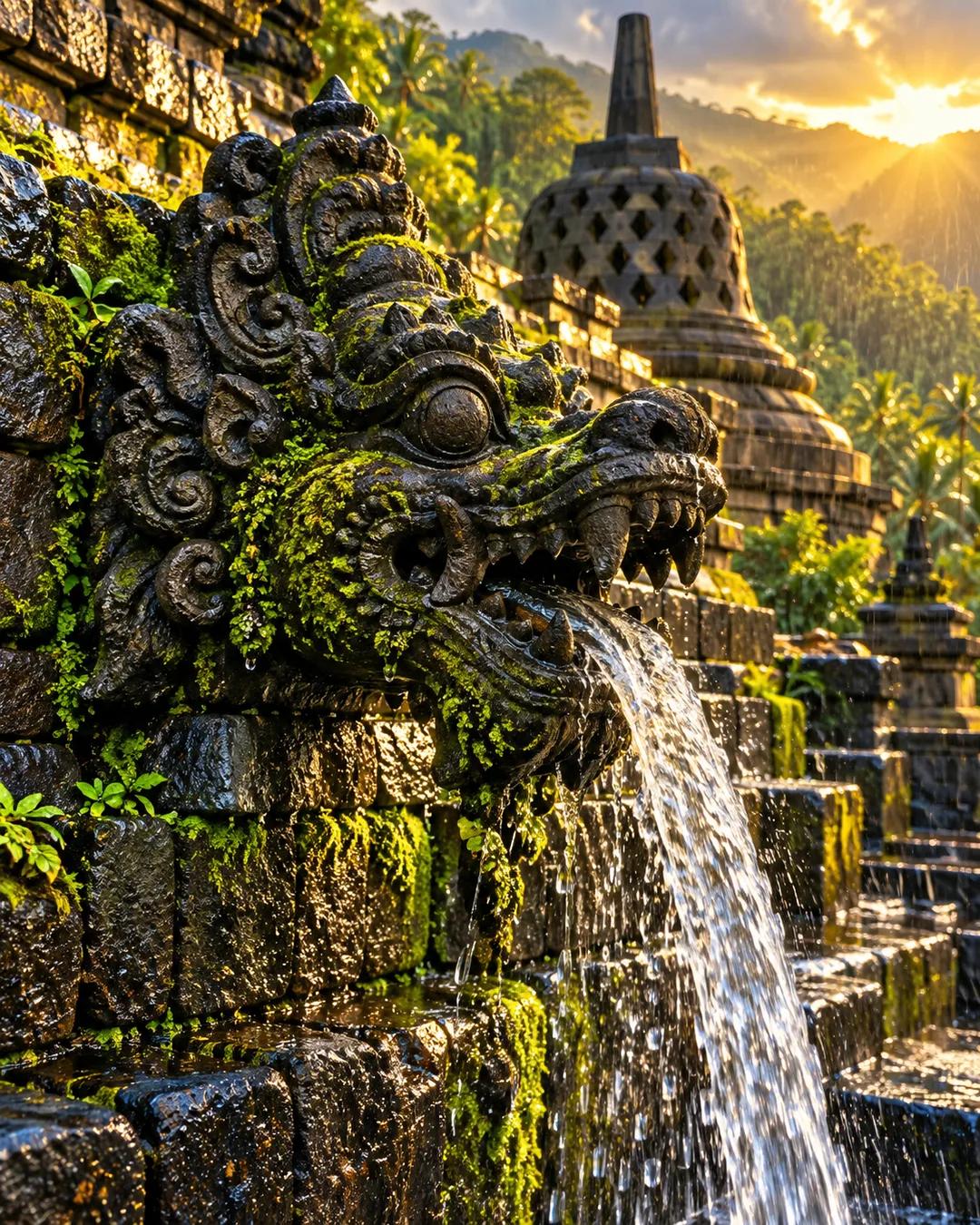
The kings of Mataram built it in the ninth century as nine stacked platforms rising 35 meters like a wedding cake, shaped like a mountain beside the volcano Merapi. Seen from above it is an enormous mandala covering the area of two football pitches. The interlocking design has carried it through the countless earthquakes of a thousand years in one of the most seismically active zones on Earth. The builders also gave it more than 100 drainage spouts, each carved as a giant or sea dragon, so rain poured from their mouths.
Stories in stone
Nearly 3,000 carved friezes and 500 Buddha statues line its walkways and stairways. Many show the life of the Buddha. Others show ordinary Javanese life: people winnowing and steaming rice, stirring milk rice in pots, shopping in a busy marketplace, carrying baskets of tropical fruit and nets full of fish. One panel shows the tumpeng, a tall cone of rice ringed with side dishes that is still made for special occasions in Indonesia.
Five large, high-sided seagoing ships are carved among the scenes. They show how accomplished Javanese shipbuilders already were by the ninth century.
How do interlocking stones survive earthquakes?
Blocks cut with notches, dovetails, and projections lock into one another, so the structure behaves as one connected mass without brittle joints. Its weight holds each block in place, and small shifts in the stones can absorb shaking without bringing walls down. A mortar joint, by contrast, tends to crack and release the blocks. Indonesia restored Borobudur between the 1970s and 1980s with UNESCO support, and UNESCO named it a World Heritage Site in 1991.
How was Borobudur rediscovered after centuries?
Volcanic ash and jungle growth covered the monument after it was abandoned. In 1814, Sir Thomas Stamford Raffles heard of it while governing Java. He sent a Dutch engineer, H. C. Cornelius, who cleared the vegetation from the site with a large crew of workers. Cornelius's drawings were published in Raffles's History of Java in 1817.
Why is Borobudur laid out as a mandala?
The monument has three tiers that represent stages of Buddhist cosmology: the world of desire, the world of form, and the formless world. The lower galleries carry carved scenes of ordinary life, the middle ones carry scenes from the life of the Buddha, and the top holds seventy-two perforated stupas around a central one. Pilgrims walk clockwise around each level as they climb. Each tier leads upward to a wide circular terrace.
More from Fall of Civilizations