Korva is a scroll of the internet’s best ideas.
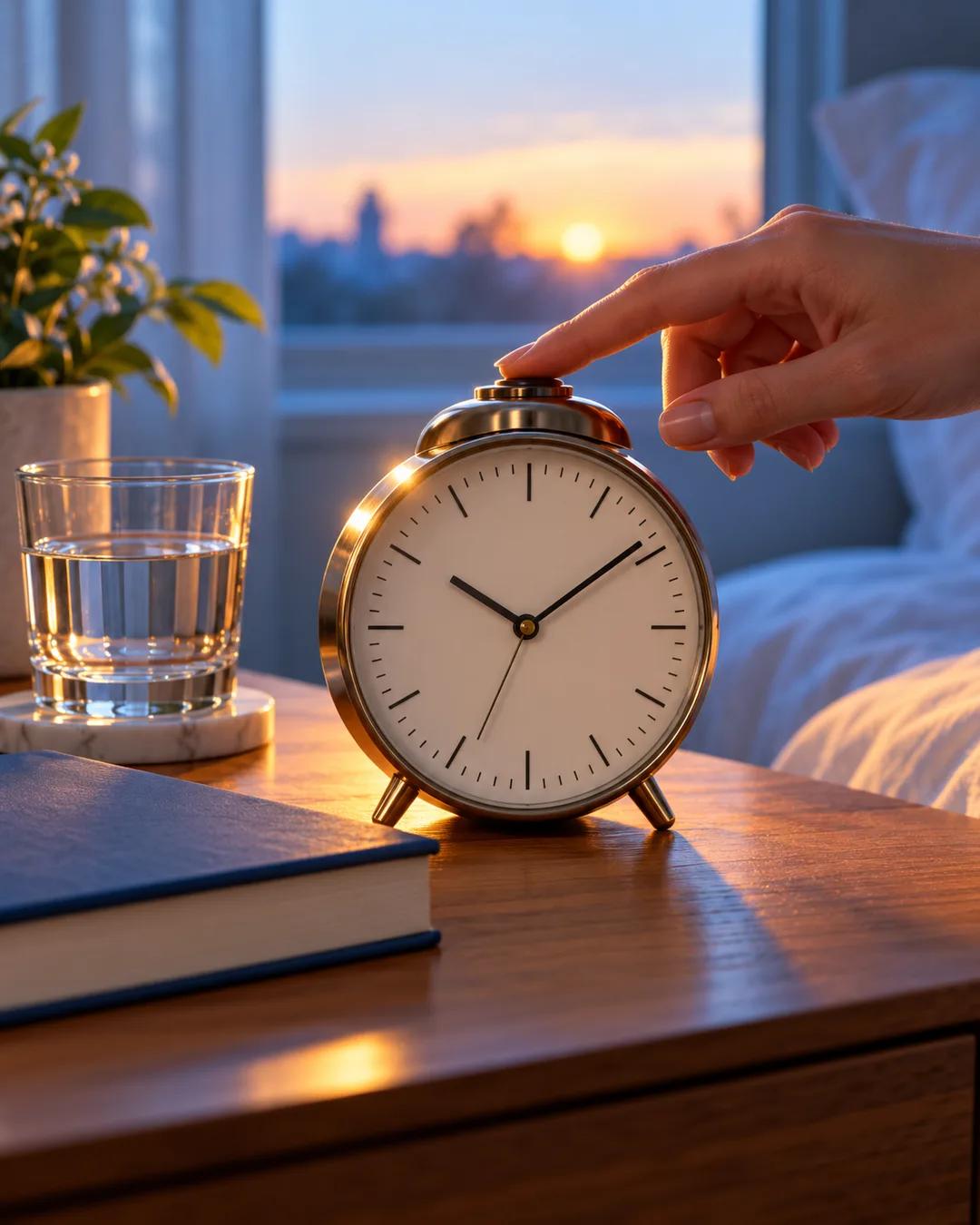
Wake time decides when you're sleepy

Sleepiness has to be built, and it builds only while a person is awake. A consistent wake-up time gives that sleep drive a predictable schedule, so tiredness arrives at about the same hour most nights. Going to bed at the same time follows as a side effect.
Most people try the reverse, because a fixed bedtime sounds easier than a fixed alarm in a world built around work schedules. Without the morning anchor, bedtime becomes a guess. Picture a lie-in of a couple of hours this morning: at 10 PM the body is nowhere near tired, anxiety about that pushes sleep even further away, and three or four hours of tossing and turning follow, when the whole point was a steady, predictable drive.
How does sleepiness build up while awake?
During waking hours, a chemical called adenosine accumulates in the brain as a by-product of neurons burning energy. Rising adenosine increases the pressure to sleep, and it is cleared away during sleep. In 1982, the Swiss researcher Alexander Borbély described this as Process S in his two-process model of sleep. Caffeine works by blocking the receptors adenosine binds to, so the chemical keeps building but is not felt.
Why does sleeping late shift the body clock?
Light is the strongest signal that sets the body clock, and sleeping late delays the first bright light of the day. The clock then drifts later, so the evening hours at which sleepiness arrives slide later too. The chronobiologist Till Roenneberg of Ludwig Maximilian University in Munich named the gap between weekday and weekend sleep timing social jet lag. His surveys of tens of thousands of people showed the gap is common and largest among young adults.
What sets the length of the body's internal day?
The master clock sits in a pair of tiny clusters of cells called the suprachiasmatic nucleus, just above where the optic nerves cross. In a 1999 study, Charles Czeisler and colleagues at Harvard kept volunteers in dim light without time cues and measured an average internal day of about 24 hours and 11 minutes. Because that is slightly longer than 24 hours, the clock needs a daily nudge from light to stay aligned with the sun.
More from Something You Should Know