Korva is a scroll of the internet’s best ideas.

You remember the meaning
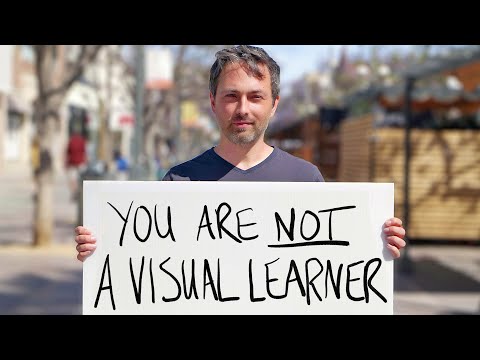
Some tasks do call for a particular modality. Learning about music should have an auditory component, and learning about geography involves looking at maps. Some people also have more aptitude for one task than another: someone with perfect pitch will recall certain tones in music better, and someone with excellent visual-spatial reasoning will be better at learning the locations of countries on a map.
Learning style theories claim something bigger, that a person's preference stays consistent across every kind of learning. By that logic, the person with perfect pitch should learn everything better by ear, and that clearly is not the case. Most people learn geography better with a map. What people recall is the meaning behind a presentation, so the precise look of the images or the pitch and quality of the sound drops away.
Why does meaning outlast the look of a lesson?
In 1972, Fergus Craik and Robert Lockhart proposed the levels of processing framework. In their account, thinking about what something means leaves a stronger memory than attending to how it looks or sounds. Later experiments supported this: people asked about the meaning of words remembered them better than people asked about the print or the rhyme of the same words. Surface features are processed shallowly, so they fade first.
How does memory separate gist from exact wording?
Valerie Reyna and Charles Brainerd's fuzzy-trace theory holds that people store two traces of an experience at once. One is a verbatim trace with exact surface detail, and the other is a gist trace that captures the meaning. The verbatim trace fades faster than the gist trace. This is why people can recall the point of a conversation long after losing the exact words used.
More from Veritasium