A Movie Star Bought a Pulp Hero and Redesigned Him
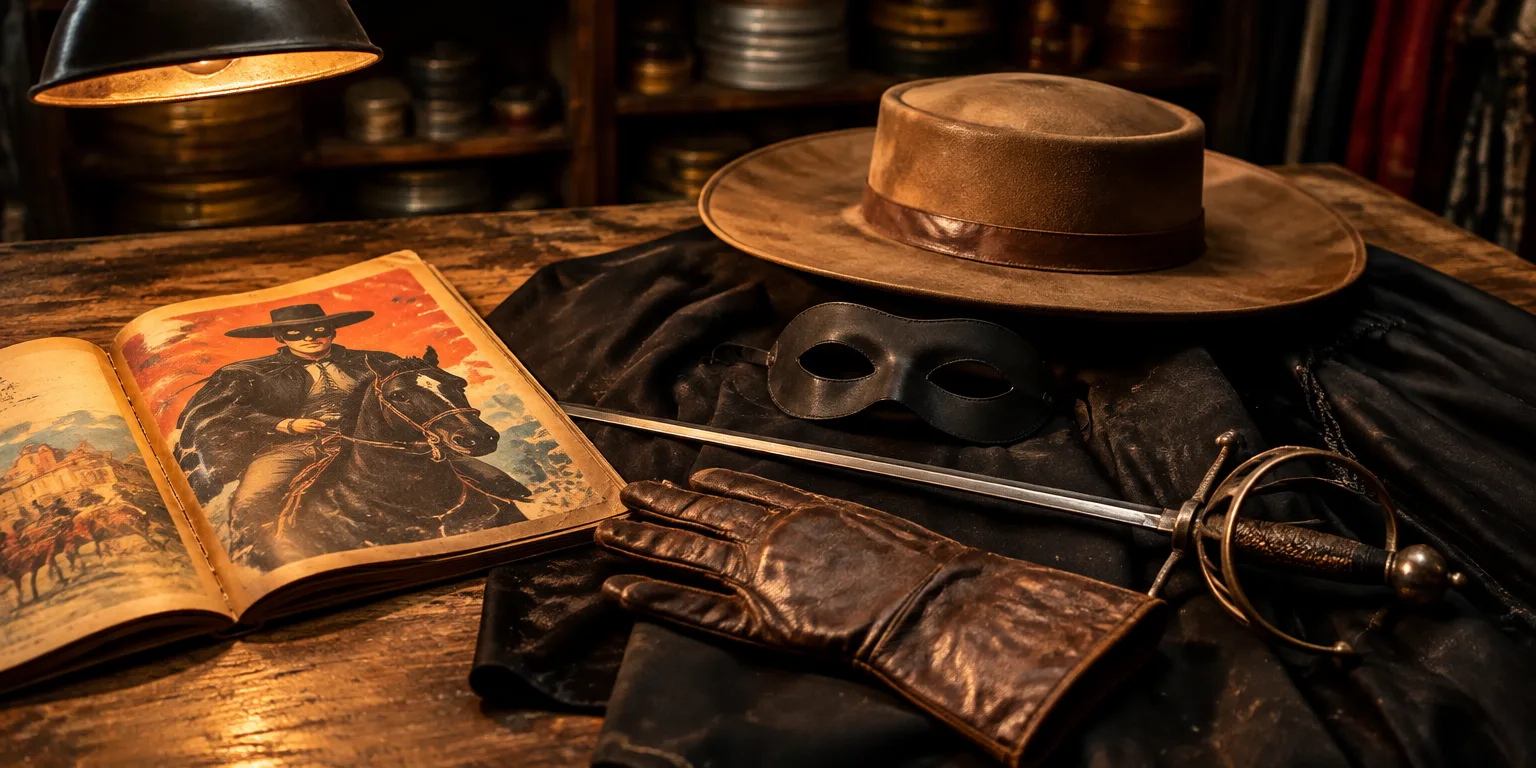
The 1920 silent film swapped the sombrero for a Cordovan hat, cut the mask in half, and turned the Z into a flourish.
 Stuff You Should Know · Zorro! That guy with the sword!
Silent film star Douglas Fairbanks liked to fool around by climbing stairs on his hands. He was one of America's first genuine movie stars, and he was looking for a part that would show off that athleticism.
He found it in The Curse of Capistrano, a 1919 pulp serial by Johnston McCulley. McCulley's hero was Don Diego Vega, the foppish son of the mayor of Los Angeles, who secretly rode at night as Zorro to defend poor farmers and others against corrupt Spanish authorities.
Fairbanks read the story and quickly bought the screen rights so he could play Zorro himself. The result was The Mark of Zorro, a 1920 silent film that became a big hit with audiences.
That was no small change, because McCulley's original Zorro looked strange by modern standards. At night, Don Diego went to the cellar with his trusty assistant, Bernardo, put on a sombrero, a purple cape, and a black mask that covered his entire face.
He was already a skilled swordsman on horseback, riding a horse named Tornado. His calling card was cutting a Z into an enemy's clothing, or, for comic effect, sometimes into the enemy himself.
Fairbanks kept the horse, the sword, and the double life, but threw out almost the whole wardrobe. The sombrero became a flat Spanish Cordovan hat, the full mask became a narrow half mask over the eyes, and the purple cape became a black cape over an all black outfit.
Once audiences saw that version on screen, it stuck as the expected look. Fairbanks also made Zorro more theatrical and acrobatic, a performer who could duel, leap, and show off, which fit an actor who had started in comedy and was remaking himself as a swashbuckler.
The film also tamed the violence. In the book, Zorro pinned a foe with a knee to the chest and carved the Z slowly with his sword tip like a pen. On screen, the Z became a quick visual flourish, the kind of thing that plays better in a movie than in a book.
Fairbanks also gave Diego a new backstory and even a new name, Don Diego de la Vega. In the film, his father sends him to Europe for schooling, where he learns fencing and ideas about social equality, then calls him home to a corrupt Los Angeles.
Moved by what he sees, the young man finds a sash, a cape, and a mask, saddles Tornado, and gets to work as a Spanish Mexican Robin Hood of 1850s California. The movie drew big crowds and proved very popular.
Questions people ask
Was Zorro based on a real person?
No, there was no historical figure named Zorro. Writers point to bandits like Joaquin Murrieta, a Sonoran miner turned outlaw during the Gold Rush, and Solomon Pico, a Californian outlaw who lost land after the American takeover, as possible inspirations.
Did the author keep writing Zorro after the movie?
Yes. After the 1920 film became a hit, McCulley expanded the serial into the novel The Mark of Zorro in 1924 and went on to write about 60 more Zorro stories before his death in 1958.
Did Zorro influence Batman?
Historians of comics say yes. Creators Bob Kane and Bill Finger borrowed Zorro's half mask, night riding, secret cave, and rich playboy cover for Batman, and later Batman stories even show Bruce Wayne leaving a screening of The Mark of Zorro on the night his parents are killed.