Assyria's Most Brutal King Was Also Its Most Bookish
He wore a writer's stylus while hunting lions, and gathered books with the focus he brought to war.
 Stuff You Missed in History Class · Ashurbanipal
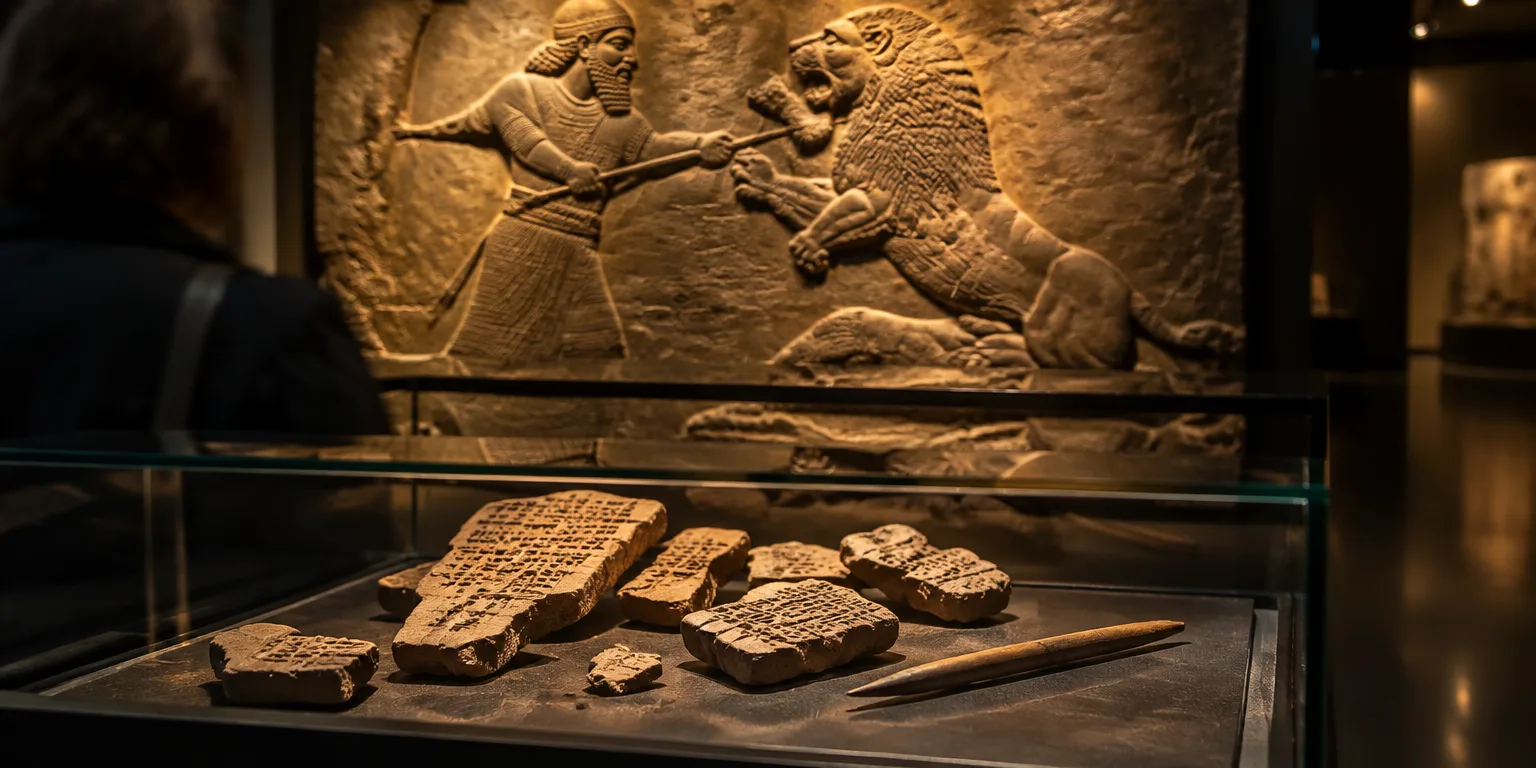
In one gallery at the British Museum, two visitors studied the same ancient king and walked away with opposite impressions. One had been reading about his library and thought how amazing it sounded. The other had been reading about his reign and thought how ruthless he seemed.
Both were right about Ashurbanipal, who took the throne of Assyria in 669 BCE. He was unusually devoted to learning for a king of his time, and brutal in war, and he used that learning to build one of the oldest known libraries gathered and organized with clear intent.
His double life began with his schooling. As a prince, Ashurbanipal trained in riding horses, driving chariots, shooting bows, battle planning, and courtly manners, all expected of royalty. He also took up past writings and historical accounts and learned to read and write multiple Sumerian and Akkadian languages in cuneiform.
That scholarly training was rare. Kings of his era were seldom literate at all, since reading and writing were left to specialists and copyists. He may have received it only because he was not at first being prepared to become king.
Once crowned, he advertised both sides of himself in stone. He built and adorned palaces with reliefs that showed him fighting enemies, hunting lions, and living in splendor, with the severed heads of enemies sometimes on display. In many depictions, even while plunging a blade into a lion, he carries a scribal tool tucked at his waist.
Accounts of his cruelty go beyond what was typical for rulers in ancient Mesopotamia. After putting down an uprising, he salted the earth. He forced captives to grind the bones of their ancestors into bricks for his palaces.
He made defeated Elamite kings pull his chariot in a victory parade. He forced one rival to dwell in a kennel meant for dogs, described in some accounts as wearing a dog collar and in others as wearing a chain driven through his jawbone, a detail that is hard to resolve from the surviving reliefs.
The library he assembled at Nineveh was different from earlier collections of texts held by monarchs, temples, and wealthy families. It was deliberately gathered and arranged as a storehouse of learning, and it is the biggest surviving body of Assyrian writing ever found, with more than 20,000 tablets and fragments found so far.
Surviving letters suggest he knew where to find texts he wanted and who held works worth adding. Some texts in the collection were written by him, and many carry colophons he wrote, while standardized colophons across many tablets point to a systematic method of labeling and cataloging.
Some of the Assyrian writing still known today survives because he had it placed there. Among them is the Gilgamesh epic and its flood tablet, which has some similarities with the flood in the biblical Book of Genesis, along with medicine, mathematics, history, dictionaries, legal texts, and works on divination.
Questions people ask
What exactly is cuneiform?
It is wedge shaped writing made by pressing a cut reed into wet clay, which was then dried or baked. It could record many languages, including Sumerian and Akkadian, using hundreds of signs for sounds, words, and ideas.
How did the library survive for more than 2,000 years?
Nineveh was sacked in 612 BCE, and fire baked many clay tablets hard while rubble buried them. That accident destroyed palaces and wooden writing boards but helped preserve the clay, though many tablets were broken and scattered.
Where are Ashurbanipal's tablets now?
Most are in the British Museum in London, which holds the bulk of the more than 20,000 tablets and fragments found at Nineveh. Others are in the Louvre in Paris, and in museums in Iraq, and many can now be viewed online as photographs and 3D images.