Falling Debris May Have Doomed Dinosaurs Within Hours
Scientists think reentering debris heated the air to oven heat, giving sheltered animals the best chance to live.
 The Joe Rogan Experience · #2580 - Kenneth Lacovera
About 66 million years ago, an asteroid as wide as 18 kilometers struck off what is now the Yucatan Peninsula in Mexico.
Paleontologist Kenneth Lacovara says it carved a crater about 110 miles across and, at first, about 12 miles deep. For comparison, the Grand Canyon is about a mile deep.
The blast pulverized a huge volume of rock, roughly the area of Massachusetts to a depth of 12 miles, into tiny fragments. That debris was thrown high above the Earth, then fell back.
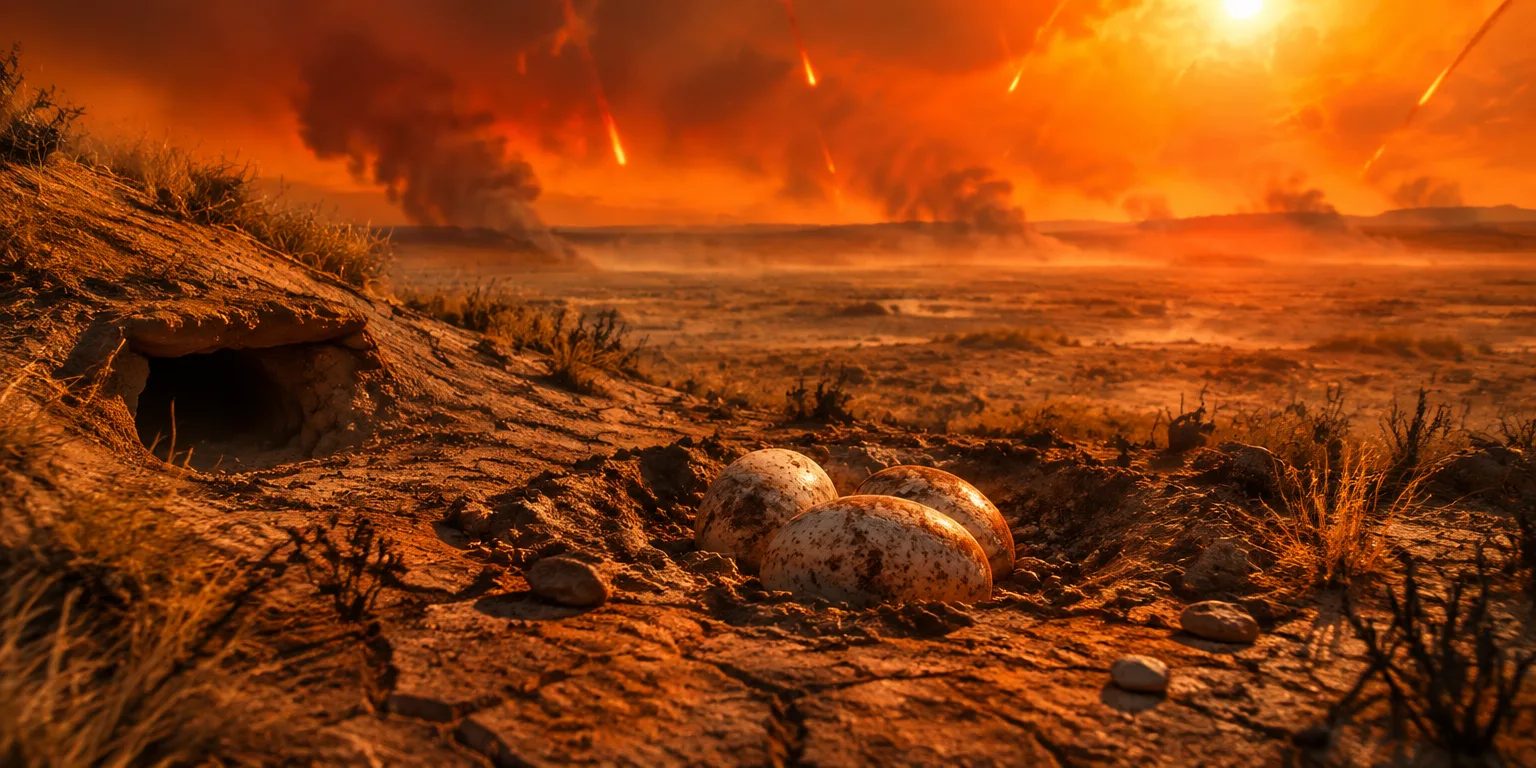
In Lacovara's account, falling back is what made the air dangerously hot. Each millimeter-sized particle heated the air around it as it dragged through the atmosphere, like an Apollo capsule glowing on reentry.
Picture trillions upon trillions of those glowing particles at once. Scientists think that within about an hour of the impact, air temperatures reached somewhere between a toaster oven and a pizza oven.
On the surface that day, Lacovara put it bluntly: "you're literally toast." The key was getting out from under the open sky.
The lethal heat was mostly radiative, meaning it traveled in straight lines like warmth from an outdoor restaurant heater. An animal had to get underground, underwater, or otherwise, as Lacovara put it, "out of the line of sight of the sky."
That may explain the pattern of survivors. Small burrowing mammals, lizards, turtles, crocodiles, and some burrowing birds could shelter. Aquatic animals also had cover.
Non-avian dinosaurs had no such refuge, in his view. Every dinosaur nest ever found, Lacovara says, is essentially a scrape on the open ground, leaving eggs exposed on the surface.
Their whole life cycle played out above ground, with no place to hide from the heat. Lacovara argues that even if one large dinosaur happened to be in a cave, there would have been no surviving breeding population.
In his view, after about 165 million years of dominance, non-avian dinosaurs were functionally extinct on impact day. The world that had seemed permanent the day before was gone within hours.
Questions people ask
What does functionally extinct mean?
Functionally extinct means too few individuals remain to sustain a breeding population, even if a few are still alive. For non-avian dinosaurs, a lone survivor in a cave would not have been enough to continue the group.
If dinosaurs died, why are birds still here?
Birds are living dinosaurs, descended from small feathered theropods. Lacovara argues that burrowing birds could shelter from the radiant heat, while all known non-avian dinosaur nests were exposed scrapes on the surface.
Was the heat the whole extinction story?
No. The intense heat lasted hours, but dust, soot, and sulfur in the atmosphere then blocked sunlight for months to years. That cooling and darkness disrupted plant growth and food chains, finishing off many survivors of the first day.