How Origen Compared Six Texts and Marked What He Added
Six parallel texts let readers compare, while small marks showed what was added and what lacked Hebrew support.
 confessionalbibliology.com · Origen’s Hexapla and the Layered Greek Tradition - Confessional Bibliology
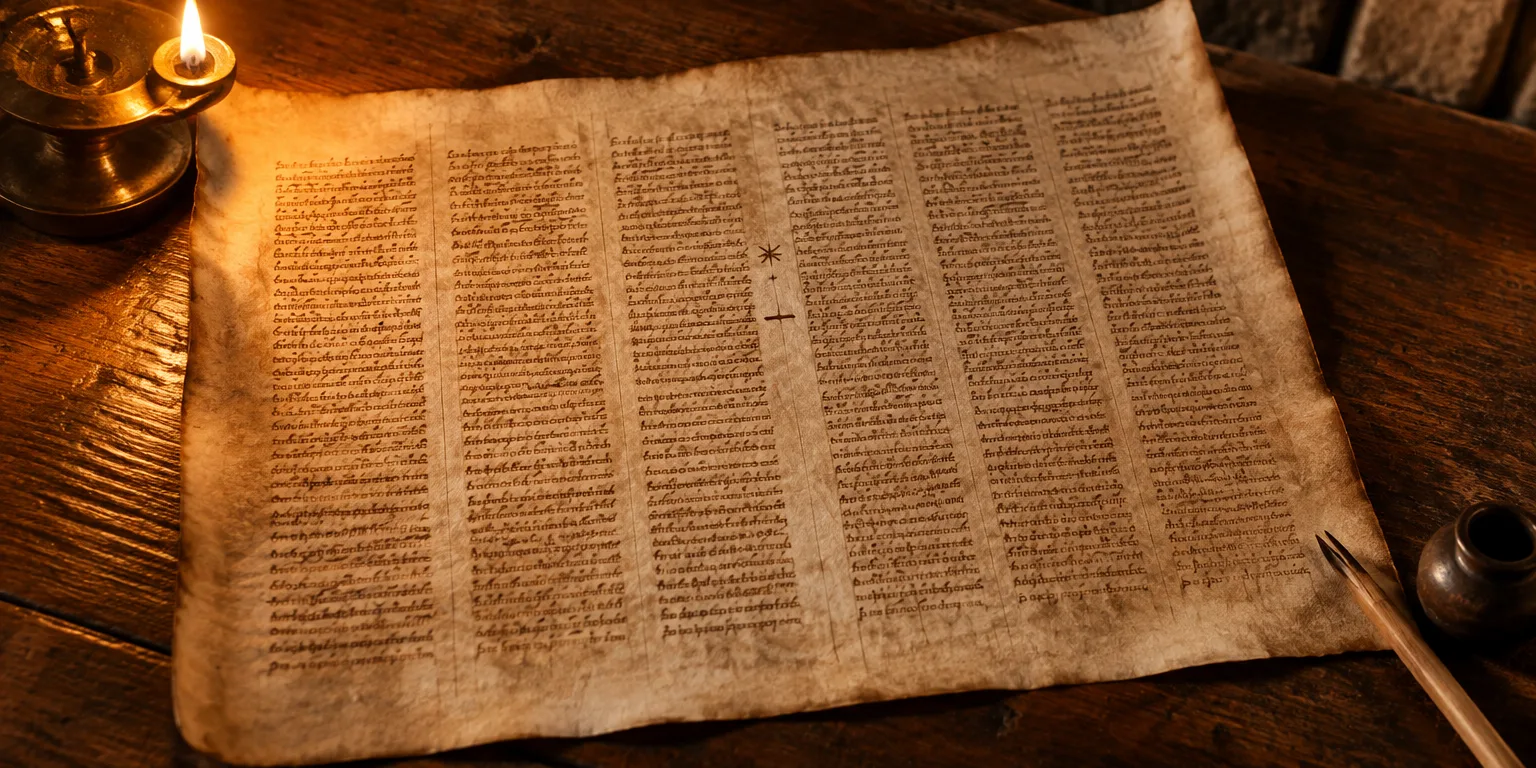
In the third century, the scholar Origen built something like a library on a single page.
Working at Caesarea, he set Scripture out in tall parallel columns so a reader could compare versions line by line. Modern accounts often place the work around A.D. 235 to 245, but that date is a reconstruction.
The name says the scale. Hexapla means sixfold, and the usual layout ran to six columns across the page.
The first column held the Hebrew text in Hebrew letters, and the second held the same Hebrew written in Greek letters, a pronunciation guide often called the Secunda.
Then came four Greek versions: the translations known as Aquila, Symmachus, a central Greek text linked to the Seventy, and the translation known as Theodotion. In a few cases, notably the Psalms, he collected extra Greek renderings, called the Fifth, Sixth, and sometimes Seventh.
According to the early church historian Eusebius, Origen studied Hebrew, brought together those translations, and also made a four column version called the Tetrapla. The point was comparison, not a new official Bible.
Origen also marked up the central fifth column to show its relation to the Hebrew he had. Where his Hebrew had words missing from the Greek before him, he supplied them from another Greek version and put an asterisk beside them.
Where the Greek had material with no counterpart in his Hebrew, he put an obelus beside it. He did not pretend the added words had always been there, and he did not simply delete the extra Greek.
The marks turned the page into a visible argument about how the versions related. A reader could see what was supplied, what lacked Hebrew support, and what came from the Greek text Origen had inherited.
Questions people ask
Why include the same Hebrew text twice?
It let a Greek reader sound out the Hebrew without reading Hebrew letters. By matching sounds across the columns, the reader could check which Hebrew words stood behind the different Greek renderings.
What did an asterisk and an obelus actually look like?
They were ancient proofreading symbols borrowed from scholars of Greek literature. The asterisk looked like a small star, and the obelus looked like a horizontal stroke or dagger, placed at the start of the line in question.
Did later copies keep Origen's marks?
Often they did not. When later copyists left the signs out, added words could read as if they had always belonged, and disputed passages blended into ordinary text. That is one reason scholars must check passage by passage to sort out what Origen inherited and what later copying changed.