One Maya Estate's Cisterns Could Hold Three Months of Rainwater
Rain drained off roofs and patios into underground tanks that could hold up to 10,000 gallons each.
 National Geographic · Lost World of the Maya (Full Episode) | National Geographic
On a lush hilltop in the Puuk region of the Yucatan, an estate called Stairway to Heaven stood in a landscape with no rivers, lakes, streams, or creeks.
Rain falls heavily here, but only about six months a year. For the other six, virtually no rain falls.
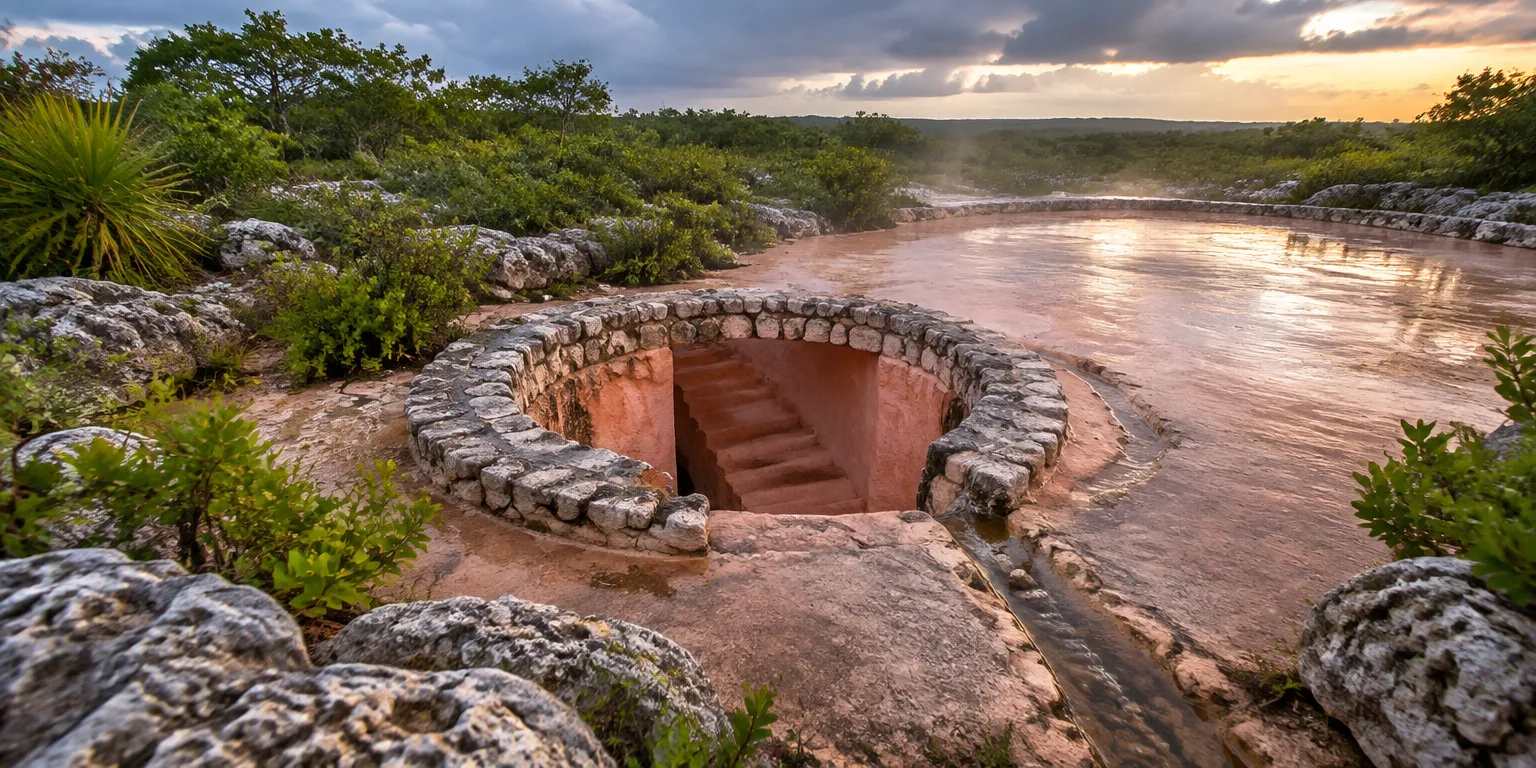
At this estate, people stored water in man-made underground cisterns called chultuns. Workers bored through hard cap rock, then dug out a large chamber in the softer rock beneath.
Then they sealed the chamber. They covered it with a thick layer of stucco, a pinkish plaster that served as a waterproof lining.
The estate was arranged to catch rain. Its rooftops, patios, and plazas drained water into eight chultuns scattered around the site, so the whole hilltop worked like a giant rain barrel.
Archaeologist Bill Ringle teamed up with Andrew Willis, an engineer, to map a chultun with an early form of laser scanning and build a three-dimensional model. The model calculated a capacity of as much as 10,000 gallons in a single chultun.
From that model and an assumed use of 27 gallons a day for a family of six, they calculated that the estate's cisterns could support seven households through three rainless months. That is a calculation, not a record of what happened.
Three months covers only half of the six-month dry season. The source does not explain how residents covered the rest.
Questions people ask
Why does the Yucatan have no rivers?
Much of the Yucatan is porous limestone. Rain sinks quickly through cracks and caves instead of gathering into rivers, so surface water is scarce even when seasonal rainfall is heavy.
What was the waterproof stucco made from?
Maya stucco was generally made by heating limestone to make lime, then mixing it with water and other materials. Once cured, it formed a hard plaster used for floors, walls, and cisterns.