Mississippians Built a Pyramid as Wide as Eight Football Fields
The pyramids were earth sealed with clay, and grass ate the evidence.
 The Shawn Ryan Show · #358 Ed Barnhart - Inside America’s Forgotten Pyramid Civilization
Starting around 900 CE, millions of people across the eastern United States built a full civilization that most Americans have never heard of. Archaeologist Edwin Barnhart calls them the Mississippians, and they built on older traditions of earthen mounds and scaled them into cities.
Those cities could hold hundreds of uniform houses, farm fields along rivers, and walls around the center. Some pyramids rose about 100 feet high. Some cities moved water through aqueducts, reservoirs, and channels to different neighborhoods.
None of this was built of stone. Many people assume complex cities needed stone, Barnhart says, but the Mississippians show they did not. Organizing workers to raise a wall two miles long and 10 to 20 feet tall from earth takes a highly organized political system, with rulers, subordinates, and laborers.
The pyramids were piles of earth shaped into flat tops with multiple terraces. Builders smoothed the sides and sealed them with clay plaster, then put buildings on top coated with the same mud stucco, which hardened in the sun.
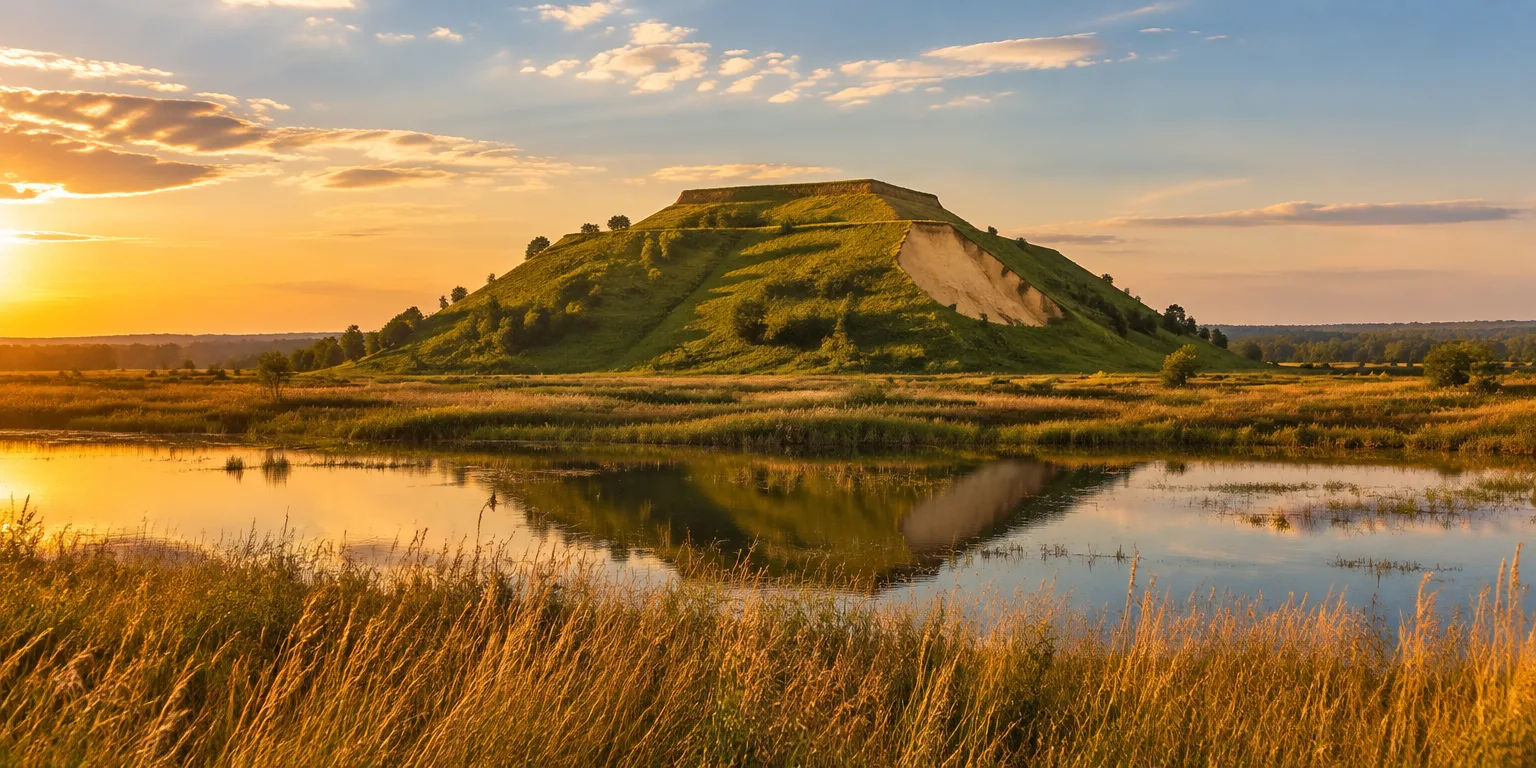
They look like grassy hills today because that clay skin broke down. Given a long time untended, grass and trees root through such a surface, break it apart, and cover the shaped form, much as weeds take over a sidewalk.
Archaeologists still find chunks of clay plaster inside the mounds. They also find traces of smoothed sides, sometimes still visible, beneath the vegetation.
The largest example is Cahokia, near present-day St. Louis. Its biggest mound covered about eight football fields at the base and carried a palace complex for the ruler and royal family. The city held about 20,000 people, with about 50,000 in nearby villages, while later centers were smaller and more spread out.
Barnhart compares the system to feudalism, with a dense center, dependent villages, and relatives of the ruler placed in outlying posts. Large corn harvests, expanding after about 800 CE, made it possible to feed so many people in one place.
Questions people ask
If they did not use stone, what held the pyramids up?
Compacted earth held them up. Builders piled soil in layers, shaped it into terraces, and sealed the surface with clay plaster to shed rain. The plaster needed maintenance, and once abandoned, water and roots broke it down.
Can I still see Cahokia today?
Yes. Cahokia Mounds State Historic Site in Illinois preserves dozens of mounds, including the largest, Monks Mound. It is a UNESCO World Heritage site with a museum, trails, and stairs to the top of the main mound.
Why did these cities need water engineering?
Dense towns need reliable drinking water, drainage, and water for cooking, bathing, and rituals. Bringing river water into a reservoir and sending it through channels let leaders store supply and distribute it, especially in dry periods.