Ropes On A Pharaoh's Coffin Lid Trace A Robbery Gone Wrong
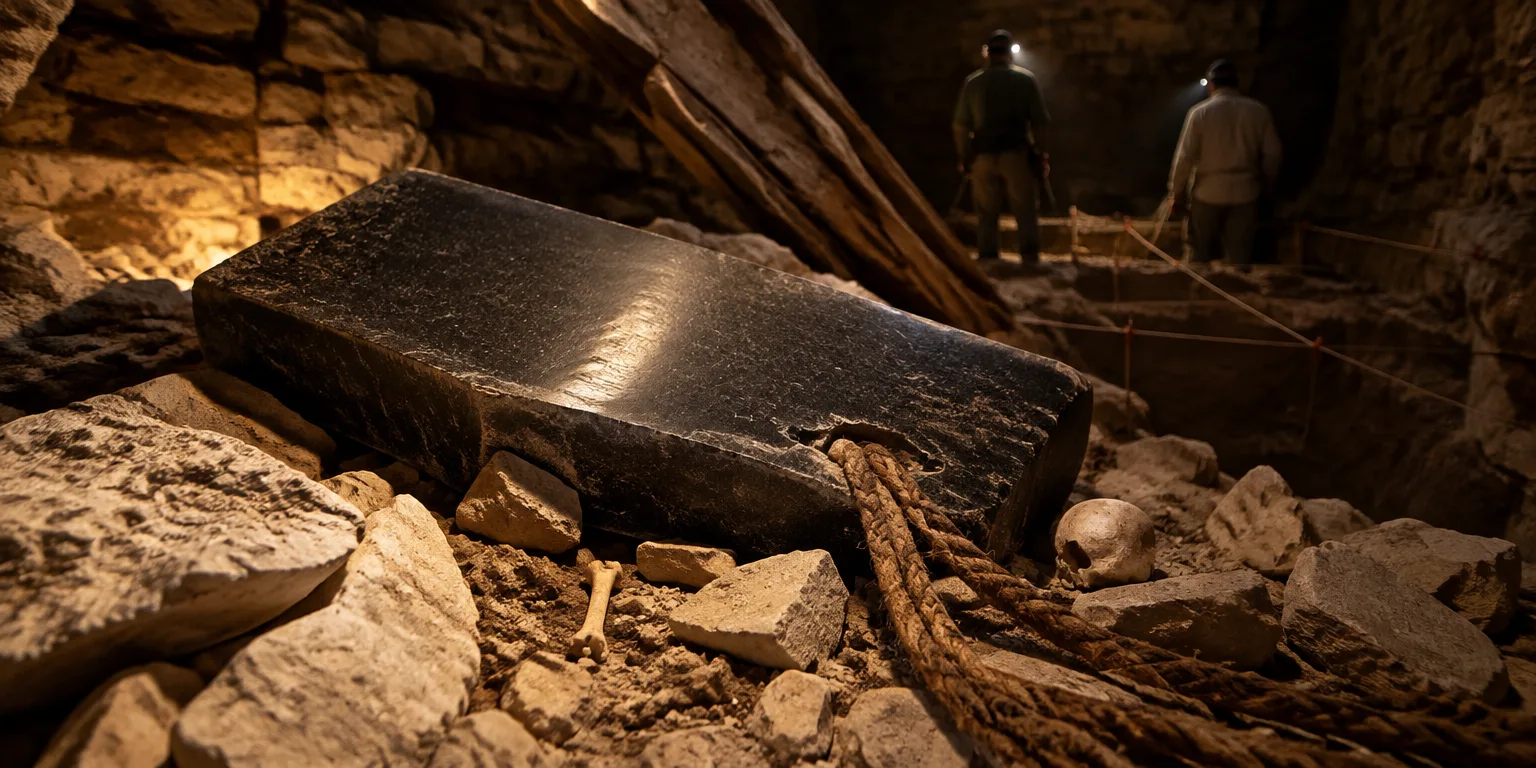
Inside Sahure's collapsed burial chamber, archaeologists found a massive lid, pulling ropes, and human bone.
 National Geographic · Unearthing Egypt's Pyramids | Lost Treasures of Egypt MEGA Episode | National Geographic
In the rubble-filled burial chamber of King Sahure's pyramid at Abusir, dig leader Mohamed Ismail Khalid with his crew have uncovered a 1.3-meter piece of the king's dark basalt coffin lid with ancient pulling ropes still attached.
Khalid reads the lid and ropes as signs of a robbery that may have been cut short, and he believes the rest of the pharaoh's coffin may still sit about six meters deeper in the chamber.
Sahure ruled about 4,500 years ago, and his pyramid was once faced in white limestone. Early investigators found the burial chamber choked with collapsed rock, and no team had fully excavated it until Khalid returned to clear it.
The lid fragment, the largest yet found in the chamber, lay upside down with a smooth surface and a hole Khalid says robbers may have cut to shift it. Beneath and around it, the team found the ropes, a jawbone, and later a piece of human skull.
Khalid reads those clues as an ancient crime scene, though the exact cause of the collapse cannot be proved from these clues alone. He believes thieves first looted the chamber about 3,000 years ago, and that later stone thieves chiseled away limestone walls and tried to drag out the lid, weakening the chamber.
The team also found a piece of human skull in the rubble, which may belong to a robber.
The team stopped short of the suspected coffin site because a broken ceiling beam made further digging unsafe. Khalid believes all the basalt found so far comes from the lid, leaving open whether the coffin box itself survives farther inside for a future season.
Questions people ask
Who was King Sahure?
Sahure was a pharaoh of Egypt's Fifth Dynasty, about 4,500 years ago. He is known for seagoing trade, sun worship, and a pyramid at Abusir, seven miles south of Giza, that was smaller than the famous Giza pyramids.
Why does a basalt lid matter more than ordinary stone?
Basalt is a dark, hard volcanic stone that ancient Egyptians prized for royal coffins, statues, and temple floors. Its black color was linked with Osiris, god of the afterlife, and working it without modern tools took great labor.
How can archaeologists tell robbers caused the collapse?
The team cites cut marks in limestone walls, stone-cutting tools, oil lamps left behind, displaced masonry, and bones mixed with rubble. Khalid argues that removing support stone weakened the chamber, though the exact moment of collapse cannot be proved from those clues alone.